What is recorded here
Early Christian monastery (OF041-004001-) founded by St Cuimín in the seventh century (Cooke 1875, 209-14). Kilcomin [Ceall Chuimín/Cill Chuimín/church of Cuimín] named after Cuimín Fada [long] a seventh century saint who was born in the territory of Caoille Conaill, located between Rathfran bay and Lacken Bay, in the barony of Tirawley, Co. Mayo where his family operated a school (Ó Riain 2011, 245). The Ordnance Survey Letters of 1838 identified Kilcommon old churchyard with ‘Disert Chuimin’ which was located close to the borders of Leinster and Munster (Herity 2008, 182). In 1875 Cooke (1875, 213) recorded that the ancient bell of St Cuimín now located in the British Museum was preserved in the parish of Kilcomin ‘up to thirty or forty years ago’. According to local tradition the ancient bell was found in a ‘well close to the ruins of Kilcommon church’ (Cooke 1875, 213).
Situated on a natural rise of ground overlooking river to the E. Located in the centre of the graveyard (OF041-004002-) are the poorly preserved remains of a rectangular church (OF041-004----). Three large grass covered flagstones in the W sector of the graveyard are marked on the OS 6-inch map as 'St. Cuimin's Seat' (OF041-004004-). Early Christian cross inscribed slab (OF041-004006-) located close to SE corner of graveyard. No surface trace visible of any holy well in the fields to the W of the graveyard. The Ordnance Survey Letters of 1838 recorded the tradition that St Cuimín 'was wont to frequent a well, which lies in Cnocan Ruadh about 20 perches to the West of the Church-yard. This well is not, however, called after his name' (Herity 2008, 183).
The above description is derived from the published 'Archaeological Inventory of County Offaly' (Dublin: Stationery Office, 1997). In certain instances the entries have been revised and updated in the light of recent research.
Compiled by: Caimin O'Brien
Date of upload: 12 June 2014
Linked to St Cuimín, a seventh-century saint associated with early Christian monasticism in Ireland, the holy well at Kilcomin is traditionally believed to have healing properties, particularly for ailments of the eyes and general wellness. The site's name, Cill Chuimín, reflects the saint's enduring local veneration.
The monument record does not grant public access. Check the route and ask the landowner before entering private land.
- What survives
- Recorded monument
Places near here
 AbbeyChurch · 394 yd
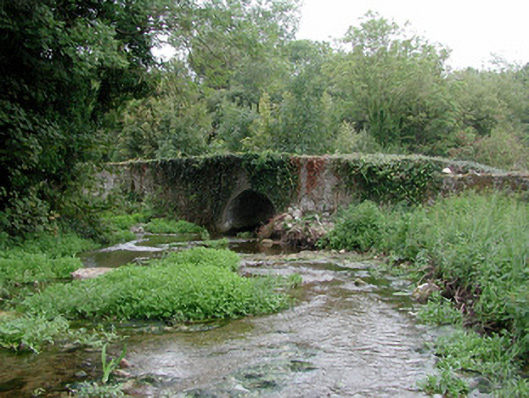 bridgebridge · 443 yd
 Cangort WoodWood · 1325 yd
 Grave YardGraveyard · 1.6 mi
 Behamore CastleCastle · 1.6 mi
 Bawn in ShinroneBawn · 1.6 mi
 Fulacht fia in AdruelFulacht fia · 1.7 mi
 Knockanacree WoodForest · 3.3 mi
 Thomas MacDonagh Heritage CentreMuseum · 3.8 mi
 MacDonagh HouseMemorial · 3.8 mi
 Eagle HillMountain / peak · 5.0 mi
 James Devaney MemorialMemorial · 8.9 mi