DDiscover AloneMapAbout

Castle in Maghernacloy

House, fortified house

What is recorded here

Situated on a broad hill. Land at Maghernacloy, consisting of nineteen tates in seventeen townlands, which became known as Hadsor’s fee-farm, was granted by Richard Devereux, the third Earl of Essex, to John Hadsor of Keppock (Cappoge), Co. Louth (LH018-003003-) in 1618 (MacDermott 2002). The Anglo-Norman family of…

Read the whole record
Situated on a broad hill. Land at Maghernacloy, consisting of nineteen tates in seventeen townlands, which became known as Hadsor’s fee-farm, was granted by Richard Devereux, the third Earl of Essex, to John Hadsor of Keppock (Cappoge), Co. Louth (LH018-003003-) in 1618 (MacDermott 2002). The Anglo-Norman family of Hadsor, originally called de Hedesor from a place in Worcestershire now called Hadzor, were associated with Co. Louth from the late twelfth century, where they were tenants of the Peppard family. Richard Hadsor was lord of Cappoge from 1586 until his death in 1635 but he was also a propagandist for English settlement in Ireland and an advisor to the English government on Irish affairs (Hodgers 2005). Richard probably secured the grant of the manor of Moymuck, which included Maghernacloy, for his youngest half-brother John in 1618, possibly in the name of John’s wife, Katherine Fleming of Gernonstown, Slane, which family had held land in Farney (Hodgers 2009, 104-5). The terms were reasonable, and included the requirement to build a strong house ‘after the English manner’ within ten years. (Manning 2007, 209-13) The house is not depicted on a map of 1634 by John Raven, but it had probably been built by the outbreak of the rebellion in 1641, although it is not mentioned in military exploits in the area during 1648 (Hodgers 2009. 112-3). John Hadsor had inherited Cappoge, but as he was implicated in the rebellion he forfeited all his property before he died in 1657 (ibid. 114-8). The fee-farm was granted by the Commonwealth to Col. Thomas Sadler who sold his interest to the Brownlow family, of Brownlows Derry, near Lurgan, Co. Armagh. After the Williamite and Jacobite war (1689-91) Thomas Clinton, a Jacobite and a relative of the Brownlows, took a lease on Maghernacloy from Arthur Brownlow. Arthur has the distinction of sitting in the Catholic Parliament of James II (1689) and subsequent ascendency Parliaments of William (1692-3, 1695-9) and Anne (1703-11) as a member for Co. Armagh (Johnston-Liik 2002, vol. 3, 291-1). He was also an Irish scholar and acquired the Book of Armagh in 1707 from its hereditary keepers, the MacMoyre family, and it has been in the Library of Trinity College, Dublin since 1853. The Clinton family retained the lease on Maghernacloy into the nineteenth century (McDermott 2002, 784). The castle was finally abandoned in the 1970s, but it was restored as a dwelling after 2000. The castle is a rectangular four-bay, two story structure (ext. dims c. 18m NW-SE; c. 8.25m NE-SW) over a basement at the NW end with a two storey tower (dims 6m NW-SE: 6.25m NE-SW) offset to the SW and SE from the S angle and a stairs tower (ext. dims 4.3m NW-SE; 3.5m NE-SW) projecting NE towards the SE end of the NE side. The wall-walk and stepped crenelations on the parapet are largely original, but all the windows and external doorways were replaced as well as the floors and the roof, probably in the eighteenth century, and the S tower may have been added at that time. The original doorway was adjacent to the stairs tower and is indicated by the machicolation on the parapet. The stairs tower has a newel stairs with pointed doorways. Six chimney stacks are supported from the first floor by corbels on the external walls. One is on the NW end wall, one on the NE wall which must have heated the hall or large public room, one on the NE wall of the attached tower, probably in a bedroom, and three on the SE end wall. (Manning 2007, 213-16) Limited excavation (04E0513) carried out in advance of the restoration of the castle as a dwelling uncovered a number of sherds of 18th century pottery (Campbell 2007). Further monitoring under the same licence took place in 2007 which established that the basement extended under the entire house (Campbell 2010).

From the National Monuments Service (Archaeological Survey of Ireland) record MO034-026

The monument record does not grant public access. Check the route and ask the landowner before entering private land.

What do you know about this place?Tap to add a comment or ask a question

What you write will be public.

Places near here

Photo credits
  • National Inventory of Architectural Heritage
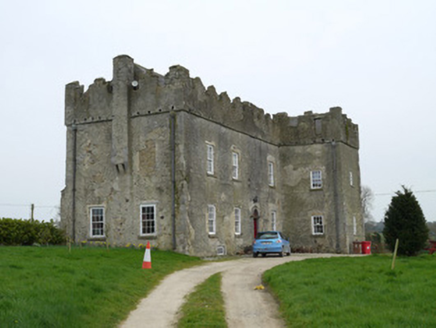
Maghernacloy CastleCastle/fortified house · 1 yd

Explorer Tom Maghernacloy Castle in Maghernacloy is strutting about like it’s got somewhere better to be, which, honestly, who could…

Mentana HouseHouse · 674 yd

Explorer Tom Mentana House in Mullaghrafferty, Monaghan, would be the person at the wedding who keeps adjusting their tie and…
post box776 yd

Explorer Tom This post box would say 'I am a pillar of the community' in a job interview, then immediately drop a letter. It’s got…
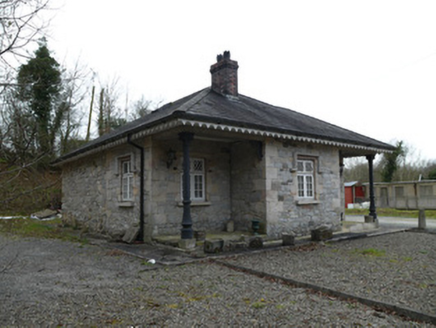
Coolderry HouseGate lodge · 1020 yd

Explorer Tom Coolderry House would be the uncle at the wedding who won’t stop talking about cast-iron columns. It’s a gate lodge…
farmyard complex1277 yd

Explorer Tom Farmyard complex in Drumbo hates when the cows wander into the wrong shed, which happens daily. The little irregular…

Coolderry Chapel of EaseChurch/chapel · 1363 yd

Explorer Tom Coolderry Chapel of Ease would tell its younger self to stop worrying about the sermon and start dancing instead. It's…

lime kiln1.0 mi

Explorer Tom Lime kiln in Carrickashedoge has a retirement plan that involves becoming a very expensive garden feature for someone’s…
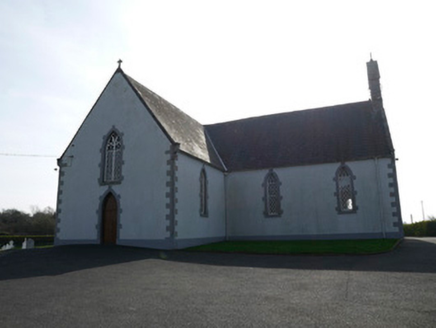
Saint Patrick's Catholic ChurchChurch/chapel · 1.1 mi

Explorer Tom Saint Patrick's Catholic Church in Carrickashedoge has a bird that refuses to leave the bell-cote, probably because it…

Carrickashedoge National SchoolSchool · 1.2 mi

Explorer Tom Carrickashedoge National School in Carrickashedoge took forty cups of tea to build, according to the tea lady who…

Ballyhoe BridgeBridge · 1.3 mi

Explorer Tom Ballyhoe Bridge in Feahoe had a fox take charge of it once, and now it’s got a reputation for being watched over. It…

Lagan BridgeBridge · 1.5 mi

Explorer Tom Lagan Bridge in Mullaghgarve is the ultimate snob, sitting right on the Ulster-Leinster border like it’s doing everyone…
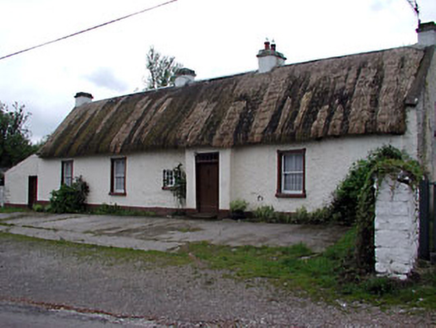
farm house1.7 mi

Explorer Tom Farm house on Meath Hill has very strong opinions on modern buildings and finds them all tacky. That tiny window by the…

More castles and forts in County Monaghan · All of County Monaghan

Add to this placeAdd a picture Add a detailed tip Add a story

Explore the map1,095,414 places to discover

Next place · or swipeMaghernacloy Castle