On a spur of high ground at the E end of a low ridge, N of the Kings River. The site commands good views of the countryside to W, NW and S.
Carrigan (1905, vol. 3, 330) identified this as the location of the early 14th-century castle of the D’Erleys, mentioned in the Red Book of Ossory c. 1300 and 1320 respectively as, ‘Curia de Erleyestoun’ and the ‘Castrum Erleye’. In 1367 John D’Erley joined the army of Edward, the Black Prince, the eldest son of Edward III in Spain where he was taken prisoner (Walsh 1958, 43). The ransom for his release was so costly that the family were forced to sell the Manor of Earleston (ibid.). Thus, towards the end of the 14th century, the Sweetmans succeeded the D’Erleys in both their property of Earlstown, and the title of Baron of Erley (Carrigan 1905, vol. 3, 330). The Register of Kells Priory mentions that in 1478, John Sweetman was chief lord of all the Barony of Erley (ibid.). Carrigan is confident that this is the same John Sweetman who, in the Pat. Rolls, is mentioned as, ‘son and heir of Nicholas Sweetman of Castellyse [i.e. Castellyfe, or Castle Eve] in the Co. Kilkenny, gent.’, who received a royal pardon for treasons etc. in 1482 (ibid.). In 1543, James Sweetman was Sheriff of Co. Kilkenny and in 1549, ‘James Sweteman, of Castelliff’ receives a pardon (ibid. 331). He was succeeded by William Sweetman, who was the largest freeholder in the Barony of Kells c. 1560 and was the Sheriff of Co. Kilkenny in 1564 (ibid.). He was succeeded by John Sweetman, probably his son, and it is John’s coat of arms [
KK027-024004-], with the date 1580, which had been on display, ‘Fixed into the side of one of the windows, in the more ancient part of the ruins’, until 1886 (ibid. 329). He died in 1605 and was succeed by his son William, who became of age in January 1615-16 (ibid. 331). William fought in the Irish Confederate Wars (1641-52) which resulted in his lands being forfeit under Cromwell and his transplantation to Connaught in 1654 (ibid. 332). There is a local tradition that Castle Eve castle was battered by Cromwell’s troops and that all the defenders, save one, were killed (Walsh 1958, 45). Seemingly large quantities of human bones were unearthed during attempts to cultivate a field adjoining the castle (ibid.). Following the confiscation, the manor was divided, the largest portion going to Captain Henry Baker, ‘in satisfaction of £479 13s. 4d. for his service in England promiscuously with the arrears of his service in Ireland in the town and lands of Castleiff and Newtown, etc.’ (Walsh 1958, 44). He was elected M.P. for Callan in the post-Reformation Parliament of 1661 and died the following year (ibid.). His inheritance was divided between his children, resulting in the further fragmentation of the original manor (ibid.). William Sweetman’s will, dated from ‘Castle Ife’ in 1672, suggests that he was able to returned to Castle Eve following the Restoration in 1660, and probably after the death of Henry Baker in 1662 (Carrigan 1905, vol. 3, 332). Sweetman’s only child, a daughter, succeeded him and through her marriage to Hugh Conway, it passed into the Conway family (ibid. 333). The Conway-Sweetmans, ‘held on in the neighbourhood of their old Castles till about 1845, when the last of them emigrated’ (ibid.). The multi-period castle complex is defined by a bawn with external moat (
KK027-024002-), with a fortified house (
KK027-024001-) in the SW angle and a substantial mural tower (KK027-024003-) on the NW angle. The E portion of the bawn does not survive. A two-storey mural tower (int. dims. c. 7m x 4.65m), constructed of roughly coursed limestone rubble with a base-batter and aligned NE-SW, occupies the NW angle of the bawn. The internal ground level of the bawn is c. 3-4m higher than the external level, so externally the tower appears higher. There is a broken-out opening at the E end of the SE wall, which seems to have been the original entrance, and another large broken-out opening towards the S end of the wall, probably where there had been a window at ground-floor level. The tower could also be entered at first-floor level from the wall-walk of the bawn. There is a pointed vault over the ground floor and the walls carry the remains of plaster rendering and a plaster cornice moulding. There is a cross-loop in the NW wall at ground-floor level and a blocked-up loop in the NE wall. Internally at first-floor level there is heavy ivy growth which obscures any features. A photograph from the NW, taken c. 1900 by Rev. William Carrigan (Carrigan 1905, vol. 3, 331), shows the external NW and SW walls of the tower, with a pointed gable, which has since collapsed, surmounting the SW wall. Carrigan (ibid. 329), describes this as the oldest part of the castle and that, ‘Fixed into the side of one of the windows, in the most ancient part of the ruins, there was, till 1886, a slab [KK027-024004-] bearing the coat of arms of John Sweetman, exactly as they are to be seen on his monument in Newtown church, viz.: party per pale; dexter, ermine, a fesse, in base a chevron, for Sweetman; sinister, also divided per pale, fretty, an eagle displayed. Towards the top of the shield are the initials I.S. for John Sweetman, and the date 1580’. This coat of arms is currently in Rothe House, Kilkenny (Salter 2004, 64). Reference:
Walsh, F.R. 1958 Castle Eve. Old Kilkenny Review 10, 42-6
See attached:
KK027-024003-_01 Exterior of tower from NW
KK027-024003-_02 From NE, exterior where bawn meets tower
KK027-024003-_03 E end of internal N wall of bawn
KK027-024003-_04 Photograph from Carrigan 1905, vol. 3, 329
 Bawn in Castle EveBawn · 35 yd
 TowerHouse, fortified house · 59 yd
 Castle (in ruins)House, 16th/17th century · 748 yd
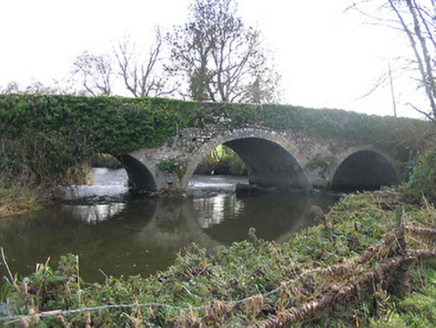 Newtown BridgeBridge · 1238 yd
 Church (in ruins)Church · 1265 yd
 Grave YardGraveyard · 1272 yd
 Bawn in Newtown (baker)Bawn · 1286 yd
 Kilcoran HouseGates/railings/walls · 1711 yd
 All Saints' Catholic ChurchChurch/chapel · 1.0 mi
 Newtown HouseCountry house · 1.0 mi
 ToberakinHoly well · 1.3 mi
 Mill IslandIslet · 1.5 mi

What do you know about this place?Tap to add a comment or ask a question