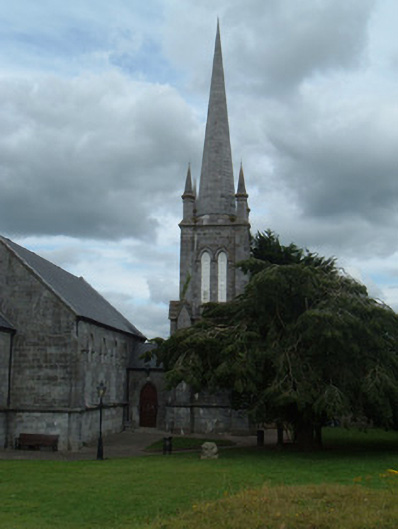
What is recorded here
Freestanding Gothic Revival limestone built former Church of Ireland church, built 1845, now in use as library. Comprising five-bay nave with shallow chancel projection to north-east, link bay connecting with square-plan three-stage bell tower with octagonal spire, at south end of main, east, elevation, and having porch projection to west gable of nave. Pitched artificial slate roofs. Tooled limestone walls with plinth, sill course, buttresses to all corners, and chamfered surrounds to openings, with hood mouldings and carved stops. Clock to tower second stage. Three-light window to chancel, with lancets to nave, and double lancet windows to tower. Replacement uPVC fittings to all window openings. Pointed arch door opening in link bay, with limestone block-and-start surround and timber battened door. Pointed arch door openings to rear of link and to west porch, having dressed chamfered surround and hood moulding with stops and having timber battened double doors with ornate strap hinges. Interior altered to accommodate use as library. Graveyard to site with grassed over barrel-roofed burial vaults and carved limestone tomb of Bruce family. Square-profile ashlar limestone piers with chamfered corners and limestone caps to front of site, in limestone wall with coping and spear-headed cast-iron railings.
This mid-nineteenth-century building retains much of its early character and form. The Gothic theme of the building culminates in the elaborate tower with tall steeple and buttresses. The ornate limestone dressings are finely carved and are indicative of the quality of nineteenth-century craftsmen. The siting of the building is interesting because it breaks the streetline, being set back from the Main Street, and provides a green space in the centre of the town. The site retains its boundaries and the graveyard contains the tomb of the Bruces, a prominent Charleville banking family. The scale of the church suggests that it resembles a small estate church as opposed to a town church, and may have been patronised by a local landlord.
This does not grant access. Most recorded buildings are privately owned; view them only from public ground unless the owner allows entry.
Places near here
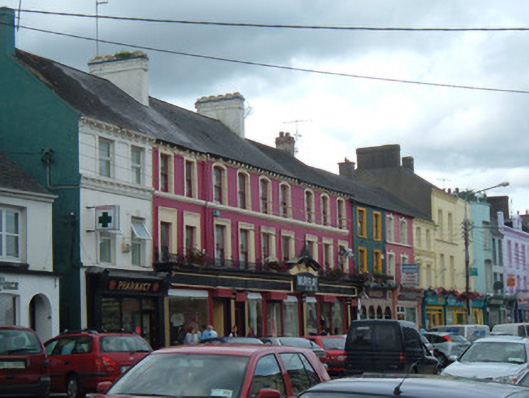 Murray and Sonhouse · 58 yd
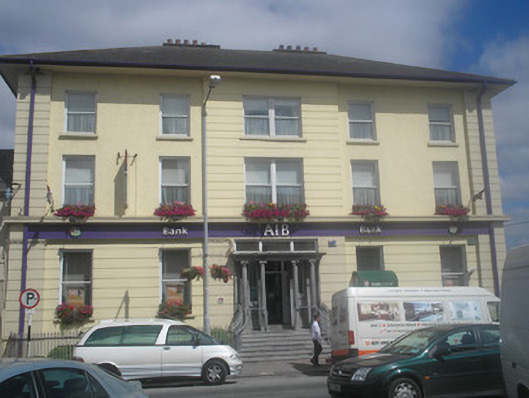 Allied Irish Bankbank/financial institution · 82 yd
 Holy Cross CemeteryGraveyard · 604 yd
 MoatEnclosure · 757 yd
 Moanboy FortFairy fort / earthen ringfort · 1516 yd
 Bawn in CregganeBawn · 2.0 mi
 Castle Harrison on Site of Castle (19*Castle, unclassified · 2.2 mi
 ToberSpring · 2.7 mi
 Lady's WellSpring · 2.8 mi
 BallinaboolaVisitor information · 3.9 mi
 CarrigeenMountain / peak · 4.5 mi
 Caher HillMountain / peak · 4.7 mi
Other information
Photo: National Inventory of Architectural Heritage · Website use allowed for educational or private purposes with source credit