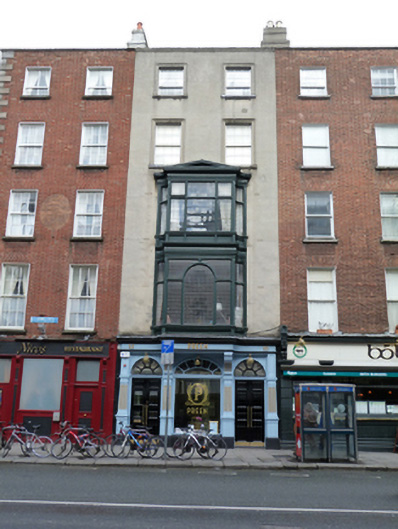
What is recorded here
Terraced two-bay five-storey over basement former house, built c.1785, with shopfront to front (south) elevation. Façade remodelled c.1900. Now in use as retail outlet and flats. M-profile pitched roof, hidden behind rendered parapet having carved granite coping, with rendered chimneystacks having clay pots. Lined-and-ruled rendered walls with masonry plinth course. Double-height oriel window with fixed pane leaded windows to first and second floors having carved cornices, carved timber pediment, timber panelled apron. Square-headed window openings with moulded architraves, granite sills and six-over-six pane and six-over-three pane timber sliding sash windows to third and fourth floors. Shopfront comprising fluted masonry pilasters and brackets supporting stepped fascia and cornice, surrounding plain square-headed display window with elliptical–headed leaded fanlight, flanked by round-headed door openings with double-leaf timber panelled and half-glazed timber panelled doors and leaded spoked fanlights. Located to north side of Dame Street.
This building was occupied by Manley & Son, Government Stockbrokers in 1894 and Fred Sutton & Co. Solicitors in 1910. The valuation jumped from £90 to £150 between these dates indicating it was remodelled at this time. The oriel window at the first and second floors is an early twentieth-century addition, and along with the moulded window surrounds, adds subtle interest to the façade. A well-executed symmetrical shopfront lends contextual as well as visual interest to the composition. Dame Street derives its name from a dam that powered a mill on the River Poddle. It was one of the principal streets of the city in the eighteenth century, leading from the Parliament House (now Bank of Ireland) to the Castle. The street was widened and remodelled by Samuel Sproule and Charles Tarrant of the Wide Street Commissioners in the late eighteenth century, and commercial buildings and financial institutions were introduced to the street in the late nineteenth and early twentieth centuries.
This does not grant access. Most recorded buildings are privately owned; view them only from public ground unless the owner allows entry.
Places near here
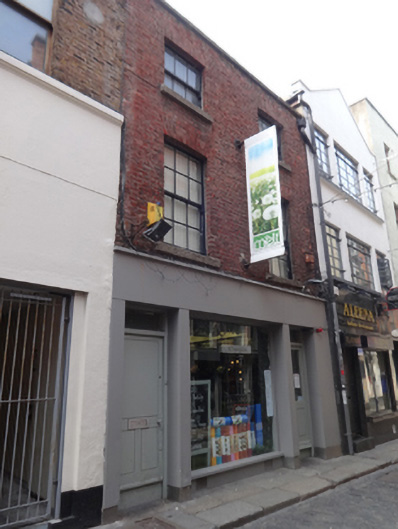 Meltprint works · 32 yd
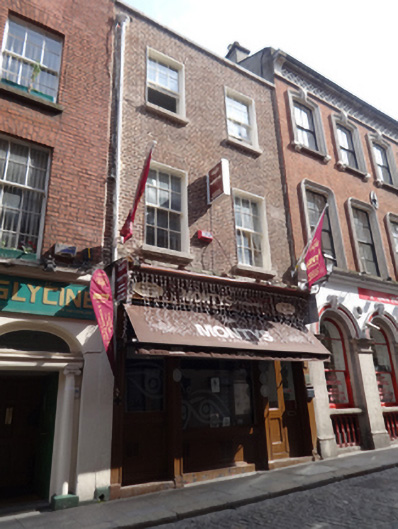 Montys of Kathmanduhouse · 47 yd
 Holy well in Unknown TownlandHoly well · 127 yd
 Tourist Information CentreVisitor information · 178 yd
 Dublin City HallHeritage attraction · 232 yd
 Battle of DublinMajor battlefield · 240 yd
 Dublin Castlegates/railings/walls · 269 yd
 Newcomen BankVisitor information · 277 yd
 CastleCastle, Anglo-Norman masonry castle · 292 yd
 Habitation site in Unknown TownlandHabitation site · 333 yd
 Special Olympics MemorialMonument · 341 yd
 St. Michael's le Pale Church YardMemorial · 422 yd
Other information
Photo: National Inventory of Architectural Heritage · Website use allowed for educational or private purposes with source credit