What is recorded here
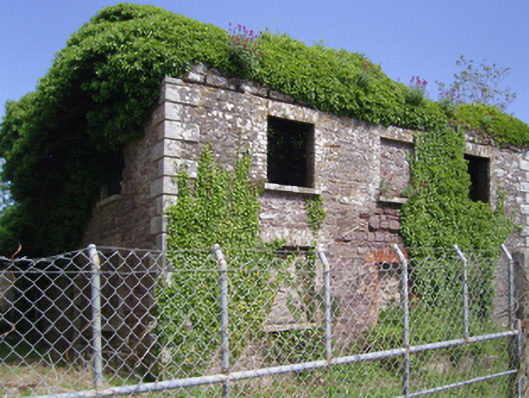
Detached three-bay two-storey constabulary barrack, extant 1877, on a T-shaped plan with remains of single-bay single-storey gabled projecting porch to ground floor. Vacated, 1920. Burnt, 1920. In ruins, 2010. Roof missing with no rainwater goods surviving on overgrown eaves. Part ivy-covered coursed rough cut "Old Red Sandstone" walls on cut-granite chamfered plinth with rusticated cut-granite quoins to corners; remains of porch with cut-granite chamfered plinth. Square-headed central door opening with red brick voussoirs framing rubble stone infill. Square-headed window openings with cut-granite sills, and yellow brick block-and-start surrounds with no fittings surviving. Interior in ruins. Set back from line of street in overgrown grounds.
The shell of a constabulary barrack representing an important component of the nineteenth-century built heritage of Fethard with the architectural value of the composition confirmed by such attributes as the compact plan form; the construction in a ruby-coloured "Old Red Sandstone" with silver-grey granite dressings producing an eye-catching two-tone palette; and the very slight diminishing in scale of the openings on each floor producing a feint graduated visual impression. NOTE: Fethard Constabulary Barrack and Baginbun Martello Tower were given a combined valuation of £61 0s. 0d. in Accounts and Papers: Local Government Local Taxation &c. (1877 LXX, 34). Fethard Constabulary Barrack was occupied (1901) by Michael Sweeney (----), 'Acting Sergeant' (NA 1901); and (1911) by John Madden (----),'Sergeant' (NA 1911). Fethard Constabulary Barrack was vacated (1920) at the height of the War of Independence (1919-21) and the New Ross Standard (6th August 1920) reports that, following loud explosions and a blaze, 'it was completely burned down [with] practically nothing being left but the walls'. Michael Conway (1895-1970), in his Witness Statement to the Bureau of Military History (12th October 1956), gave the following account of the destruction of Fethard Constabulary Barrack: '[Fethard was] where we tested our first bombs made out of the boxes of cart-wheels. They proved to be most successful. During this operation I got a bad fright. When we were sprinkling the floors and woodwork of the barracks with petrol I went into the day-room with two others. Then an explosion took place inside the barracks. The door banged and locked. I had the bombs in my coat pocket. As luck happened, I was able to kick out the door panels with my foot and got out on to the road. The barracks by this time was in flames. I threw off my coat as I felt the heat on my back. I then threw the bombs through the top windows into the blazing barracks. They exploded and blew the roof completely off the barracks' (BMH.WS1509).
From the Buildings of Ireland (National Inventory of Architectural Heritage) record 15619005
This does not grant access. Most recorded buildings are privately owned; view them only from public ground unless the owner allows entry.
Places near here
 boathouse40 yd
 monument46 yd
 Hook Tourism (Fethard Office)Visitor information · 90 yd
 Fethard CastleCastle, hall-house · 126 yd
 Grange BeachBeach / strand · 1.1 mi
 Baginbun BeachBeach / strand · 1.2 mi
 Baginbun HeadHeadland · 1.4 mi
 Lady WellHoly well · 3.0 mi
 Grave YardGraveyard · 3.0 mi
 Tintern AbbeyBuilding misc · 3.0 mi
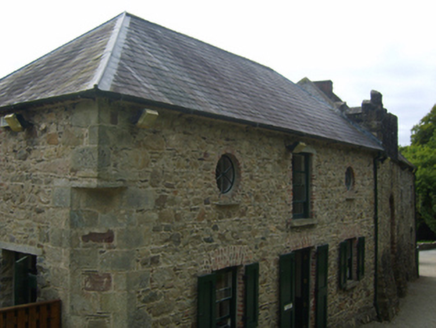 Tintern AbbeyStables · 3.1 mi
 Houseland Castle (in ruins)Castle, tower house · 3.2 mi
Pictures: P L Chadwick, Geograph · CC BY-SA 2.0; National Inventory of Architectural Heritage; Andreas F. Borchert, Wikimedia Commons · CC BY-SA 4.0; Paul O'Farrell, Geograph · CC BY-SA 2.0; Oliver Dixon, Geograph · CC BY-SA 2.0; A.-K. D., Wikimedia Commons · CC BY-SA 4.0; cisko66, Wikimedia Commons · CC BY 3.0; Eirian Evans, Geograph · Creative Commons Attribution-ShareAlike 2.0; Sean O Briain, Geograph · CC BY-SA 2.0
More historic places in County Wexford · All of County Wexford
What do you know about this place?