DDiscover AloneMapAbout

Earthwork in Castlebarrett

Earthwork
Computer-made picture that does not show Earthwork in CastlebarrettNot a photo of this monument
Computer-made picture. It does not show this monument. · Report the wrong picture

The monument record does not grant public access. Check the route and ask the landowner before entering private land.

What do you know about this place?Tap to add a comment or ask a question

What you write will be public.

What is recorded here

In undulating pasture, on W shoulder of Clyda River valley; remains consist of oval earthwork (CO042-009001-), in NW corner of which stand fragmentary remains of rectangular structure, with partially-collapsed, four-storey tower (CO042-009003-) built against its N wall (both E walls are in line). Earthwork is…

Read the whole record
In undulating pasture, on W shoulder of Clyda River valley; remains consist of oval earthwork (CO042-009001-), in NW corner of which stand fragmentary remains of rectangular structure, with partially-collapsed, four-storey tower (CO042-009003-) built against its N wall (both E walls are in line). Earthwork is flat-topped (c.46m E-W; c. 42m N-S); defined SW->NE by wide earth-cut fosse (Wth 17m; D 2.2m), and by scarped edge above steep natural slope NE->SW. Only three wall fragments (NW, NE and SE corners) of rectangular structure (c. 16m N-S; c. 10m E-W) now stand; a substantial clump of fallen masonry lies in fosse to W. Surviving fragments stand to two storeys and are missing much of their facing stones. NE corner has two much-ruined window opes, one above the other, near N end of E wall; where wall breaks off to S, skewbacks for arch and draw-bar socket indicate former doorway near centre of E wall. SE corner breaks off to W and N at sides of window embrasures, at both floor levels. NW fragment very poorly preserved and overgrown.Though little of it survives, this structure appears to be remains of late 12th/early-13th century hall. W and S walls of attached tower have collapsed above 1st-floor level but N and E walls stand to near full height. Ground-floor chamber (5.5m N-S; 4m E-W) covered by rounded wicker-centred vault; double-splayed window in N wall; much of S wall gone; recess in E wall appears to be blocked stairs. Access to higher floors not gained. Windows in centre of N wall at 1st-, 2nd- and 3rd-floor levels, and in centre of E wall at 1st- and 2nd-floor level; embrasures square-set with segmental vaults; lights gone except for single ogee-headed light in E wall at 1st-floor level, and double ogee-headed light with transom at 3rd-floor level in N wall. Also at 3rd-floor level, set into NE corner of room, is window with double flat-headed light and transom; mullion stands on corner of tower (similar window in Desmond Castle, Kinsale). Much-ruined fireplace in E wall at 1st-floor level; fireplace in centre of E wall at 3rd-floor level has lintel decorated with plain geometric designs. Above 3rd-floor level, broken face of W wall shows mural stairs rising to NW corner; passage continues through surviving section of N wall at this level. Atop NE corner five rounded corbels are all that survive of corner bartizan. This attached tower has all the appearance of 15th/16th- century tower house. According to Windele (1897, 252), writing in 1840s, 'at the south side stood a three-quarter round tower' which was pulled down in 1835, now no trace of such a structure. According to O Murchadha (1985, 19), 'the original builders of the castle were the de Cogans, from whom the Earl of Desmond acquired it in 1439'; not occupied by Barretts until early 17th century. Both Twohig (1978, 8) and Barry (1983, 301) list this as example of Norman ringwork castle. Also known as 'Castlemore' (Healy 1988, 319-20).

From the National Monuments Service (Archaeological Survey of Ireland) record CO042-009001

Places near here

Photo credits
  • Jonathan Thacker, Geograph · CC BY-SA 2.0
  • Mike Searle, Geograph · CC BY-SA 2.0
  • Maker not stated on source page, ru.pinterest.com
  • Jonathan Thacker, Geograph · Creative Commons Attribution-ShareAlike 2.0
  • National Inventory of Architectural Heritage
  • Maker not stated on source page, www.dreamstime.com
  • Maker not stated on source page, au.pinterest.com
  • Chani Anderson / EchoLive, www.echolive.ie
  • Maker not stated on source page, en.wikipedia.org
  • JohnArmagh, Wikimedia Commons · Public domain
Castle BarrettCastle · 11 yd

Explorer Tom Castle Barrett in County Cork is just the remains of a twelfth-century fortress. It's been standing around for ages…

Castle Barrett (in Ruins)Castle, Anglo-Norman masonry castle · 15 yd

Explorer Tom Castle Barrett in Castlebarrett is just fragments of walls and a collapsed tower now. It was known as Castle More back…

CastleCastle, tower house · 16 yd

Explorer Tom Castle in Castlebarrett is doing its best impression of a giant potato on the hillside. It's got a fancy four-storey…

Temple Michael ChurchChurch/chapel · 646 yd

Explorer Tom Temple Michael Church has been out of use since 1707, which makes it older than most of us combined. The sandstone…

bridge647 yd

Explorer Tom Bridge in Ballynamona is solidly constructed with rusticated limestone walls that show off mid-nineteenth-century…
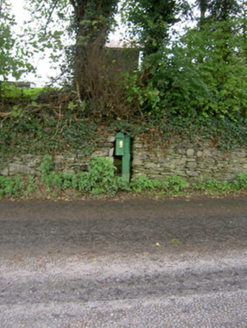
post box754 yd

Explorer Tom That old post box in Clashmorgan is stuck in time since the 1920s. It’s got 'Saorstát Éireann' cast on the door, which…

milestone/milepost840 yd

Explorer Tom Milestone or milepost in Ballynamona is standing there looking smug about its job. It’s been marking that road since…

Fairy fort / earthen ringfort in Ballynamona (barretts By.)Fairy fort / earthen ringfort · 853 yd

Explorer Tom Fairy fort / earthen ringfort in Ballynamona is hiding behind a field fence. A guy found an underground passage nearby…

Standing stone in ClashmorganStanding stone · 899 yd

Explorer Tom Standing stone in Clashmorgan is perched right on top of a Dooneen, which sounds like a fancy hill but is likely just a…

Clyda Rovers GAA pitchGAA ground · 929 ydChurch in MourneabbeyChurch · 1176 yd

Explorer Tom Church in Mourneabbey is playing possum while the ivy tries to eat it alive. The walls are full of little holes that…

Mourne Abbey (in Ruins)Religious house, Knights Hospitallers · 1189 yd

Explorer Tom Mourne Abbey is sitting in the mud like it's having an existential crisis about its life choices. It was home to…

More archaeology and monuments in County Cork · All of County Cork

Add to this placeAdd a picture Add a detailed tip Add a story

Explore the map1,095,414 places to discover

Next place · or swipeCastle Barrett