DDiscover AloneMapAbout

Timber circle in Knowth

Timber circle
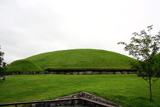
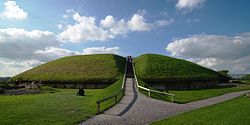
Computer-made picture that does not show Timber circle in KnowthNot a photo of this monument
Computer-made picture. It does not show this monument. · Report the wrong picture

What is recorded here

This timber-circle is part of Eogan's Phase 4 Grooved Ware Complex, and it is located c. 12m E of the entrance to Tomb 1C East and c. 5m S of Tomb 18 (Eogan and Roche 1997, 101-23). This phase is now called Late Neolithic, dating to c. 2800 - c. 2500 BC (Eogan and Cleary 2017, 42). This feature consists of a…

Read the whole record
This timber-circle is part of Eogan's Phase 4 Grooved Ware Complex, and it is located c. 12m E of the entrance to Tomb 1C East and c. 5m S of Tomb 18 (Eogan and Roche 1997, 101-23). This phase is now called Late Neolithic, dating to c. 2800 - c. 2500 BC (Eogan and Cleary 2017, 42). This feature consists of a subcircular wooden structure (dims 8.37m x 7.15m) defined by 19 post-holes, each with a post-pit, placed c. 0.65m apart. There is an entrance defined by 2 larger posts and a projecting porch of 2 larger posts on the E side. In addition the porch is flanked by three posts or pits on either side in a line parallel with the circumference of the circle. Nine small stones (diam. c. 0.15m) are placed 2-3m from each other outside the circle of posts SE-W-NE but these are not centred on the timber-circle and could be a natural occurrence. Just inside the circle of posts were 4 larger posts forming a square. Artefacts were added to the fills of the post-holes, and in the case of the central posts little pockets or annexes, rich in artefacts, were added to the backfills. The posts were cut through a humus sealing Neolithic material and the timber-circle is associated with a black earth that underlay habitation material from Beaker Concentration D (ME019-030035-). Over 500 sherds representing at least 45 vessels of Irish Grooved ware were recovered from the post-holes as well as a polished stone axehead and flints, with a greater proportion of the flints than usual derived from chalk flint. Both the flints, dominated by scrapers, and the flat-based pottery are concentrated in the 4 internal posts and the posts of the entrance and those of the circle opposite the entrance. It is likely that the structure was an unroofed ritual structure, perhaps with lintels connecting the posts (H 2m plus). It was probably built and the artefacts deposited with the posts in a single phase, and the posts were allowed to decay in situ rather than being burnt or dug out. Radiocarbon dates of 4130 +- 35 bp (2739 +- 94 cal. BC) and 3985 +_ 35 bp (2519 +- 39 cal. BC) were derived from samples in 2 different post-holes. The timber-circle is reconstructed. (Eogan and Roche 1997, 103-223) Date of upload: 06 November 2013 Amended: 17 September 2020 See the attached plans and images: _1 from Google Earth aerial photograph taken 12 July 2013. _2 Plan from Knowth 2, Fig. 21 _3 View from E

From the National Monuments Service (Archaeological Survey of Ireland) record ME019-030033

The monument record does not grant public access. Check the route and ask the landowner before entering private land.

What do you know about this place?Tap to add a comment or ask a question

What you write will be public.

Places near here

Photo credits
  • Sitomon, Wikimedia Commons · Public domain
  • Rob Hurson, Wikimedia Commons · CC BY-SA 4.0
  • John M, Geograph · CC BY-SA 2.0
  • Tjp finn, Wikimedia Commons · CC BY-SA 4.0
  • David Brossard, Wikimedia Commons · CC BY-SA 2.0
  • National Inventory of Architectural Heritage
  • Jonathan Billinger, Geograph · Creative Commons Attribution-ShareAlike 2.0
  • John M, Wikimedia Commons · CC BY-SA 2.0
  • Martin Richard Phelan, Wikimedia Commons · CC BY-SA 2.0
  • Mike Searle, Wikimedia Commons · CC BY-SA 2.0
  • Sitomon, Wikimedia Commons · CC BY-SA 2.0
  • Willow, Wikimedia Commons · CC BY 2.5
KnowthArchaeological place · 59 ydMoatPassage tomb · 60 yd

Explorer Tom Moat in Knowth suspects the postman is up to no good and keeps an eye on every delivery. It’s the focal point of the whole cemetery, acting like a proud grandpa at a family reunion. It's free, it's odd, what more do you want?

Not indicatedPassage tomb · 63 yd

Explorer Tom Passage tomb in Knowth made a New Year's resolution to stop losing kerbstones, but failed miserably again this year. It’s sitting right next to the big mound, looking slightly embarrassed about its missing bits. Go back in winter, it's a different animal.
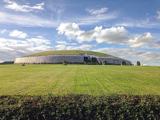
NewgrangeHeritage attraction · 1337 ydOengus Óg: NewgrangeLegend location · 1337 yd

Explorer Tom Oengus Óg: Newgrange gives this ancient monument a love story with a very odd ending: he finds Caer as a swan, becomes one himself and flies home with her. I was ready for a romantic walk; Oengus went straight for wings. Fair play to him.
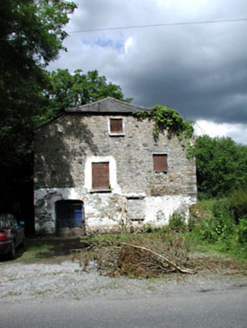
Mill HouseMill (water) · 1680 yd

Explorer Tom Mill House in Rossnaree remembers when a fox took charge of the flour sacks during a power cut. The wheel is still there, looking tired after centuries of grinding. Walk past slowly like you’re inspecting for termites.

Catholic Church of the Nativity of Our LadyChurch/chapel · 1.1 mi

Explorer Tom Catholic Church of the Nativity in Rossnaree smells like old books and fresh rain, according to my very reliable nose. The plaster vault inside is fancy enough to make you feel underdressed. Toast it with a cup of tea from your car window.

Brú na Bóinne Visitors CentreVisitor information · 1.8 miDowth CastleCastle, tower house · 1.8 mi

Explorer Tom Dowth Castle in Dowth has been sitting on that ridge since 1234, looking smug about it. Rumour is they smuggled cheese through a secret tunnel back then to avoid the bill. Stop the car, it’s worth the hazard lights.

Fennor CastleCastle · 2.0 miEuropean Yew3.0 mi

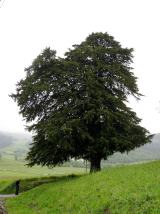
Explorer Tom European Yew in Meath brags about surviving a storm that flattened everything else nearby, acting like it was barely a hiccup. It’s got major survivor's guilt but pretends to be totally unbothered by it all. Tell the kids it's a castle. Close enough.
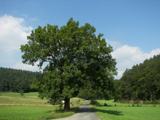
European ash3.1 mi

Explorer Tom European ash in County Louth was once a matchmaker who worked under its branches, pairing off locals with questionable taste. Bring wellies and low expectations, leave delighted by the absolute chaos of romance it orchestrated here.

More archaeology and monuments in County Meath · All of County Meath

Add to this placeAdd a picture Add a detailed tip Add a story

Explore the map1,093,392 places to discover

Next place · or swipeKnowth