
Places near here
Photo credits
- National Inventory of Architectural Heritage
- Richard Fensome, Wikimedia Commons · CC BY-SA 2.0
- Vimalkvn, Wikimedia Commons · CC BY-SA 4.0
- P L Chadwick, Geograph · CC BY-SA 2.0
- Robin Webster, Wikimedia Commons · CC BY-SA 2.0
 Denis O'Sullivan & Co. SolicitorsHouse · 17 yd
Explorer Tom House in Cork City was the former County Library, so it knows all the secrets. I think it would win a county fair for best dressed up in its original late-Georgian glory. Make up your mind and vote for it!
 The Aaran Isle InnHouse · 33 yd
Explorer Tom The Aaran Isle Inn is a late-Georgian house that has been altered so much it looks like a chameleon having an identity crisis. It’s on Dyke Parade, which sounds like a place where you go to drown your sorrows in stout. Look serious, or the ghosts will think you’re mocking them.
 University College CorkHouse · 37 yd
Explorer Tom University College Cork on Dyke Parade is a late-Georgian terrace that lost a bet with a priest years ago and never forgave him. It’s substantial and unaltered, which means it’s stubborn as hell. Walk past and pretend you’re not whispering about the debt.
 gate lodge93 yd
Explorer Tom Gate lodge in Cork City is haunted by the ghost of a cow that tried to buy it with milk money. The Constable used to open and close gates here, but now it’s just guarding its own ego on Mardyke Walk. It’s a bit of a social history snob; try not to make eye contact if you want to survive the encounter.
 University College Cork, The Maltings ComplexMaltings · 120 yd
Explorer Tom The Maltings Complex in Cork City is an industrial relic that now belongs to UCC, probably serving beer in what used to be grain storage. It’s got a roof profile that defies physics and logic. Wave at the windows like you’re greeting old friends from the brewery era.
 water trough144 yd
Explorer Tom There’s a legend that a giant used this water trough on Lancaster Quay to wash his feet before building the city walls. He left behind a smell of wet wool that never quite faded, even after all these years. Dip your finger in if you’re brave!
 cobbles/flags/paving/kerbing184 yd
Explorer Tom More cobbles in Cork City on Prospect Row are playing hard to get under the concrete. Dating back to around 1860, these stones are quietly proving they were built better than today's pavement. A real architectural heritage gem, even if it is a bit rough around the edges now.
 factory186 yd
Explorer Tom The Factory in Cork City is proud of its ability to outlast fashion trends. It made boots for decades and still stands tall on Washington Street. The sliding sash windows are dusty but full of industrial spirit. Admire the brickwork from a respectful distance.
 George BooleMemorial · 365 yd
Explorer Tom George Boole lived here inventing boolean logic while pretending he wasn't just playing with fancy switches for fun. There was definitely a fake royal visit where the Queen mistook him for a plumber, but nobody can prove it. Linger, it's not going anywhere and neither should you.
 Gill Abbey (Site of) (1949-50)Religious house, Augustinian canons · 421 yd
Explorer Tom Gill Abbey in Cork City was founded by Cormac MacCarthaig and burned down by Anglo-Normans who were scared of the men of Desmond. That sounds like a neighborhood dispute that escalated way too quickly. Tell me if the gossip I made up about the monks is true, or just lie.
 Cathedral446 yd
Explorer Tom Cathedral in Cork City was built in French Gothic style by William Burges. He did everything himself, including the stained glass! That’s one dedicated architect. Go see if he left any signatures on the walls.
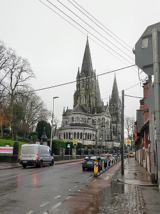 Saint Fin Barre's CathedralHeritage attraction · 448 yd
Explorer Tom Cork gave this cathedral three spires. I would have asked for a fourth. Saint Fin Barre's Cathedral gives Cork three spires and enough carved faces to make a visitor look twice at every corner. The site has a much older religious history linked to Finbarr, but this striking building is a Victorian creation. William Burges took on his first major commission here from 1863, designing not only the structure but much of the sculpture, glass, mosaics and furniture. Burges had more ideas than I have pockets, and he seems to have spent every one. It was consecrated in 1870; the limestone spires waited until 1879 to finish the skyline. Thomas Nicholls modelled many of the exterior figures, including gargoyles that look ready to comment on your shoes. This remains a Church of Ireland cathedral with visitor arrangements, so check service times and admission before exploring the interior. Look closely at the details rather than only the three dramatic points above; Burges hid a whole argument for extravagance down at eye level.
More historic places in County Cork · All of County Cork

What do you know about this place?Tap to add a comment or ask a question