DDiscover AloneMapAbout

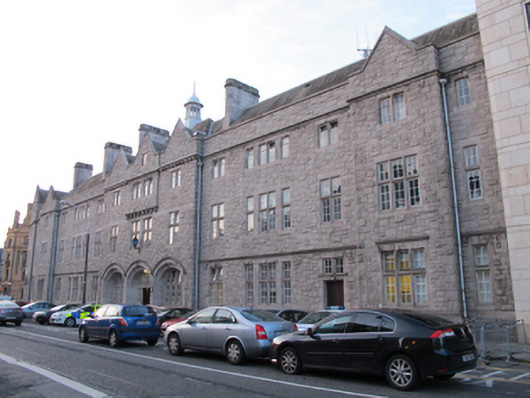
Pearse Street Garda Station

Garda station/constabulary barracks
Pearse Street Garda Station
Photo: National Inventory of Architectural Heritage · Report the wrong picture

This does not grant access. Most recorded buildings are privately owned; view them only from public ground unless the owner allows entry.

What do you know about this place?Tap to add a comment or ask a question

What you write will be public.

What is recorded here

Corner-sited attached fourteen-bay three-storey over basement and with attic accommodation garda station, built 1915, with bow-fronted full-height bay to side (north-west) elevation, triple gable-fronted breakfront, having projecting central gable on carved corbels, and gabled end bays to front (south-west) elevation,…

Read the whole record
Corner-sited attached fourteen-bay three-storey over basement and with attic accommodation garda station, built 1915, with bow-fronted full-height bay to side (north-west) elevation, triple gable-fronted breakfront, having projecting central gable on carved corbels, and gabled end bays to front (south-west) elevation, gabled end bay and L-plan return and recent two-storey extension to rear (north-east) elevation. Pitched slate roof, cruciform to west, hipped to return, with octagonal cupola, ashlar granite chimneystacks and cast-iron rainwater goods, snecked granite parapet having carved granite coping, crennellated parapet to bow bay. Snecked rock-faced granite walls, having carved string courses, platband, snecked rock-faced plinth course with carved granite capping, rock-faced quoins. Square-headed window openings arranged singly, in pairs and groups of three and four, having chamfered granite surrounds, sills and mullions, some transom and mullioned windows, some carved hood mouldings, metal-framed casement windows. Arcade of segmental-headed arches to breakfront with carved hood moulding having figurative stops, interlaced shamrocks to outer stops. Carved granite surrounds, transom and mullioned windows with metal casement windows to outer arches, flanking square-headed door opening having sidelights and mullioned overlight, timber battened door, recent steps and wheelchair ramps. Segmental-headed door openings with carved hood mouldings and figurative or shamrock stops, dressed chamfered granite surrounds, square-headed door openings, timber battened door and limestone steps. Sidelights and segmental-headed overlights to entrance to front. Square-headed door opening to front, dressed chamfered granite surround and carved hood moulding, timber battened door. Rear enclosed by masonry wall in snecked granite, roughly coursed, with granite coping. Interior recently altered. Located to west end of Pearse Street, at junction with Townsend Street.
Police barracks built for the Dublin Metropolitan Police, replacing the former barracks on College Street. Commissioned in 1910, it was built to designs by the Office of Public Works under the supervision of M.J. Burke, with H.G. Leask and A. Robinson as job architects. Built in a Scottish Baronial style, evident in the gables and mullioned windows. The bow end to College and D’Olier Street reflects the design of the original terrace and of the bow-ended buildings opposite (50020276/50020272). The carved figurative stops articulate the separate entrances, one for Inspectors who used the officer’s entrance, and the other for rank-and-file constables who used the main public entrance. The well-executed rock-faced stone is an example of the fine craftsmanship of the stone masons at Ballybrew granite quarry, Co. Wicklow, creating a stoic, sombre impression. Following the DMP’s amalgamation with An Garda Síochána in 1926, Pearse Street Station became headquarters of the ‘B’ District. The building is an attractive termination to the west end of Pearse Street and an historic landmark in Dublin’s streetscape.

From the Buildings of Ireland (National Inventory of Architectural Heritage) record 50020309

Places near here

Photo credits
  • Angilbas at English Wikipedia, Wikimedia Commons · Public domain
  • Superchilum, Wikimedia Commons · CC BY-SA 4.0
  • Maker not stated on source page, www.flickr.com
  • Agence Rol, Wikimedia Commons · Public domain
  • Maker not stated on source page, www.tripadvisor.ca
  • Maker not stated on source page, www.dreamstime.com
  • N Chadwick, Geograph · Creative Commons Attribution-ShareAlike 2.0
  • National Inventory of Architectural Heritage
  • Oisín Ó Doinn, Wikimedia Commons · CC BY-SA 4.0
  • NateBergin, Wikimedia Commons · CC BY 4.0
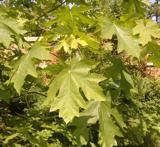
Bigleaf Maple152 yd

Explorer Tom Bigleaf Maple: Rumour has it a tragic love affair ended right next to this maple, with tears soaking into the roots for…
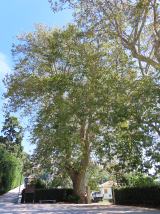
Oriental plane164 yd

Explorer Tom Oriental plane in Dublin would survive a zombie attack by standing perfectly still while they walk past, which is…

Church in Unknown TownlandChurch · 167 yd

Explorer Tom This Lutheran church from the early 1700s had people smoking clay pipes, judging by their teeth! That's a fun detail…

Burning of the Custom HouseArmed conflict · 408 yd

Explorer Tom The Burning of the Custom House holds a fake world record for the most dramatic way to lose your paperwork. It still…

St. Marys ChurchChurch · 840 yd

Explorer Tom St. Marys Church in County Dublin is one of the earliest galleried churches in Ireland, dating to the late 17th…

Graveyard in Unknown TownlandGraveyard · 858 yd

Explorer Tom Graveyard in Dublin was St Thomas's graveyard, used until 1882 before things got messy during the 1916-1922 period. The…

Wolfe Tone MemorialStatue · 887 yd

Explorer Tom Wolfe Tone Memorial in County Dublin is having a serious feud with the rain because his bronze stance looks like he’s…
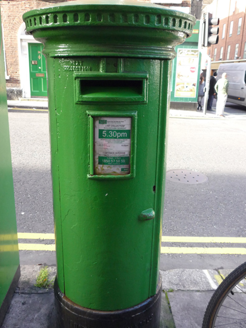
post box945 yd

Explorer Tom Post box in County Dublin is a Victorian-era cast-iron pillar from around 1880 that looks like it’s about to swallow…
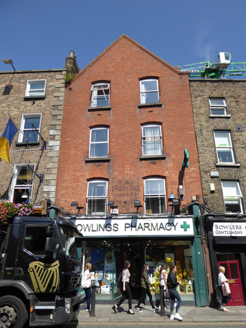
shop/retail outlet963 yd

Explorer Tom Shop on Baggot Street Lower would tell the place that replaced it, 'You’re just a photocopy of my original charm…

Religious houseReligious house, Cistercian monks · 985 yd

Explorer Tom St Mary’s Abbey in Dublin would handle a nosey neighbour by simply closing its windows and pretending it doesn't hear…
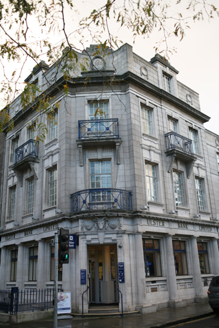
Ulster BankBank/financial institution · 1063 yd

Explorer Tom Ulster Bank on Baggot Street has a hidden message in its stones if you read the classical details correctly, or at…

Cathedral1117 yd

Explorer Tom Cathedral. Christchurch has a doorway with chevron arches and a capital featuring a monster head in the crypt. It is…

More historic places in County Dublin · All of County Dublin

Add to this placeAdd a picture Add a detailed tip Add a story

Explore the map1,095,414 places to discover

Next place · or swipeBigleaf Maple