What is recorded here
Located towards the S end of a N-S ridge. Thomas Moigne was the first Protestant bishop of Kilmore and he was succeeded by William Bedell in 1629. Moigne seems to have refurbished the Cathedral church (CV025-070004-) and built a house beside it in the 1620s when he reported that ‘The Cathedral church is newly built and repaired…A fair stone house built at Kilmore by the now bishop, which together with the building of other outhouses and of seats in the chancel and body of the church of Kilmore had cost £600’ (Kelly 2017, 251). The house was a ruin by the end of the century when, according to Rev. William Henry writing in the 1730s (King 1892, 10-12), Bishop Whetnell (Bishop 1699-1713) began the construction of the present palace. Henry describes the house as: 'long, lofty and capacious, about a hundred feet in length, and forty in width; it has two fronts; the entrance is by the E side. The front is a large square court, the south side of which is formed by the church, the west by the house, the north by a wall'd enclosure ... from the east side, which seems open, there is descent by several steps into a spacious gravelled terrace… the south end of the house looks into the churchyard, and from it the church goes off in right angles, being contiguous and having a communication with the house.'
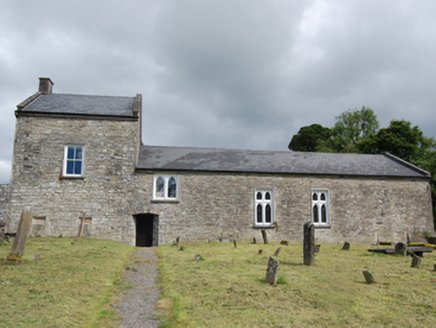
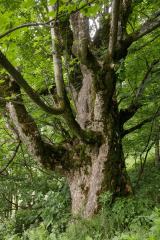
When the new See House was built for the Bishop c. 200m to the NNE c. 1840 the old palace was due to be demolished (Lewis 1837, vol. 2, 185), but the ground floor of the W (L c. 35m; T 0.7m; H c. 3-4m) wall and the N wall (L c. 9m) remain. The W wall has a central doorway (Wth 1.2m) now bordered with brick, and 10 large, elliptical-headed windows (Wth 1.2-1.25m; H 2.4m) with no surviving dressed stone. The windows are unevenly spaced, being 1.9-2.85m apart. Although the sources do not specify this the palace was probably of two stories, and the first floor block at the W end of the old cathedral is probably part the old palace. The terrace (Wth 7.15m; H 1.5m) outside the W wall is part of the design, and the ancient, hollow sycamore tree (diam. c. 2.4m) which Bishop Bedell is said to have planted is towards the S end of the terrace beside a graveyard of later bishops. The W wall of the graveyard associated with cathedral abuts the SW angle of the palace.
Located towards the S end of a N-S ridge. Thomas Moigne was the first Protestant bishop of Kilmore and he was succeeded by William Bedell in 1629. Moigne seems to have refurbished the Cathedral church (CV025-070004-) and built a house beside it in the 1620s when he reported that ‘The Cathedral church is newly built and repaired…A fair stone house built at Kilmore by the now bishop, which together with the…
From the National Monuments Service (Archaeological Survey of Ireland) record CV025-073
The monument record does not grant public access. Check the route and ask the landowner before entering private land.
- What survives
- Recorded monument
Places near here
 Kilmore Parochial HallCathedral · 22 yd
 Sycamore61 yd
 St Feidhlimidh CathedralCathedral · 164 ydCastleCastle, motte and bailey · 183 ydSt. Felimys WellHoly well · 244 yd
 Cucumber Magnolia318 yd
 Rambling at Farnham EstateVisitor information · 1.6 miBellvilleMountain / peak · 2.2 mi
 Cloughoughter CastleIsland castle ruin · 3.0 mi
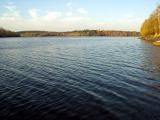 Lough OughterLake and island landscape · 3.0 mi
 Clogh Oughter CastleCastle, Anglo-Norman masonry castle · 3.1 mi
 Court tomb in GartnanoulCourt tomb · 3.7 mi
Pictures: National Inventory of Architectural Heritage; Christian Pirkl, Wikimedia Commons · CC BY-SA 3.0 at; Olliebailie, Wikimedia Commons · CC BY-SA 4.0; Bruce Marlin, Wikimedia Commons · CC BY 3.0; Peter Gerken, Geograph · CC BY-SA 2.0; Oliver Dixon, Wikimedia Commons · CC BY-SA 2.0; Sarah777 at English Wikipedia, Wikimedia Commons · Public domain; Adam Simpson, Geograph · CC BY-SA 2.0; NTF30, Wikimedia Commons · CC BY-SA 4.0
More archaeology and monuments in County Cavan · All of County Cavan
What do you know about this place?