DDiscover AloneMapAbout

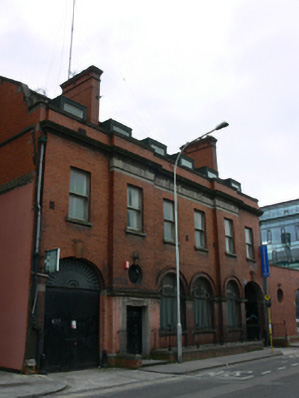
Office on Lime Street

Office
Office on Lime Street
Photo: National Inventory of Architectural Heritage · Report the wrong picture

This does not grant access. Most recorded buildings are privately owned; view them only from public ground unless the owner allows entry.

Recorded change of use
Originally office; recorded by the architectural inventory as studio
What do you know about this place?Tap to add a comment or ask a question

What you write will be public.

What is recorded here

Freestanding six-bay two-storey with attic storey former offices, built 1909, having integral carriage arches to end bays and shallow projections to front (north) elevation, single-storey wing wall to west, and triple-pile goods shed to rear (south) elevation. Now in use as studio. Pitched slate roof with recent…

Read the whole record
Freestanding six-bay two-storey with attic storey former offices, built 1909, having integral carriage arches to end bays and shallow projections to front (north) elevation, single-storey wing wall to west, and triple-pile goods shed to rear (south) elevation. Now in use as studio. Pitched slate roof with recent square-headed dormer windows, terracotta ridge cresting, red brick chimneystacks, some cast-iron rainwater goods set in recesses, red brick parapet having carved masonry capping. Pitched slate roofs to store with clerestories having timber louvered vents. Red brick, laid in Flemish bond to walls to front (north) range, red brick plinth course having carved limestone capping and string course, some smooth rendered walls, carved stone cornice over fascia with raised lettering to front, brown brick and yellow brick in Flemish bond to east, west and elevations of store to rear. Square-headed window openings having granite sills and one-over-one pane timber sliding sash windows. Round-headed window openings to ground floor to front, with moulded brick archivolts supported on red brick pilasters, carved stone sills and timber and metal framed windows. Square-headed window openings to side having granite sills and timber battened shutters, segmental headed window openings to rear, blocked. Oculi with some terracotta or render keystone details, having metal and timber framed windows and some wrought-iron openwork panels. Square-headed door opening with carved limestone shouldered architrave having date panel over, double-leaf timber panelled door approached by nosed granite step. Elliptical-headed carriage arches with terracotta keystones, and double-leaf timber battened doors, steel grill to overlight to opening to east, cast-iron wheel stops. Elliptical-headed carriage arches to wing wall, with render impost and keystone details, having double-leaf timber battened doors and recent door. Loading platform to goods shed, having render and coursed rubble stone platform, cast-iron and mild-steel girder supports, and corrugated-iron canopy. Cobbled yard. Wrought-iron railings with cast-iron corner posts on carved limestone and red brick plinth wall to front. Situated to south and centre of Sir John Rogerson's Quay, at junction with Lime Street.
The British & Irish Steam Packet Company (B&I line), established in Dublin in 1836, moved their offices here to Sir John Rogerson’s Quay in 1909, at a time when the company was involved in a long and costly legal battle over berthing facilities. It continued to operate successfully until 1992, its success largely built on its domination of the Dublin-Waterford-Wexford routes, made possible through its acquisition of the Waterford Steamship Company in 1870 after the latter's founders, the Malcomson family, declared bankruptcy. The classically influenced façade was designed by W.H. Byrne & Sons and was formally opened in 1910. The contractors were John & P. Good, costing over £35,000. The large site, with its goods sheds and rear loading platform, executed by McCoughlan’s Dublin Foundry, serviced the busy terminus and offices. The red brick of the façade melds beautifully into the streetscape, mirroring similar materials in nearby buildings, while the massing is broken up by the details in render and limestone.

From the Buildings of Ireland (National Inventory of Architectural Heritage) record 50020477

Places near here

Photo credits
  • Maker not stated on source page, www.pinterest.com
  • Agence Rol, Wikimedia Commons · Public domain
  • Angilbas at English Wikipedia, Wikimedia Commons · Public domain
  • Superchilum, Wikimedia Commons · CC BY-SA 4.0
  • National Inventory of Architectural Heritage
  • N Chadwick, Geograph · Creative Commons Attribution-ShareAlike 2.0
  • Maker not stated on source page, www.dreamstime.com
Church in Unknown TownlandChurch · 603 yd

Explorer Tom St Marks has a doorway possibly from around 1700, which is a nice touch. The graveyard was active until the 1950s, so…

Burning of the Custom HouseArmed conflict · 790 yd

Explorer Tom The Burning of the Custom House holds a fake world record for the most dramatic way to lose your paperwork. It still…
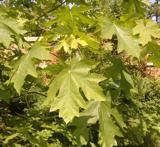
Bigleaf Maple898 yd

Explorer Tom Bigleaf Maple in County Dublin is waiting for a bishop who refused to visit because he thought it looked too much like…
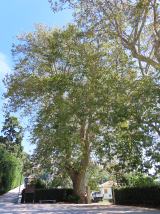
Oriental plane904 yd

Explorer Tom Oriental plane in Dublin would survive a zombie attack by standing perfectly still while they walk past, which is…

post box1043 yd

Explorer Tom Post box on Fitzwilliam Street Lower is a cast-iron pillar box from about 1885 with a shallow domed cap and letter…
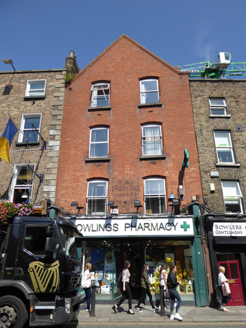
shop/retail outlet1226 yd

Explorer Tom Shop on Baggot Street Lower would tell the place that replaced it, 'You’re just a photocopy of my original charm…
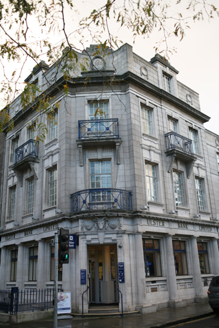
Ulster BankBank/financial institution · 1230 yd

Explorer Tom Ulster Bank on Baggot Street has a hidden message in its stones if you read the classical details correctly, or at…
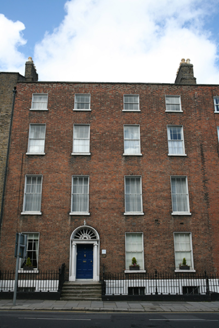
United Arts ClubHouse · 1263 yd

Explorer Tom United Arts Club in County Dublin is a four-bay townhouse that used to be a residence. Built c.1800, it’s now a…
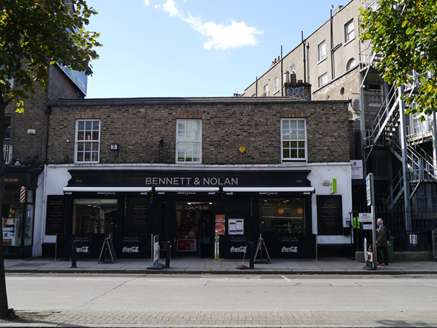
stables1263 yd

Explorer Tom Stables on Baggot Street Lower in County Dublin are sitting right on the street, which is weird for a mews. They’ve got…

Young Women's Christian AssociationHouse · 1327 yd

Explorer Tom Young Women's Christian Association on Baggot Street Lower has a name that really means ‘We Like Our Windows To Be…

Wolfe Tone MemorialStatue · 1354 yd

Explorer Tom Wolfe Tone Memorial in County Dublin is having a serious feud with the rain because his bronze stance looks like he’s…

Graveyard in Unknown TownlandGraveyard · 1423 yd

Explorer Tom Graveyard in Dublin was St Thomas's graveyard, used until 1882 before things got messy during the 1916-1922 period. The…

More historic places in County Dublin · All of County Dublin

Add to this placeAdd a picture Add a detailed tip Add a story

Explore the map1,095,414 places to discover

Next place · or swipeChurch in Unknown Townland