What is recorded here
No visible chamber remains, but the ground still holds three separate underground passages built from stone and cut rock. They belong together inside a broad oval enclosure, and they include narrow creeps, side galleries, air vents and a small chamber reached through a tight opening. One passage also contained an ogham stone set across a junction as a lintel. The site is not a single hidden room; it is a buried network of routed spaces that people shaped, entered and reused across a long time.
The following description is derived from both the published 'Archaeological Inventory of County Louth' (Dublin: Stationery Office, 1986) and the 'Archaeological Survey of County Louth' (Dublin: Stationery Office, 1991). In certain instances the entries have been revised and updated in the light of recent research.
Date of upload/revision: 17 July 2007
Excavated in 1977 by E. P. Kelly (NMI file, IA/41/77). A complex of three drystone-built Man-made underground passages was found within an oval enclosure (LH007-072001-) which measured 90m in max. diam.
One of the Man-made underground passages (LH007-072002-) had been robbed of its capstones and parts of the walls in the medieval period and used thereafter as a refuse dump. Large quantities of medieval pottery, metal objects, sea shells, animal bones and some human remains were recovered from the fill. A stone slab bearing Early Bronze Age carvings (LH007-072003-) had been reused as a jamb in this structure. The Man-made underground passage consisted of a passage (L 5m, Wth 0.9m) extending from W-ENE, turning S for 2.5m, then extending NE as a second passage (L 14m, Wth 1.5m). At the NNE end of the passage are the remains of an air-vent continuing on along the same line as the passage. Passage 3 (L 10.5m, Wth 1.5m) extends S from the NNE end of Passage 2. At the N and S ends of this passage are stone-built creeps which reduce the width of the passage to c. 1m. At the S end of Passage 3 is a gallery (L 9.7m, Wth 2m) which extends WNW-ESE, with the opening from Passage 3 in the middle of its N side wall.
A stone-lined sunken walkway extended from the middle of the S wall of Passage 1 across to the entrance to a second Man-made underground passage (LH007-072004-). This Man-made underground passage consists of a drystone-built gallery (overall L 14m, Wth 1-1.2m, H 1.5m) extending from the entrance at the SE to NW with a slight turn to W at the NW end. Slots running from floor level up to the roof, 3.7m from the entrance, probably formerly held wooden door jambs. At the NW end the lower walls of the Man-made underground passage consist of bedrock which has been quarried into.
The third and largest Man-made underground passage (LH007-072005-) of the group consists of a passage in three sections (overall L 34m), partially drystone-built and partly rock-cut. The first section of passage (L 7m, Wth 0.8m) extends N-S and has a recess (L 0.8m, Wth 0.8m) in the E wall 3m from the entrance. Most of this section of passage had been delintelled in antiquity. At the S end the passage turns sharply E (L 9m) and the N wall of the passage is formed by bedrock in the W wall 2m from its N end. At the S end of the passage an air-vent leads off S at roof level. Passage 2 (overall L 21m) extends from the middle of the W wall of the final section of Passage 1. It runs SW (L 10m) then gently curves W (L 11m). At the W end a creep in the S wall gives access to a sub-rectangular chamber (L 1.6m, Wth 1.4m, H 1m) with an air-vent in the S wall at roof level. At the junction of Passages 1 and 2 an ogham stone (LH007-072006-), bearing an inscription translated as MAQI COR.BIR (MA)QE TAN ... (B stroke) ... NIOT(A) S. LAGIA MAQI MUC ..., was used as a lintel. This use of ogham stones for Man-made underground passage lintels is well attested elsewhere, as is their use at strategic points in a Man-made underground passage (Ancient Monuments of Northern Ireland 1969, 21).
The monument record does not grant public access. Check the route and ask the landowner before entering private land.
- What survives
- Recorded monument
Places near here
 Enclosure in BallybarrackEnclosure · 1 yd
 Church (in Ruins)Church · 48 yd
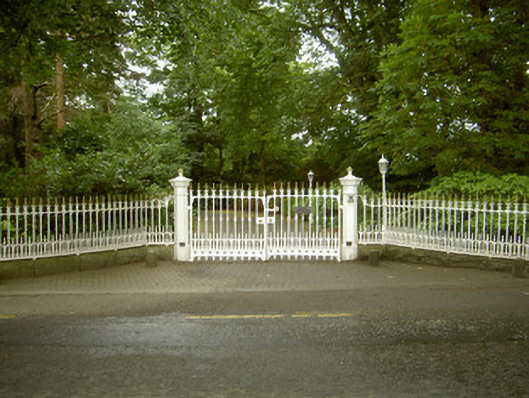 Ballybarrack Housegates/railings/walls · 139 yd
 BallybarrackMountain / peak · 426 yd
 Man-made underground passageMan-made underground passage · 1074 yd
 Photo GalleryHeritage attraction · 1.2 mi
 Dundalk CentralHeritage attraction · 1.2 mi
 Maid of ErinMemorial · 1.6 mi
 Bombing 1975Memorial · 1.6 mi
 CastleCastle, tower house · 1.8 mi
 Castletown MotteArchaeological place · 1.9 mi
 Soldiers' PointHeadland · 3.4 mi