What is recorded here
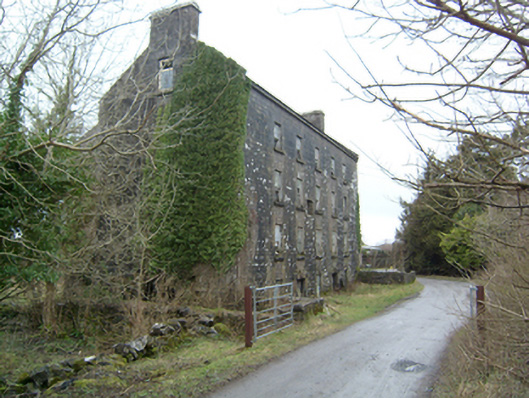
Kilroe Mills in Grange has two water wheels and still keeps all its internal workings. Even in retirement, it’s ready for that particular Galway emergency: somebody saying their own mill was bigger.
Detached five-bay four-storey watermill, built c.1790, with dormer attic, and having mid-nineteenth century two-bay full-height return to return to give T-plan. Now derelict. Pitched slate roof with three rendered chimneystacks to gables, stone copings with cut-stone kneelers, central roof-light to west elevation and with parapet wall to mid-roof of return. Ashlar limestone walls with draughted and tooled quoins to front, and lime rendered random rubble walls elsewhere, with projecting eaves course. Square-headed windows openings with tooled surrounds, stone sills and six-over-six pane timber sliding sash windows, with some replacement timber windows to gables and rear. Two square-headed door openings to front elevation with limestone block-and-start surrounds having triple keystones and segmental relieving arch over. Timber sheeted half-doors. door. Internal workings in situ and date of AD 1798 carved in timberwork. Millrace adjacent and two timber water wheels in situ, one to each gable of main block. Set parallel to laneway with limestone squared and snecked wall to north and south.
Kilroe Mills, taken together with the adjacent miller's house known as "Inish Lodge", forms a grouping that has considerable architectural, social and technical significance. The mill was built c.1790 and has associations with John J. Gunning, tanner of Galway who bought the land in the parish of Kilcoona after the Great Famine and ran a flour milling business. The building was possibly originally a flax mill and then converted in two phases c.1840 and c.1870 and the rear central return shows evidence of this expansion. The imposing four-storey structure is a striking feature in the landscape. The openings are simple and the façade classically proportioned with good architectural detailing to the door openings. The survival of all its internal workings makes this a building of special importance and the presence of two water wheels is most unusual. Kilroe Mill was a focal point for the local community, providing employment, and played a key role in the economic prosperity of the area in particular its role as a flour mill after the Great Famine. The building also serves as a reminder of past industrial processes and represents an integral element of the industrial heritage of the area
From the Buildings of Ireland (National Inventory of Architectural Heritage) record 30405622
This does not grant access. Most recorded buildings are privately owned; view them only from public ground unless the owner allows entry.
Places near here
 Kilroe MillsMiller's house · 37 ydEnclosure in An MásEnclosure · 1.0 mi
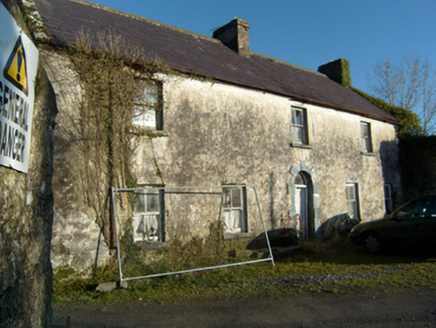 mill manager's house1.0 miBallinduff BayBay · 1.2 mi
 Kilcoona Round TowerHeritage attraction · 1.9 mi
_-_geograph.org.uk_-_6021184.jpg/250px-Castles_of_Connacht,_Cloonboo,_Galway_(2)_-_geograph.org.uk_-_6021184.jpg "Photo: Mike Searle, Wikimedia Commons · CC BY-SA 2.0") Cloonboo CastleCastle, tower house · 2.6 mi
Cloonboo CastleCastle, tower house · 2.6 mi_-_geograph.org.uk_-_1953815.jpg/250px-Castles_of_Connacht,_Cloonboo,_Galway_(1)_-_geograph.org.uk_-_1953815.jpg "Photo: Mike Searle, Wikimedia Commons · CC BY-SA 2.0") Cloonboo CastleCastle · 2.6 miCúil DiarmuidWood · 2.6 miOileán an AoilIsland · 3.2 mi
Cloonboo CastleCastle · 2.6 miCúil DiarmuidWood · 2.6 miOileán an AoilIsland · 3.2 mi Grave YardGraveyard · 4.4 mi
 KnockmaaWood · 5.3 mi
 Ross Errilly FriaryHeritage attraction · 6.1 mi
Pictures: National Inventory of Architectural Heritage; Wanfried-Dublin, Wikimedia Commons · CC BY-SA 3.0; Mike Searle, Wikimedia Commons · CC BY-SA 2.0; Mac McCarron, Geograph · Creative Commons Attribution-ShareAlike 2.0; Enda O Flaherty, Geograph · CC BY-SA 2.0; The original uploader was Dppowell at English Wikipedia ., Wikimedia Commons · CC BY-SA 2.5
More historic places in County Galway · All of County Galway
What do you know about this place?