DDiscover AloneMapAbout

Kiln in Grawky

Kiln
Kiln in Grawky
Photo: National Inventory of Architectural Heritage · Report the wrong picture

This does not grant access. Most recorded buildings are privately owned; view them only from public ground unless the owner allows entry.

Recorded change of use
Originally kiln; recorded by the architectural inventory as outbuilding
What do you know about this place?Tap to add a comment or ask a question

What you write will be public.

What is recorded here

Freestanding two-bay lime kiln, erected c. 1860. Now out of use or in use as outbuilding with modern addition to the front (west). Constructed of roughly coursed rubble stone masonry with roughly square-quoins to the corners. Segmental-headed openings to front (south) having red brick voussoirs and lining to former…

Read the whole record
Freestanding two-bay lime kiln, erected c. 1860. Now out of use or in use as outbuilding with modern addition to the front (west). Constructed of roughly coursed rubble stone masonry with roughly square-quoins to the corners. Segmental-headed openings to front (south) having red brick voussoirs and lining to former oven apertures intrados. Slightly raised rubble stone parapet to front. Built into sloping ground with former quarries adjacent to the east (now flooded). Earthen embankment to rear and south, formerly giving access to loading chambers to top. Set back from road in rural location to the east of Manorcunningham. Single-storey lean-to shed to west with corrugated-metal roof and blockwork walls.
This interesting double lime kiln, originally erected during the second half of the nineteenth century, survives in good condition and retains its early character. Its form consisting of two adjoining lime kilns, and it is unusually substantial and well-built for its type. It is well-built using local rubble stone masonry and is an appealing and unassuming element of the agricultural/industrial and social heritage of County Donegal. The brick lining to the over apertures is and interesting feature that indicates its relatively late date. The embankment to the rear was built/modified to allow for the easy loading of stone through openings in the roof structure, while the apertures to the front were used to fire the oven to burn the stone and produce lime. It is located adjacent to a former quarry to the east, a logical site for such a feature due to ease of transport of the raw material, limestone. Lime kilns appear to have come into popular use in Ireland during the eighteenth century and were a very common feature in the rural landscape up until the first decades of the twentieth century. They were used to burn limestone to produce lime, which was used as an agricultural fertilizer and spread on agricultural land, or in construction as a mortar and a render. Lime was also used for lime-washing buildings, particularly farm buildings, as it was regarded as a cleansing agent at the time. This double kiln is more substantial than is more commonly encountered, which suggests a small-scale industrial process at the time as opposed to a kiln erected for use by a local farmer. Small rural lime kilns started to go out of common usage during the late nineteenth-century with the advent of industrial-scale lime production facilities and improvements in the transport network, particularly the development of the railways. This simple feature is an interesting feature in the rural landscape to the east of Manorcunningham, and is an integral element of the built heritage of the local area.

From the Buildings of Ireland (National Inventory of Architectural Heritage) record 40905443

Places near here

Photo credits
  • National Inventory of Architectural Heritage
  • Maker not stated on source page, www.pinterest.ru
  • Maker not stated on source page, www.pinterest.com
  • Kenneth Allen, Geograph · CC BY-SA 2.0
  • Maker not stated on source page, www.visitgalway.ie
  • Kenneth Allen, Geograph · Creative Commons Attribution-ShareAlike 2.0
  • Maker not stated on source page, ru.pinterest.com
  • Maker not stated on source page, www.kinopoisk.ru
  • Maker not stated on source page, au.pinterest.com
outbuilding698 yd

Explorer Tom Outbuilding in Grawky Glebe puts red-brick surrounds around openings in its grey stone face. Those brick eyebrows make…
bridge1056 yd

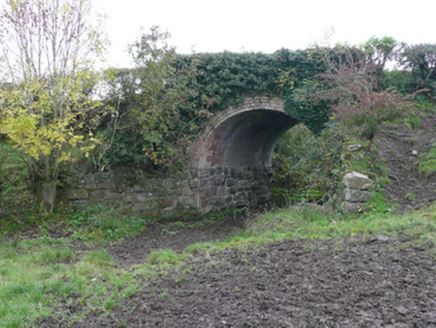
Explorer Tom Bridge in Tullybogly has a brick arch that looks like it’s wearing a very fancy, red-brick scarf. I picture the stone…

Standing stone in HighbankStanding stone · 1305 yd

Explorer Tom Standing stone in Highbank fell over and got a concrete cast about fifteen years ago! It’s sitting up proud on the…

Standing stone in Baile Na Bó,tullyboglyStanding stone · 1615 yd

Explorer Tom Standing stone in Baile Na Bó, Tullybogly used to have a partner on that ridge! I bet it got tired of standing there…

St. Columba’s Catholic ChurchChurch/chapel · 1.1 mi

Explorer Tom St. Columba’s Catholic Church in Drumoghill is packed with seven hundred standing people! I bet they were all staring…

Bullaun stone in GaldonaghBullaun stone · 1.2 mi

Explorer Tom Two lads in a pub bet this Bullaun stone in Galdonagh could survive a thousand years without getting polished, and they…

Drumoghill BridgeBridge · 1.2 mi

Explorer Tom Drumoghill Bridge has a fairy dispute over parking rights right now, with the tiny ones claiming the left arch and the…

WoodtownHouse · 1.2 mi

Explorer Tom Woodtown in Ryelands has a bird that refuses to leave, claiming it owns the roof now and always has. The heavy Roshin…

Second Ray Presbyterian ChurchChurch/chapel · 1.3 mi

Explorer Tom Second Ray Presbyterian Church is a 19th-century hall that looks like it’s wearing a very fancy, two-storey entrance…

Raymoghy Old Church GraveyardGraveyard · 1.6 mi

Explorer Tom Rymoghy Old Church Graveyard keeps its history in the gate. Three medieval window fragments are built right into the…

Maylin WoodOfficial walking route · 1.9 mi

Explorer Tom Maylin Wood is Donegal's reminder that a good outing does not need to occupy half a calendar. This small loop near…

Balleeghan Friary GraveyardGraveyard · 2.2 mi

Explorer Tom Balleeghan Friary Graveyard comes with a quiet but vivid detail: ivy-covered ruins by Lough Swilly, built from granite…

More historic places in County Donegal · All of County Donegal

Add to this placeAdd a picture Add a detailed tip Add a story

Explore the map1,095,414 places to discover

Next place · or swipeoutbuilding