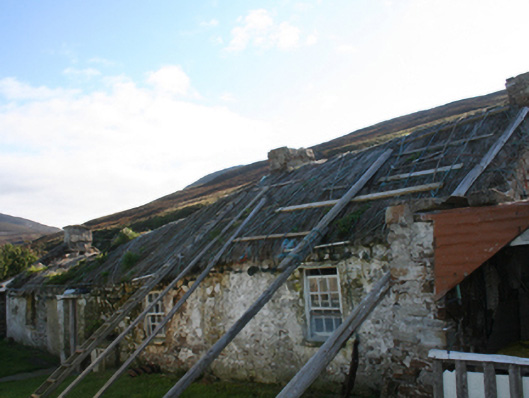
What is recorded here
Detached five-bay single-storey vernacular house, built c. 1780, windbreak porch to front, single-bay outbuilding to east gable, single-bay shed to west gable, now disused. Round pitched, partially collapsed, rye thatched roof with latticed restraining ropes, and stone pegs, limewashed rendered chimneystacks to centre…
Read the whole record
From the Buildings of Ireland (National Inventory of Architectural Heritage) record 40900916
Places near here
Photo credits
- National Inventory of Architectural Heritage
- Michael Dibb, Geograph · CC BY-SA 2.0
- Andreas F. Borchert, Wikimedia Commons · CC BY-SA 4.0
- Carroll Pierce, Wikimedia Commons · CC BY-SA 2.0
- Andreas F. Borchert, Wikimedia Commons · CC BY-SA 3.0 de
- Patrice78500, Wikimedia Commons · Public domain
- N Chadwick, Geograph · CC BY-SA 2.0
- N Chadwick, Wikimedia Commons · CC BY-SA 2.0
- David Ayrton, Geograph · CC BY-SA 2.0
- Kenneth Allen, Geograph · CC BY-SA 2.0
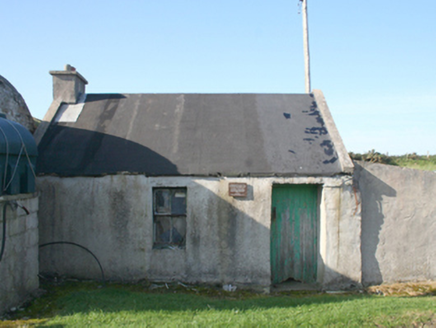 forge/smithy41 yd
Explorer Tom Forge or smithy in Lenan was built around 1840. Its plaque remembers the crew of Wellington Bomber W5653, who died in the Urris crash on 11 April 1941; their bodies were laid in this forge before transfer to Dunree and burial in Britain. I let the plaque speak here.
 Gap of Mamore ViewpointViewpoint · 1167 yd
Explorer Tom Gap of Mamore Viewpoint sits along the Wild Atlantic Way, offering a dramatic look at this famous gap in County Donegal.
 Lenan FortBattery · 1317 yd
Explorer Tom Lenan Fort has a rock-cut ditch that was seven metres and seventy centimetres wide, which is basically a swimming pool carved straight into the hillside. I picture myself standing at the edge, trying to decide if I could cannonball across without getting damp socks.
 Saint Éigneach's WellHoly well · 1364 yd
Explorer Tom Saint Éigneach's Well sits right on top of Mamore Gap, where pilgrims used to go barefoot around seven cairns. That’s a serious blister-fest, but apparently worth it for the spiritual glow-up at this mountain summit. There’s even a Lourdes grotto and Padre Pio statue nearby, so it’s got a very eclectic holy vibe.
 Mamore GapViewpoint · 1365 yd
Explorer Tom Mamore Gap provides a scenic pause point, offering lovely views over the surrounding hills and valleys in County Donegal.
 Mamore HillMountain / peak · 1.0 mi
Explorer Tom Right then, we've got ourselves a proper mountain called Mamore Hill tucked away in County Donegal. I imagine it's the sort of peak that looks like it’s been napping through the centuries, waiting for someone curious enough to poke its nose and see what’s over the ridge.
 Urris HillsMountain / peak · 1.1 mi
Explorer Tom Urris Hills in County Donegal sounds like it's having a proper chat with the Gap of Mamore, judging by that caption. It’s a mountain that seems to know exactly where its boundaries are, even if the trail doesn't.
 Dunree CentreMuseum · 3.2 mi
Explorer Tom Dunree Centre is one building in the Fort Dunree grounds, where the fort's story takes six exhibition chapters to tell. I would give them proper time: a place that has watched over Lough Swilly for so long deserves more than a quick look at the view.
 Glenevin WaterfallWaterfall · 3.3 mi
Explorer Tom Glenevin Waterfall offers a stunning view of the falls in County Donegal, a natural spectacle waiting to be discovered.
 Glenevin Waterfall, ClonmanyWaterfall · 3.3 mi
Explorer Tom Glenevin Waterfall sits at the head of a maintained walk near Clonmany, one of the few falls with a proper path.
 Dunree HeadHeadland · 3.3 mi
Explorer Tom Dunree Head juts out proudly into the Donegal waters, a classic headland that definitely deserves your admiring gaze.
 Rusty NailPub · 3.5 mi
Explorer Tom Rusty Nail in County Donegal likely has a nail so rusty it’s got its own personality. I suspect the pub is held together by hope and that single, stubborn nail.
More historic places in County Donegal · All of County Donegal

What do you know about this place?Tap to add a comment or ask a question