What is recorded here
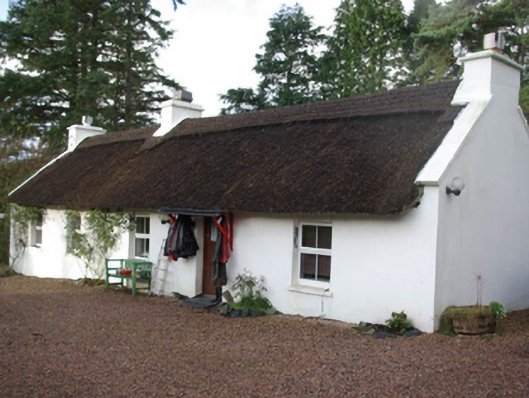
Detached five-bay single-storey thatched house, built c. 1830, having single-storey flat-roofed extension to the rear (north-west). Still inhabited. Pitched thatched roof with raised scalloped ridge with decorative ropework, raised rendered verges to gable ends (north-east and south-west) and having three rendered chimneystacks (one to either gable end and one offset to the south-west side of centre). Smooth rendered walls. Square headed window openings with replacement window fittings. Square headed door opening, offset to north-east side of centre, having timber sheet door. Modern timber canopy over door. Set back from road in own grounds close to the east shoreline of Lough Eske, and to the north-east of Donegal Town. Two-bay single-storey outbuilding to site (north-west) having pitched corrugated metal roof, rubbles tone walls and square-headed doorways with timber sheeted doors. House accessed along laneway from the north-east; laneway flanked along south side by rubble stone boundary wall. Gateway to roadway to the north-east comprising a pair of rubble stone gate piers (on square-plan) having a pair of wrought-iron gates.
This vernacular house retains some of its early character despite some alterations and extension. Modest in scale, it exhibits the simple and functional form of vernacular houses in Ireland. The thatched roof, although recently replaced, is an important element of this vernacular house, and adds to its visual appeal. Thatched roofs were, until recently, a ubiquitous feature of the rural landscape of Donegal but are now sadly becoming increasingly rare survivals. The form of this building (location of chimneystacks and door) suggests that this building is/was of the ‘direct entry’ type that is characteristic of the vernacular tradition in north-west Ireland, and that it has been extended to the south-west by two bays at some stage. This house represents a modest surviving example of a once common building type in the rural Irish countryside, and is a valuable addition to the vernacular heritage of County Donegal. The simple rubble stone outbuilding and the gateway to the north-west add to the setting and completes the context.
This does not grant access. Most recorded buildings are privately owned; view them only from public ground unless the owner allows entry.
Places near here
 Ardnamona Housepier/jetty · 1107 yd
 Benson's HillMountain / peak · 1208 yd
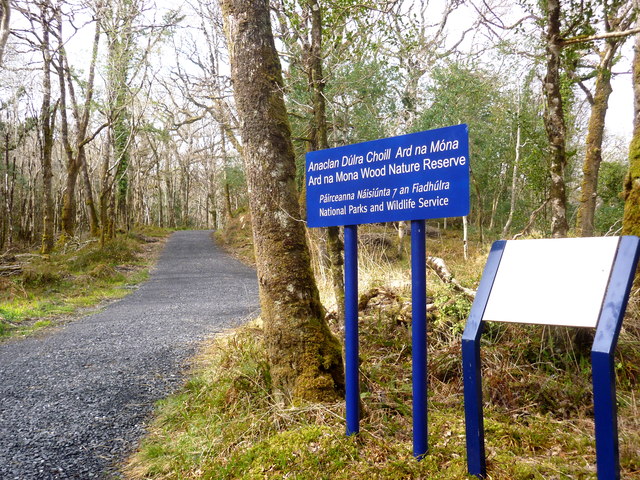 Ard na Mona WoodOfficial walking route · 1717 yd
 Edergole Bridgebridge · 1.3 mi
 Enclosure in ArdeevinEnclosure · 1.4 mi
 IndicatedBawn · 1.5 mi
 Old CastleCastle, tower house · 1.9 mi
 Banagher HillMountain / peak · 2.0 mi
 Ardnamona Nature ReserveNational nature reserve · 2.7 mi
 The Ring, Leghawny Stone EnclosureEnclosure · 3.0 mi
 Donegal Railway Heritage CentreMuseum · 4.8 mi
 Donegal CastleMuseum · 5.0 mi
Other information
Photo: National Inventory of Architectural Heritage · Website use allowed for educational or private purposes with source credit