What is recorded here
Holy well in Rathnaleugh: St Patrick drank from it and planted a yew rod that became a great tree shading the water until old age took the tree around 1838. The well itself has vanished beneath reclaimed marsh, leaving only a wet place beside a whitethorn and a graveyard remembered for the yew that is no longer there.
Reference to a venerable yew tree growing over the Yew Tree Well. The tree has decayed and rotted away by 1838 (Carrigan 1905, vol. 2, 139-40). A wet area around a whitethorn tree may indicate the site of the well. Church (LA027-004-) and well were dedicated to St Patrick. Situated in low-lying marshy area. No visible surface remains remain. According to local information this area was reclaimed.
Described by Carrigan as 'Rathnaleugh, according to Dr. Joyce, means the fort of the leamh, or marsh mallows. There was a church (LA027-004-) here which the old people called Kilclaena, that is, the bent or inclining church, or the church (in the townland) of Claenagh. In the Down Survey Books the name is written Kilklienagh. The church which must have been founded here in a very far-off age, has disappeared as completely as if it had never been. The churchyard (LA027-004001-) is almost on a level with the surrounding field, and preserves no trace of the fence that once enclosed it, there are some rude headstones. Locally the churchyard is best known as the 'Yew Tree Graveyard'. It is so called from a venerable yew tree (LA027-004004-) that grew, about 60 yards to the west, over the 'Yew Tree Well' (LA027-004003-). An ancient road (LA027-004004-) led from the Co. Tipperary, over a togher or causeway at this well, and thence through Rossmore, &c. St. Patrick once travelled along the road. When he came to the togher, being both weary and thirsty he sat down by the well to rest himself, and partook of its clear, pure waters. Ere resuming his journey he took a yew rod, which he had been carrying in his hand, and planted it in the bank beside the well. The rod took root and grew into a great tree which, after shading the Yew Tree Well for many centuries, at length decayed through old age, and rotted away completely about the year 1838' (Carrigan 1905, vol. 2, 139-40).
The above description is derived from the published 'Archaeological Inventory of County Laois' (Dublin Stationery Office, 1995) compiled by P. David Sweetman, Olive Alcock and Bernie Moran. In certain instances the entries have been revised and updated in the light of recent research.
Date of upload: 17 December 2007
Linked to Saint Brigid, the well was traditionally associated with healing and fertility rites. The yew tree, often symbolic of sacred and enduring sites, may have reinforced its spiritual significance in local folklore.
The monument record does not grant public access. Check the route and ask the landowner before entering private land.
- What survives
- Recorded monument
Places near here
 Burial Ground (Disused)Church · 5 yd
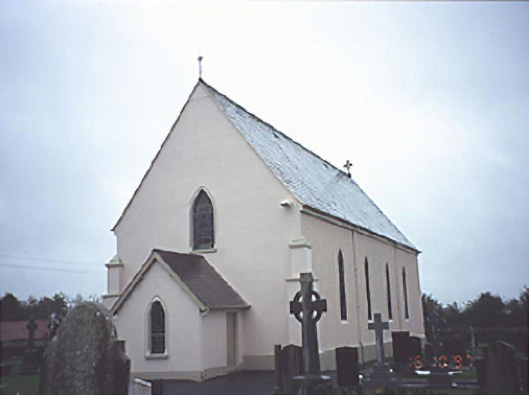 Catholic Church of the Assumptionchurch/chapel · 1360 yd
 Fairy fort / earthen ringfort in GarranmaconlyFairy fort / earthen ringfort · 1713 yd
 IndicatedChurch · 1.1 mi
 CastleCastle, unclassified · 1.3 mi
 Bawn in Castlefleming Stubber,garrisonBawn · 1.4 mi
 Carricknasrock WoodWood · 3.4 mi
 Black HillMountain / peak · 3.7 mi
 Clonmeen WoodWood · 4.4 mi
 Cnoc SeanrathaMemorial · 6.7 mi
 College HillMountain / peak · 8.3 mi
 DelaneyMemorial · 10 mi