What is recorded here
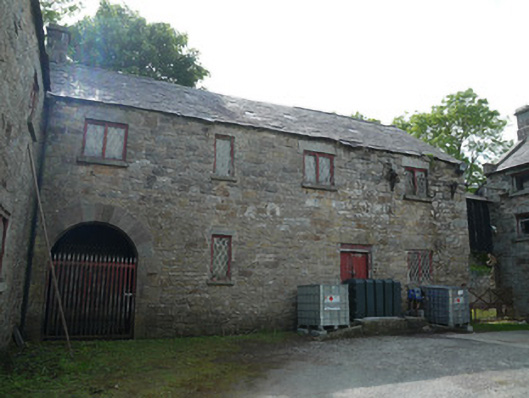
Derrylavan Mill in Derrylavan still has its water wheel behind an iron gate. You’d swear it had been caught trying to leave. After all those years going round without getting anywhere, even a wheel might start pricing a bicycle.
Four-bay two-storey corn mill with attic, built c.1840, having three-storey mill building and smithy attached to south. Single-storey with attic to rear due to sloped site. Pitched slate roof. Rubble stone walls with dressed stone quoins. Square-headed window openings with stone surrounds, lintels and sills, and having timber-framed windows with quarry glazing. Square-headed door opening having timber battened double-leaf door. Round-arch opening having tooled stone voussoirs to water-wheel opening, with wrought-iron gate. Water-wheel in situ. Attached to mill store to north with timber-clad extension having lean-to slate roof. Adjoining mill building, formerly in use as smithy, to south, having projecting gabled front (east) bays. Pitched slate roof. Stone walls. Square-headed openings having cut-stone lintels and sills. Timber-framed windows having quarry glazing. Square-headed door openings having timber battened double-leaf doors. Corn mill and adjoining building form western and southern boundaries to mill yard complex. Rubble stone wall to roadside boundary having stone gate piers and cast-iron entrance gates to front yard.
These former mill buildings form part of an interesting group of mill related structures associated with the Lough Fea Estate. It displays skilled stone masonry and, despite its disuse, retains much early fabric, including machinery and windows. Mills were vital structures in Irish society and important for the economic life of local communities. Together with its associated structures they form a physical reminder of their role and the industrial legacy of County Monaghan and adds interest to the rural landscape.
From the Buildings of Ireland (National Inventory of Architectural Heritage) record 41403120
This does not grant access. Most recorded buildings are privately owned; view them only from public ground unless the owner allows entry.
Places near here
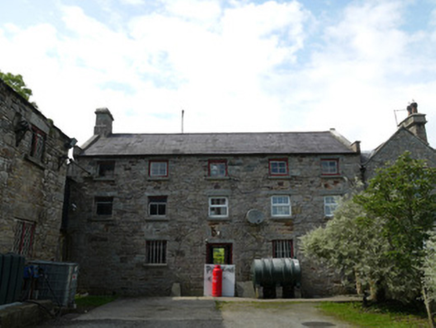 Derrylavan MillStore/warehouse · 29 yd
 Derrylavan MillMill manager's house · 35 ydIndicatedFairy fort / ringfort · 377 ydfrotFairy fort / earthen ringfort · 1207 yd
 European Beech1353 yd
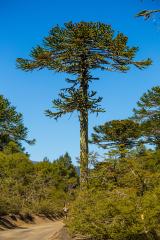 Monkey-puzzle1575 ydDrumerlough MoreMountain / peak · 2.8 mi
 Mannan Castle (in ruins)Castle, Anglo-Norman masonry castle · 3.6 miTobernagalliaghSpring · 3.8 miIn Memory of Our DadMemorial · 3.9 mi
 Fair of MuffMemorial · 6.0 mi
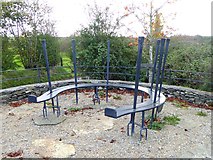 Fair of MuffVisitor information · 6.0 mi
Pictures: National Inventory of Architectural Heritage; Malene Thyssen, Wikimedia Commons · CC BY-SA 3.0; Vicente Fernández Rioja, Wikimedia Commons · CC BY-SA 4.0; Kieran Campbell, Geograph · CC BY-SA 2.0; Oliver Dixon, Geograph · CC BY-SA 2.0
More historic places in County Monaghan · All of County Monaghan
What do you know about this place?