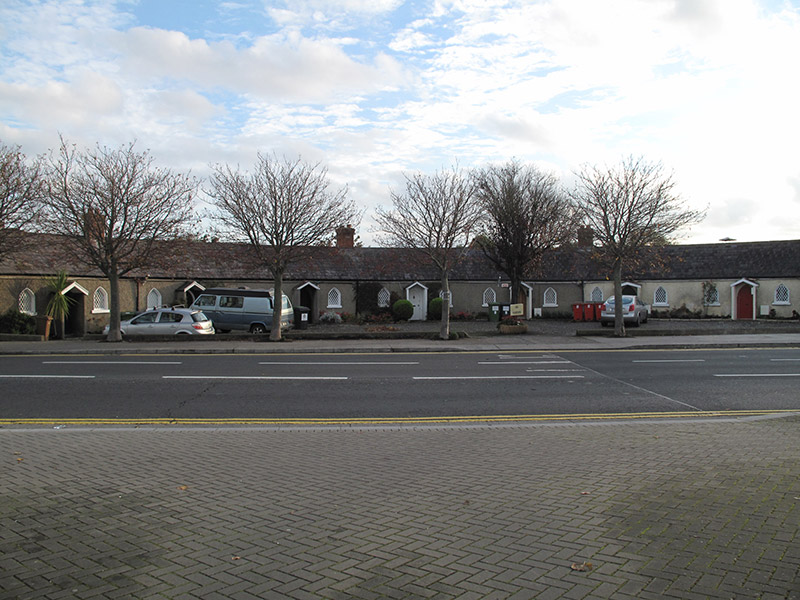
What is recorded here
Terrace of eight three-bay single-storey houses, built c. 1790, with gabled open porches to front (west) elevation, some having returns to rear, and southernmost having bowed projection with conical roof. Continuous hipped natural slate roof with red brick chimneystacks, smooth render eaves course, some recent rooflights and cast-iron rainwater goods. Roughcast rendered walls. Pointed arch window openings with raised render reveals, painted masonry sills and leaded timber-framed windows. Square-headed window openings to bow. Pointed arch door openings to porches to front with timber battened doors and limestone steps. Cobbled yard to front of houses with some trees, and with flower beds to front of each house. Laid out in crescent plan.
Laid out in a formal plan, this terrace retains its original form, and much fabric and character. The symmetrical façade of each house lends a pleasing sense of balance to the composition as a whole, with leaded windows and central porches subtly enlivening the façade. The scale and form of the terrace, now predominantly surrounded by larger buildings, makes it an interesting part of the streetscape. This well-composed terrace of workers' houses was built by Samuel Dick, a Governor of the Bank of Ireland and linen merchant who resided in the adjacent Violet Hill (later Edenmore, now St. Joseph’s Hospital). The house to the south end of the terrace once functioned as the village post office. After Dick’s death the rent of the cottages was endowed to the running of the charity school he built in the village and today seven of the cottages are still administered by the governors of Springdale National School. These cottages are representative of workers' housing constructed throughout the eighteenth and nineteenth centuries, providing both housing adjacent to the workplace as a means of attracting skilled workers and as a means of social control on the part of the owner.
This does not grant access. Most recorded buildings are privately owned; view them only from public ground unless the owner allows entry.
Places near here
 church/chapelchurch/chapel · 87 yd
 St Assam's ChurchRuins · 91 yd
 Ecclesiastical enclosure in Unknown TownlandEcclesiastical enclosure · 121 yd
 Windmill in Unknown TownlandWindmill · 381 yd
 All Saints Boundary WoodsWood · 762 yd
 St. Annes WoodsWood · 1044 yd
 Bull Island Nature ReserveVisitor information · 1137 yd
 Hermit's CaveMonument · 1184 yd
 Battle of ClontarfMajor battlefield · 1.4 mi
 Map of Baldoyle Industrial EstateVisitor information · 1.6 mi
 Clontarf War MemorialMemorial · 1.6 mi
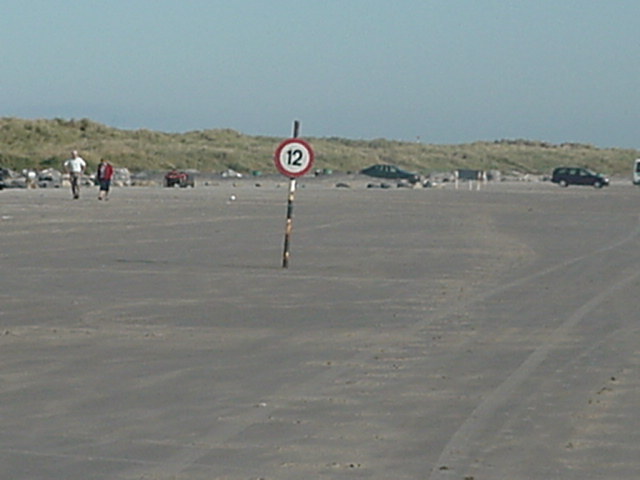 Dollymount StrandBeach / strand · 1.7 mi
Other information
Photo: National Inventory of Architectural Heritage · Website use allowed for educational or private purposes with source credit