Yarmouth Roads is a rare sixteenth-century merchant ship wreck off the Isle of Wight, probably built in the Mediterranean and perhaps the Spanish Santa Lucia, lost while carrying wool to Flanders in 1567. That name remains unproved. Four large hull pieces, two deck levels and goods from Italy, Spain, England and the…
Read the whole record
Yarmouth Roads is a rare sixteenth-century merchant ship wreck off the Isle of Wight, probably built in the Mediterranean and perhaps the Spanish Santa Lucia, lost while carrying wool to Flanders in 1567. That name remains unproved. Four large hull pieces, two deck levels and goods from Italy, Spain, England and the Low Countries survive beneath shallow moving sand. The wreck reveals trade and shipbuilding at the start of Atlantic expansion even though its crew and final moments remain unknown.
The vessel and voyage
The wreck was a heavily built merchant sailing ship about 30 to 32 metres long, large for the sixteenth century. Its smooth edge-to-edge hull planking, iron fastenings and inner supports point to Mediterranean construction. Italian pottery, possible Italian, Spanish or Low Countries copper-alloy scraps, and English or Low Countries pewter show that the people aboard used goods from several trading regions. A court petition records a Spanish ship called Santa Lucia carrying wool to Flanders when she was lost off Yarmouth in 1567. Because very few matching losses are known there, Santa Lucia is a strong possibility, but no inscription or dated timber has proved that the seabed wreck is her.
How it was lost
The hull came to rest on a shallow clay ledge in Yarmouth Roads. The bottom and keel disappeared, while sections of the sides and stern fell outward and survived in hollows beneath moving silt and sand. That pattern is consistent with a ship stranded and broken by current and weather, but no source records the exact cause for the unnamed wreck. If it is Santa Lucia, the 1567 petition says only that the ship perished off Yarmouth and that wool was salvaged. It does not establish whether a storm, navigation error, collision or hidden damage put her there. The separate bronze gun found east of Yarmouth Harbour dates after 1580 and does not belong to this wreck.
Deaths and survival
No reliable death total, survivor list, captain or crew member has been connected to the wreck. The Santa Lucia papers name merchant Antonio de Guaras because he petitioned for the return of salvaged wool, but they do not prove that this is his ship or say what happened to the people aboard. Salvaged cargo shows that somebody reached or worked the loss site; it does not show whether the original crew escaped. Until the identity is settled or another court paper appears, a story of drowning or rescue would be invented. The named modern people are the volunteer researchers who found the wreck during the Isle of Wight Maritime Heritage Project.
What remains
Volunteers found a sliver of timber in 1984 while searching for the source of Roman pottery brought up by fishing nets. Excavation revealed four substantial hull pieces, including part of the port side with two deck levels and collapsed stern material. The wreck lies in only five to six metres of water, where strong current and an eroding seabed expose and cover it. Finds include pewter plates and spoons, almost complete coloured pottery jugs, copper-alloy scraps, a bronze mortar resembling pieces from Spanish Armada wrecks and three stone cannonballs. Sandbags placed after the 1980s work still protect parts, though some have torn. Later surveys show only limited timber above the seabed. Samples taken in 2015 and 2016 support continuing study of the wood.
Why it mattered
Very few working merchant hulls survive from this period. Yarmouth Roads can show how Mediterranean builders selected and joined timber, and how a large ship carried people and goods between southern Europe, England and the Low Countries. Its mixture of objects makes international trade visible without needing a famous battle or treasure cargo. The wreck also has unusual local importance: it was discovered by Isle of Wight volunteers during a planned seabed search and helped drive the creation of the local maritime archaeology group that still cares for it. Recent tree study connects one small protected place off Yarmouth with questions about Iberian forests, imperial shipbuilding and the pressure large fleets placed on woodland.
Sources for this account
Sources checked 2026-08-15.
 Yarmouth PierListed building · 453 yd
 Bugle HotelListed building · 511 yd
 Yarmouth CastleScheduled monument · 521 yd
 The George HotelListed building · 543 yd
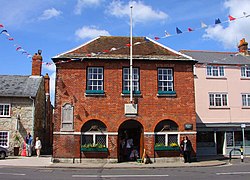 Yarmouth Town HallMuseum · 545 yd
 The Town HallListed building · 546 yd
 Mill CopseWood · 1239 yd
 Fort Victoria Country ParkMuseum · 1.2 mi
 Boundary stone in Bouldnor CopseMonument or public art · 1.7 mi
 Bouldnor CliffCliff · 2.0 mi
 Colwell BayBeach / strand · 2.0 mi
 Hummet CopseWood · 2.5 mi

What do you know about this place?Tap to add a comment or ask a question