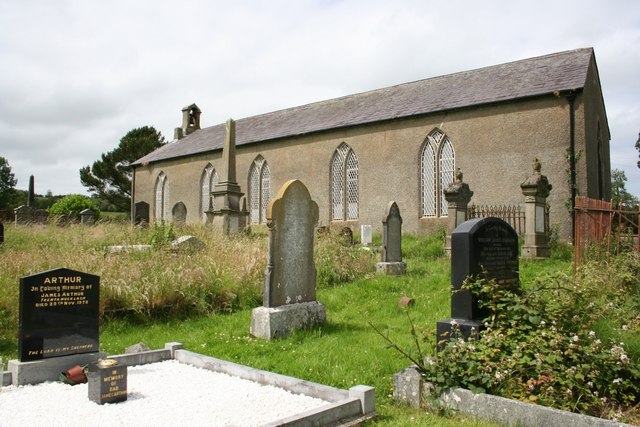
What is recorded here
Freestanding five-bay Church of Ireland church, dated 1627, renovated c. 1830, and containing medieval fabric. Pitched slate roof with projecting ashlar sandstone eaves course, replacement rainwater goods, having ashlar bellcote to west. Roughcast rendered walls with batter to base of east wall, mediaeval fragments above and to both sides of door include a plaque over inscribed ‘AEDIF CVRA/THO BRVCE/RECTOR HVOVS ECCLAESIA/1627,’ and beside it, a tablet of comparable size bearing a false-relief coat-of-arms surmounted by the initials TB. Carved head and two hood-mould stops, comprising relief carvings of lion-like creatures with vine leaf enrichment, set on either side of door. Pointed-arch headed, Y-tracery window openings with ashlar sandstone surrounds, crown glass quarries in cast-iron frames with coloured glass margin lights, three-light Decorated Gothic east window with block-and-start sandstone surrounds and stained glass. Pointed-arch headed door opening with ashlar sandstone block-and-start surrounds, recessed timber sheeted double doors. Interior with timber king post roof trusses, timber boarding to coved ceiling, timber pews, timber panelled reredos, carved limestone pulpit and lectern, marble baptismal font and war memorials. Set in churchyard with memorial stones, rubble stone boundary wall on two sides with wrought-iron gates with ashlar copings, hedging to remainder. Opposite church door, forming part of the pathway revetment, is a “seventeenth century memorial flanked by two sections of a horizontal hood-mould which as the profiles indicate, belong to the same window as the stops. These fragments are fifteenth century in character and undoubtedly belonged to the medieval parish church” (Lacy 1983).
A simple hall type parish church whose late medieval origins are only discernable on close examination. Dated to 1627, it incorporates fabric dating back to the fifteenth century. It is given added context and interest by the large collection of gravemarkers and post-medieval tombstones in the surrounding churchyard. The church continues to provide an important religious and social focus for members of the surrounding community.
This does not grant access. Most recorded buildings are privately owned; view them only from public ground unless the owner allows entry.
Places near here
 Taughboyne ChurchChurch · 9 yd
 IndicatedHoly well · 59 yd
 Corn Millmill (water) · 103 yd
 Castlethird Stone RingfortFairy fort / stone ringfort · 940 yd
 CastleCastle, unclassified · 1.9 mi
 Emmery Celtic CrossWood · 3.1 mi
 Mongavlin CastleHouse, fortified house · 3.9 mi
 Gortmonly HillMountain / peak · 4.6 mi
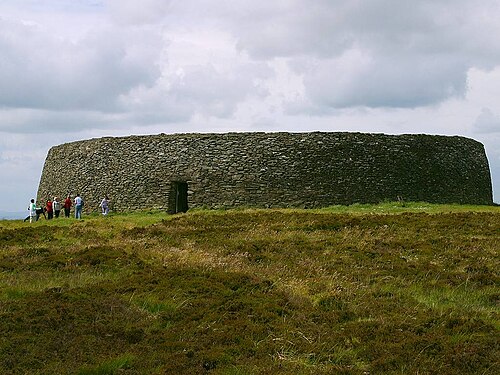 Grianán of AileachFairy fort / stone ringfort · 4.8 mi
 Greenan MountainMountain / peak · 4.8 mi
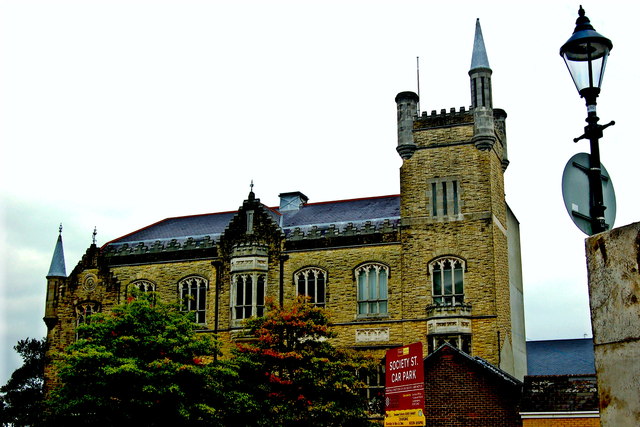 Apprentice Boys of Derry and Siege MuseumMuseum · 6.5 mi
 Diamond War MemorialMemorial · 6.5 mi
Other information
Photo: Robert Graham · Creative Commons Attribution-ShareAlike 2.0