What is recorded here
Half-hidden under lichen on a Kerry hillside, a fractured sandstone boulder still holds two cup-and-ring marks joined by a honeycomb of grooves. The stone leans into a field boundary, facing the Kealduff River valley and rugged western mountains. Whoever cut those marks worked a small corner of a huge slope, making a pattern that rain, wind and time have barely erased.
The decorated surface of this boulder, 2.8m x 1.9m, slopes steeply upwards to NE. It is very badly weathered and covered with lichen. Two cup-and-ring motifs are joined by a network of curving grooves, one of which is .84m long. Nearby, an irregular oval area formed by a gapped groove encloses two cupmarks, one with radial groove. The remainder of the decoration consists of curved lines and a few simple cupmarks and pockmarks. The boulder is incorporated into the boundary of a small field (Finlay 1973, 86-7).
See attached drawing of rock art taken from O'Sullivan and Sheehan 1996, Fig. 54 (g)
The above description is derived from A. O'Sullivan and J. Sheehan (compilers), 'The Iveragh peninsula: an archaeological survey of South Kerry'. Cork University Press (1996), no. 320. In certain instances the entries have been revised and updated in the light of recent research.
In upland heath pasture, on a steep portion of a NE-facing slope (172m OD), extensive views afforded overlooking Kealduff River valley and Lough Brin to NE. Directly overlooked by steep, rugged mountain landscape to W. Incorporated into the drystone boundary of a small field, a smooth and fractured sandstone rock face (dims. 2.95m N-S; 2.05m E-W; H 1.6m) with a roughly rectangular decorated surface (dims. 0.9m N-S; 0.9m E-W) having an NE-facing aspect. The decoration is confined to the NW-quadrant of rock face and is defined by a distinct rock fracture (long axis E-W). There are approximately ten complete motifs of which there are two distinct cup-and-one ringmarks (total diam. 12cm) at NW-side. These have cupmarks (diam. 4cm; D 4mm) and a ring (Wth 1cm; D 2mm). A small network of lines appear to form a honeycomb pattern between the two cup-and-rings and continues to SE of these motifs. A curvilinear radial groove (Wth 1cm; D 3mm) extends across surface of stone from the honeycomb pattern, to S. A semi-circle of pickmarks is located at edge of stone, to N of the two cup-and-ringmarks. A pair of cupmarks to SW are joined by a short linear groove and enclosed by an oval ring (D 3mm) of pickmarks, which is open to WSW.
Compiled by: Alison McQueen and Vera Rahilly
Date of upload: 8 March 2017
Likely dating to the Neolithic or Bronze Age, this rock art may have had ritual or symbolic significance, possibly linked to territorial markers or spiritual beliefs. The cup-and-ring motifs and grooves are commonly found in prehistoric contexts across Atlantic Europe.
The monument record does not grant public access. Check the route and ask the landowner before entering private land.
- What survives
- Recorded monument
Places near here
 An Cnoc RiabhachMountain / peak · 1103 yd
 Megalithic structure in DerreenyMegalithic structure · 1109 yd
 Mass-rock in DerreenyMass-rock · 1438 yd
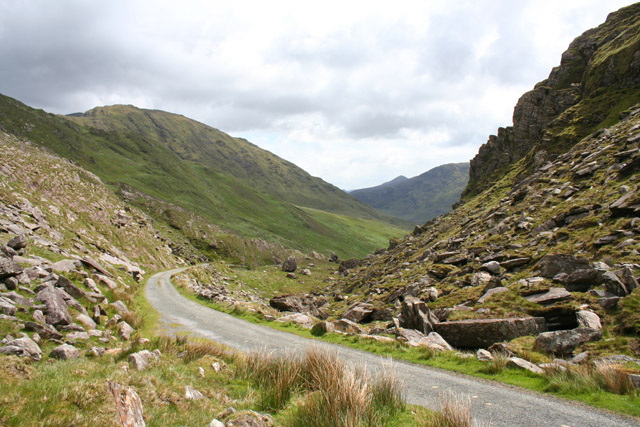 Ballaghbeama GapViewpoint · 1.0 mi
 Stumpa Dúloigh SW TopMountain / peak · 1.6 mi
 CarrauntoohilMountain / peak · 5.3 mi
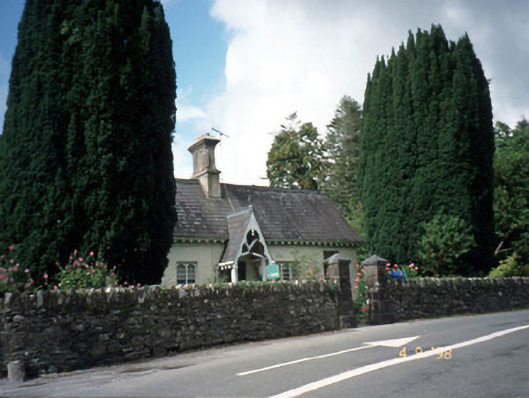 Blackwater Cottagehouse · 5.5 mi
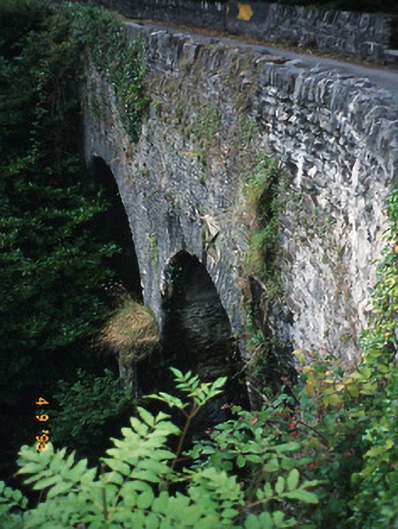 Blackwater Bridgebridge · 5.5 mi
 Dromore CastleCastle · 6.0 mi
 Cappanacush Castle (ruins)Castle · 6.4 mi
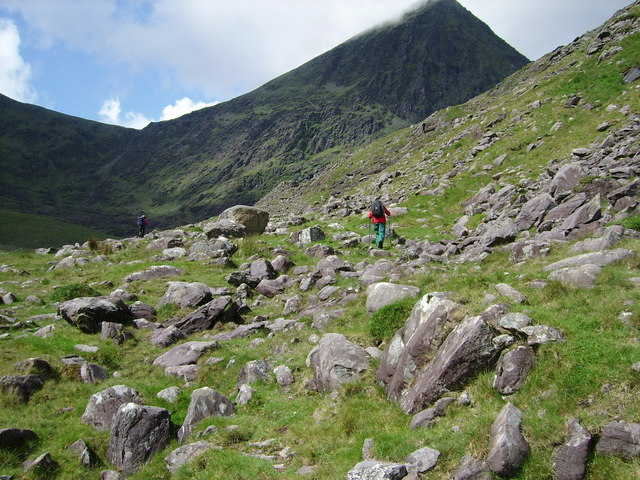 Devil's Ladder RouteWalking route · 6.4 mi
 Crash site of USAAF DakotaHeritage attraction · 6.5 mi