What is recorded here
Rock art in Derrynablaha carries eight cupmarks, a cup-and-ring and a curved line across a weathered sandstone face. The marks sit on a rounded boulder in rough Kerry pasture, small enough to touch but old enough to belong before written memory. A person may have knelt there in rain or sunlight, pressing a tool into stone while the Kealduff River tributaries moved unseen below. The cups still hold darkness, waiting for a finger to enter them and complete the gesture.
This weathered, lichen-covered, rounded boulder measures 1.4m x 1.1m x 1m high. On its downward sloping SW face are eight simple cupmarks, a cup-and-radial groove, a cup-and-ring and a short curved line (Finlay 1973, 86).
See attached drawing of rock art taken from O'Sullivan and Sheehan 1996, Fig. 54 (e)
The above description is derived from A. O'Sullivan and J. Sheehan (compilers), 'The Iveragh peninsula: an archaeological survey of South Kerry'. Cork University Press (1996), no. 316. In certain instances the entries have been revised and updated in the light of recent research.
Date of upload: 28 July 2013
In rough pasture, at top of grass covered knoll (105m OD); recent trackway cut around base of knoll to S. Tributaries of Kealduff River to N and S. Very rough and fractured, sandstone boulder (dims. 1.43m N-S; 1.08m E-W; H 1.0m) with a sub-rectangular decorated surface (dims. 0.6m N-S; 0.55m E-W) having an SW-facing aspect. The motifs consist of seven cupmarks of varying sizes with very distinct examples (diam. 3.5cm; D 11mm) and some shallower yet still obvious examples (diam. 3cm; D 5mm); one half cupmark (Wth 4cm; D 5mm); one cup-and-one ring (total diam. c. 9cm), having a cupmark (diam. 3.5cm; D 4mm) and ring (Wth 1cm; D 2mm). The cupmarks are distinct whereas the cup-and-ringmark is faint. A larger boulder is located c. 3m to SSE of the rock art example.
Compiled by: Alison McQueen and Vera Rahilly
Date of upload: 8 March 2017
Likely dating to the Neolithic or Bronze Age, this rock art may have had ritual or symbolic significance, possibly linked to water or landscape features. Cup-and-ring motifs are commonly associated with ceremonial or territorial marking in prehistoric Atlantic Europe.
The monument record does not grant public access. Check the route and ask the landowner before entering private land.
- What survives
- Recorded monument
Places near here
 Megalithic structure in DerreenyMegalithic structure · 709 yd
 Mass-rock in DerreenyMass-rock · 928 yd
 An Cnoc RiabhachMountain / peak · 1650 yd
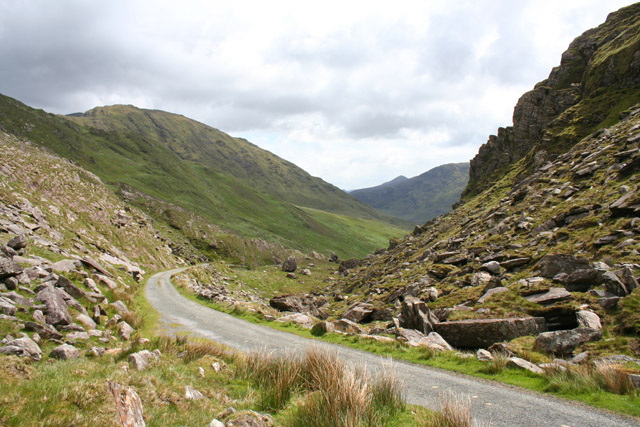 Ballaghbeama GapViewpoint · 1.1 mi
 Stumpa Dúloigh SW TopMountain / peak · 1.3 mi
 CarrauntoohilMountain / peak · 5.1 mi
 Blackwater Cottagehouse · 5.6 mi
 Blackwater Bridgebridge · 5.6 mi
 Devil's Ladder RouteWalking route · 6.1 mi
 Crash site of USAAF DakotaHeritage attraction · 6.2 mi
 Cappanacush Castle (ruins)Castle · 6.3 mi
 Coss StrandBeach / strand · 6.6 mi