What is recorded here
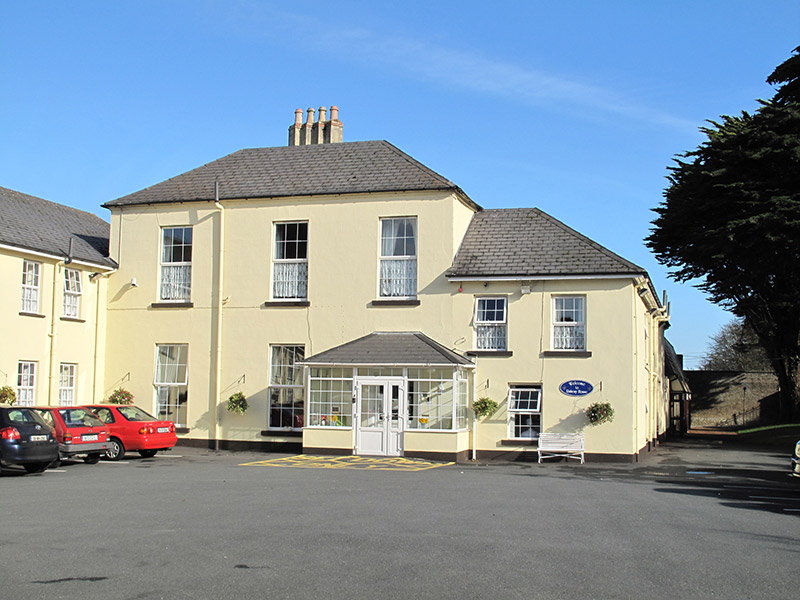
Detached three-bay two-storey house, built c. 1780, having recent porch to south-east corner, lower multiple-bay two-storey block to south and multiple-bay two-storey block of c. 1950 to north. Further blocks to east. Hipped skirt artificial slate roofs to early and south blocks and pitched to north block, with rendered eaves course to early block. Stack of four offset rendered and brick chimneys to middle of roof of earliest block. Rendered ruled-and-lined walls with painted plinths. Square-headed window openings with stone sills to early and southern blocks and concrete to northern, with replacement uPVC windows. High brick boundary wall to east, roughcast rendered walls to road (south), with gateway and gate lodge. Gateway, missing gates, comprises central vehicular entrance flanked by cut granite piers and decorative curving cast-iron railings atop cut granite plinth walls, with similar terminating piers. Piers are square-plan with panels to front face, plinths, cornices and caps. Cast-iron wheel-guards to central piers. L-plan three-bay gate lodge has hipped artificial slate roof with rendered chimneystack, rendered walls and replacement windows and doors.
Raheny House (formerly Ballyhoy/The Cottage) was occupied by the Seagrave family from the late eighteenth century, and later by John D’Arcy, who became Lord Mayor of Dublin in 1852. Rev. James Barlow, Vice Provost of Trinity College, lived here from 1865 until 1914, and Frank Gallagher, first editor of 'The Irish Press' was the last private owner. It was purchased in 1986 by An Garda Síochána and has since been altered for use as a retirement home. The house is a relatively modest middle-sized dwelling. Its offset chimneystack contrasts pleasingly with plain rendered walls. The accompanying gateway provides context to the building and is of high-quality stone masonry with good cast-iron railings, and the associated gate lodge adds further interest and context.
This does not grant access. Most recorded buildings are privately owned; view them only from public ground unless the owner allows entry.
Places near here
 All Saints' Churchchurch/chapel · 118 yd
 milestone/milepostmilestone/milepost · 161 yd
 Ecclesiastical enclosure in Unknown TownlandEcclesiastical enclosure · 465 yd
 All Saints Boundary WoodsWood · 600 yd
 Millennium ArboretumWood · 709 yd
 Windmill in Unknown TownlandWindmill · 976 yd
 Hermit's CaveMonument · 1245 yd
 Bull Island Nature ReserveVisitor information · 1401 yd
 Battle of ClontarfMajor battlefield · 1.2 mi
 Clontarf War MemorialMemorial · 1.3 mi
 Clontarf Castle HotelVisitor information · 1.5 mi
 Stardust MemorialMemorial · 1.6 mi
Other information
Photo: National Inventory of Architectural Heritage · Website use allowed for educational or private purposes with source credit