What is recorded here
Kingsmountain once held a burial chamber beneath an earth mound, but a land owner removed the mound and scattered the soil across a field, leaving only the decorated stone behind. That surviving rectangle still displays six spirals cut into Lower Carboniferous sandstone, some turning clockwise and others anti-clockwise along its broad face. The chamber bones are gone, the original orientation is lost, and the stone may even stand inverted, yet its swirling marks still point toward the people who shaped them before the field swallowed the rest.
Described by Eogan (2000) as follows: ‘According to Conwell (1873, 14) a mound existed at this site up to a few years previously when it was removed by the land owner and the material spread over the field as top dressing. This implies that the mound was of earth. The stone was in the centre of the mound and it is stated that it covered a chamber that was constructed from flag stones; these were smaller than the decorated stone. However, the size and shape of the decorated stone suggests that it was an orthostat rather than a capstone.
To-day the decorated surface faces in a southerly direction, but as the stone has been re-erected, its original orientation is not known, nor can it be assumed that it was re-erected the correct way up. The chamber contained bones “all of which have disappeared”. The stone, rectangular in cross-section, is slightly over 2m in height and measures 0.85m in length at the base. The material is sandstone, the surface being uneven and flaked in places. Professor Phillips reports that “this stone is composed of well sorted cross-bedded quartz sandstone with a few circular calcareous concretions. This rock is of Lower Carboniferous age and could have been quarried in the Oldcastle area to the west.” The decoration is confined to the lower half of one of the two broad faces where it occupies virtually the entire surface. The motifs consist almost entirely of spirals. These are six in number. The bottom two are anti-clockwise; the remainder are clockwise. There are three main spirals and these extend diagonally along the face from top to bottom. The uppermost spiral is of four turns but portion of the top is now missing. At its base there are two sagging lines; perhaps these are all that remain of two further members. To its upper left there are traces of a curvilinear motif. The middle spiral consists of seven turns. The bottom example has five turns. It has been damaged due to the removal of part of the stone's surface, especially on the right hand side. To the left of the central spiral there are three further spirals, but smaller and not so well preserved. That on the top has four turns; the middle has three and the bottom possibly five. To the bottom right of the large uppermost spiral there are two further lines. These are parallel and almost vertical. Between the outermost one and the edge there appears to be same slight depressions, possibly pickmarks.’ (Moore 1987, no. 26; Herity 1974, 244; Shee Twohig 1981, 224-5; Eogan 2000, 4-6)
Compiled by: Paul Walsh
Date of upload: 21 April 2015
Passage tomb, likely Neolithic in date. Its significance lies in the reported presence of art, which is rare and valuable for understanding symbolic expression in early Irish prehistory.
The monument record does not grant public access. Check the route and ask the landowner before entering private land.
- What survives
- Recorded monument
Places near here
 EnclosureEnclosure, large enclosure · 1218 yd
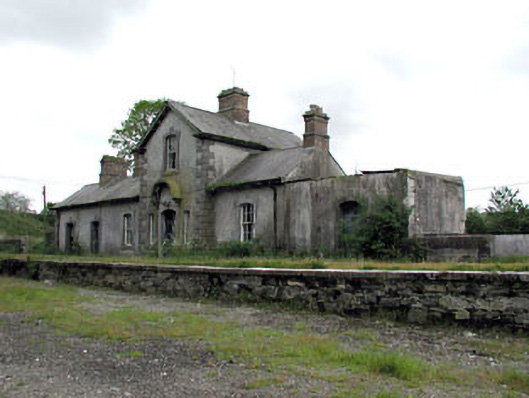 Virginia Road Railway Stationrailway station · 1.1 mi
 post boxpost box · 1.1 mi
 CastleCastle, motte and bailey · 1.1 mi
 IndicatedFairy fort / earthen ringfort · 1.2 mi
 Ballyhist WoodWood · 1.3 mi
 Balgree MoteCastle, motte · 1.5 mi
 Oliver Plunkett memorialMemorial · 2.0 mi
 Drumlerry WetlandForest · 2.1 mi
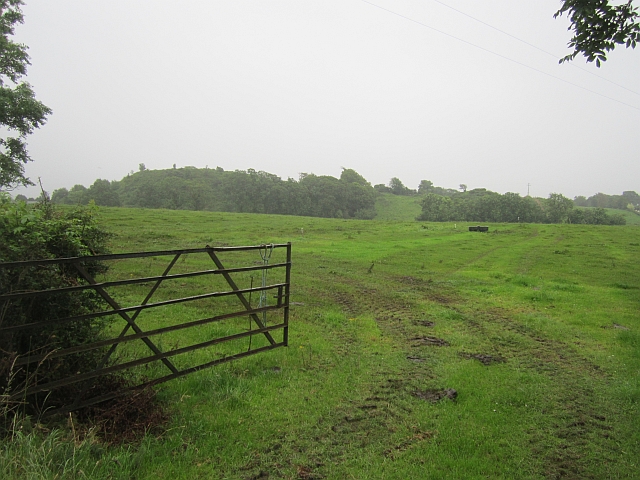 IslandMountain / peak · 2.5 mi
 Stony IslandIslet · 2.8 mi
 Ryefield IslandIslet · 2.9 mi