
What is recorded here
Multiple-bay vault and landscaped cemetery feature, built c. 1840. Circular street of vaults accessed by sunken channel; linear street sunken to centre; surface laid out with funerary monuments in concentric circles. Vault walling in roughly-hewn squared uncoursed limestone with cement ribbon pointing. Series of square-headed entrances having brown brick jambs and granite lintels inscribed with family names, four-panel cast-iron doors with circular ventilation openings and fixed numerical identifiers, some with additional plaques. Main circle accessed at north and south by stone bridge crossing to central section, having steps to sunken channel at either side. Bridge parapets of ashlar granite having moulded granite copings, curved to square-plan stone piers; granite flagged deck and flooring to central vault. Central vaults accessed by flights of fifteen granite steps at each end. Earth and pea gravel flooring to outer channel. Circle has wide granite perimeter coping supporting funerary monuments over each vault. Grassed inner circle, planted with yew trees and variety of funerary monuments.
The O'Connell Circle is an original vault and landscape feature laid out to designs by Glasnevin Cemetery architect Patrick Byrne (1782-1864) about 1840. Each vault measured 8 ft x 8 ft and there were strict regulations about the type of monument or tomb that could be permitted within the circle, which was intended to be the showpiece of the New Ground, for prestige burials. The vault was the temporary burial place of the cemetery's founder, Daniel O’Connell, lawyer, prominent politician and champion of Catholic rights, who had campaigned for a non-denominational burial site in the city. O'Connell died in Italy in 1847. According to his dying wish, his heart was buried in Rome and his body at Glasnevin, in the O’Connell Circle. However, in 1869, his remains were exhumed and reinterred in the crypt beneath the Irish Round Tower. The vault has strong architectural and landscape qualities, sitting firmly within a tradition of landscaped non-denominational garden cemeteries that had become widespread throughout Europe in the nineteenth century, following the example of Père Lachaise in Paris. It is carefully conceived to achieve visual continuity with the surrounding setting when viewed from across the cemetery, marked by a cluster of yew trees that frames the central passage. It forms part of a coherent grouping of cemetery features at Glasnevin Cemetery, formerly known as Prospect Cemetery, which ranks among Europe's most noted civic cemeteries.
From the Buildings of Ireland (National Inventory of Architectural Heritage) record 50130071
This does not grant access. Most recorded buildings are privately owned; view them only from public ground unless the owner allows entry.
Places near here
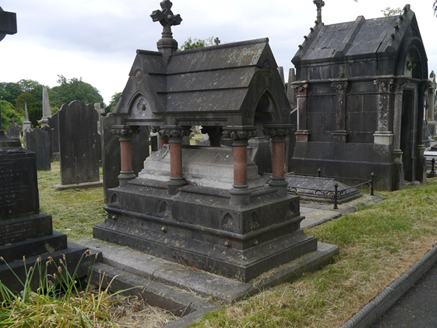 Charles McGauran MonumentGrave monument · 64 yd
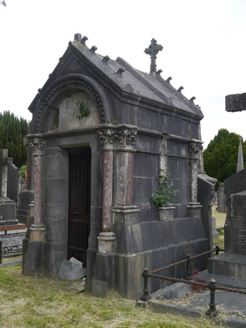 Keogh MonumentGrave monument · 69 yd
 Glasnevin CemeteryHistoric cemetery · 144 yd
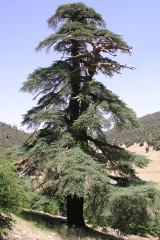 Atlas Cedar228 yd
 National Botanic GardensHeritage attraction · 264 ydShVisitor information · 298 ydRepublican plotMemorial · 299 yd
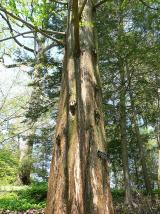 Dawn Redwood299 yd
 Michael CollinsMemorial · 368 yd
 Glasnevin cemetery Ireland's necropolisVisitor information · 488 ydBurial in Unknown TownlandBurial · 558 ydSettlement cluster in Unknown TownlandSettlement cluster · 636 yd
Pictures: National Inventory of Architectural Heritage; William Murphy from Dublin, Ireland, Wikimedia Commons · CC BY-SA 2.0; Nikos D. Karabelas, Wikimedia Commons · CC BY 4.0; Maker named on the Wikimedia Commons picture page · CC BY-SA 3.0; Gareth James, Geograph · CC BY-SA 2.0
More historic places in County Dublin · All of County Dublin
What do you know about this place?