What is recorded here
Martello Tower No. 11 rose at Sandycove Point in 1804 to guard Scotsman's Bay with five heavy guns and two mortars. Its squat granite body hid a murder hole, narrow stairs and a roof deck built for lethal fire. Years later Joyce placed Stephen and Dedalus inside that same chamber, turning a military warning into a birth scene. The tower still stands where iron tracks and gun loops wait beneath a vaulted ceiling, bridging wartime fear and literary life.
Sandycove Martello Tower No. 11 (Kerrigan 1995, 17), situated on a raised area at Sandycove Point overlooking Scotsman's Bay. According to Kerrigan (1995, 168) construction of the Dublin area Martello Towers and their batteries commenced in 1804 under the supervision of Colonel Benjamin Fisher of the Royal Engineers and by December 1805 all towers were armed and complete. Kerrigan (ibid., 170) recorded that; ‘The towers and batteries south of Dublin are numbered from 1 to 16, but there were only fourteen towers, as at two locations there were batteries only, while several of the towers were close to adjacent batteries’. A Martello tower known as Joyce's Tower because it is mentioned in Ulysses (Turner 1983, 93). It is a squat granite built circular tower. A doorway in the SSW leads into the ground floor that formerly stored the magazines and artillery. The door is defended by a murder hole. The Round Room on the first floor is accessible from a narrow stairs. It has a vaulted roof and a fireplace in the East. There is a door in the W that provides access to the roof where there is a circular gun deck with metal tracks and a central surround. There are offset recesses along the wall that allow access to gun loops.
Martello Tower described by Kerrigan as; 'Sandycove tower, no. 11, similar in basic design to those at
Bullock and Seapoint, is now the James Joyce Museum, the tower is the setting for the opening chapter of Ulysses. The battery here is a short distance from the Martello, on a promontory forming the eastern
end of Scotsman's Bay; there were five 24-pounders here mounted on traversing platforms and two 10-inch mortars'.
See attached plan of Sandycove Martello Tower No. 11 courtesy of the Irish Military Archives - Archival Reference Code: IE/MA/MPD/AD119456-007
See attached Taylor's Map showing the location of the Martello Tower and Battery.
Taylor, J. 1816 Taylor's map of the environs of Dublin: extending 10 to 14 miles from the castle, by actual survey, on a scale of 2 inches to one mile.
Photo ©YvonneM https://en.wikipedia.org/wiki/James_Joyce_Tower_and_Museum#/media/File:James_Joyce_Tower_01.JPG
DU023-019----_03 Patrick Healy Collection, https://hdl.handle.net/10599/1654, © South Dublin Libraries, Local Studies Collection, County Library, Town Centre, Tallaght, Dublin 24
Compiled by: Geraldine Stout and Padraig Clancy
Revised by: Caimin O'Brien
Date of revised upload: 23 January 2023
The monument record does not grant public access. Check the route and ask the landowner before entering private land.
- What survives
- Recorded monument
Places near here
 James Joyce Tower and MuseumMuseum · 2 yd
 Sandycove BeachBeach / strand · 64 yd
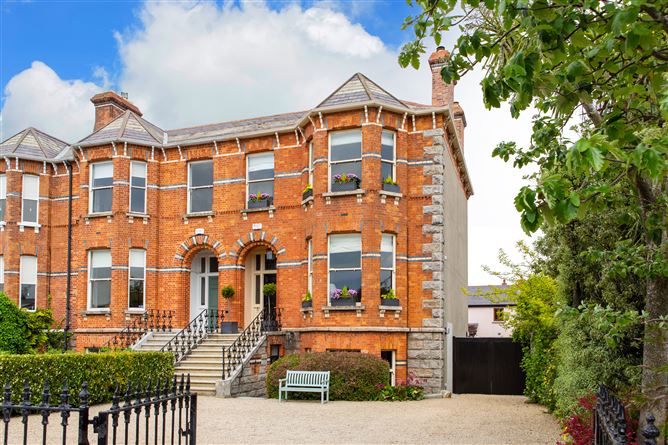 Sandycove BatteryBattery · 91 yd
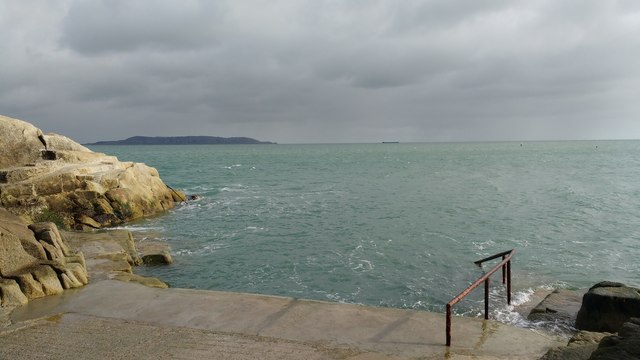 Forty FootHeritage attraction · 101 yd
 Druids AltarMegalithic structure · 490 yd
 Geographic PointerViewpoint · 1248 yd
 Site of CastleCastle, unclassified · 1334 yd
 Indicated as Dalkey LodgeHouse, 16th/17th century · 1379 yd
 Church in DalkeyChurch · 1404 yd
 Castle (in ruins)Castle, tower house · 1405 yd
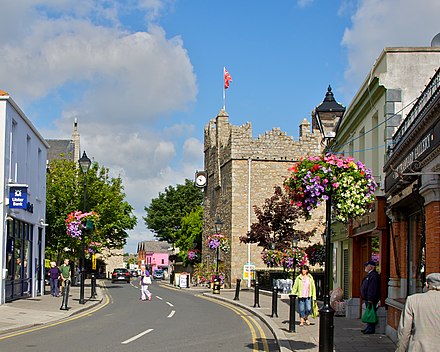 Dalkey Heritage CentreVisitor information · 1421 yd
 Christ the KingMemorial · 1477 yd