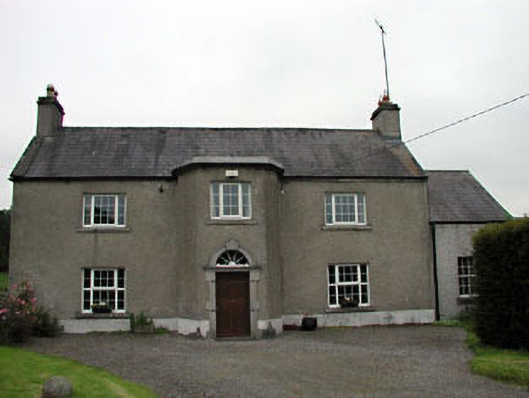
What is recorded here
Detached three-bay two-storey house, c.1760, on a symmetrical plan with single-bay two-storey flat-roofed projecting entrance bay to centre on a polygonal plan having round-headed door opening and originally with tripartite window openings to flanking bays. Reroofed and extended, c.1840, comprising single-bay single-storey end bay to south-west. Refenestrated, c.1995. Gable-ended roofs. Replacement slate, c.1840. Clay ridge tiles. Rendered chimney stacks. Rendered coping to gables. Cast-iron rainwater goods on eaves course. Flat-roof to projecting entrance bay. Mineral felt. Roughcast walls. Unpainted. Square-headed window openings. Cut-stone sills. Replacement uPVC casement windows, c.1995. Early 6/6 timber sash window to end bay. Round-headed door opening. Cut-stone Gibbsian surround. Replacement timber panelled door, c.1995. Spoked fanlight. Set back from road in own landscaped grounds. Gravel forecourt to front.Gateway, c.1840, to north-west comprising pair of piers with wrought iron double gates.
Lilac Hall is a fine example of an late eighteenth-century Georgian farm house that retains some of its original character. Built on a symmetrical plan and with reserved detailing, the entrance (north-west) front is dominated by the unusual polygonal entrance bay that incorporates a fine cut-stone Gibbsian doorcase. The evolution of the house and the change of tastes is evident in the alteration of the roof in the mid nineteenth century and also dating from this period is the fenestration to the end bay, the earliest surviving fittings in the house. The house is attractively set in its own grounds and is approached by a pleasant avenue. The gateway to north-west is also a fine example of early surviving iron work.
This does not grant access. Most recorded buildings are privately owned; view them only from public ground unless the owner allows entry.
Places near here
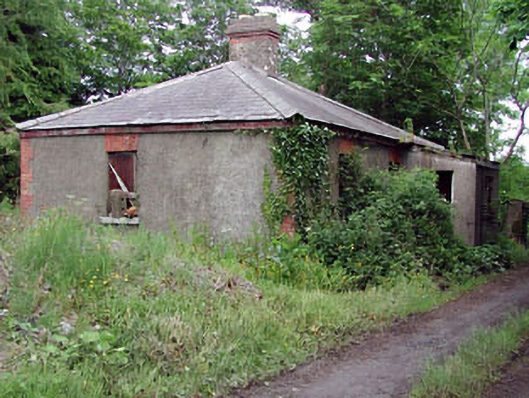 Rathmoregate lodge · 581 yd
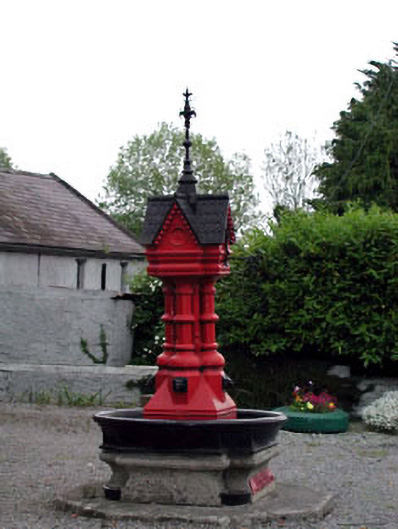 Tickell Memorial Fountainfountain · 958 yd
 Cross in Rathmore WestCross · 1061 yd
 MoatEnclosure · 1121 yd
 Rathmore MoatCastle, motte and bailey · 1160 yd
 CastleCastle, unclassified · 1.5 mi
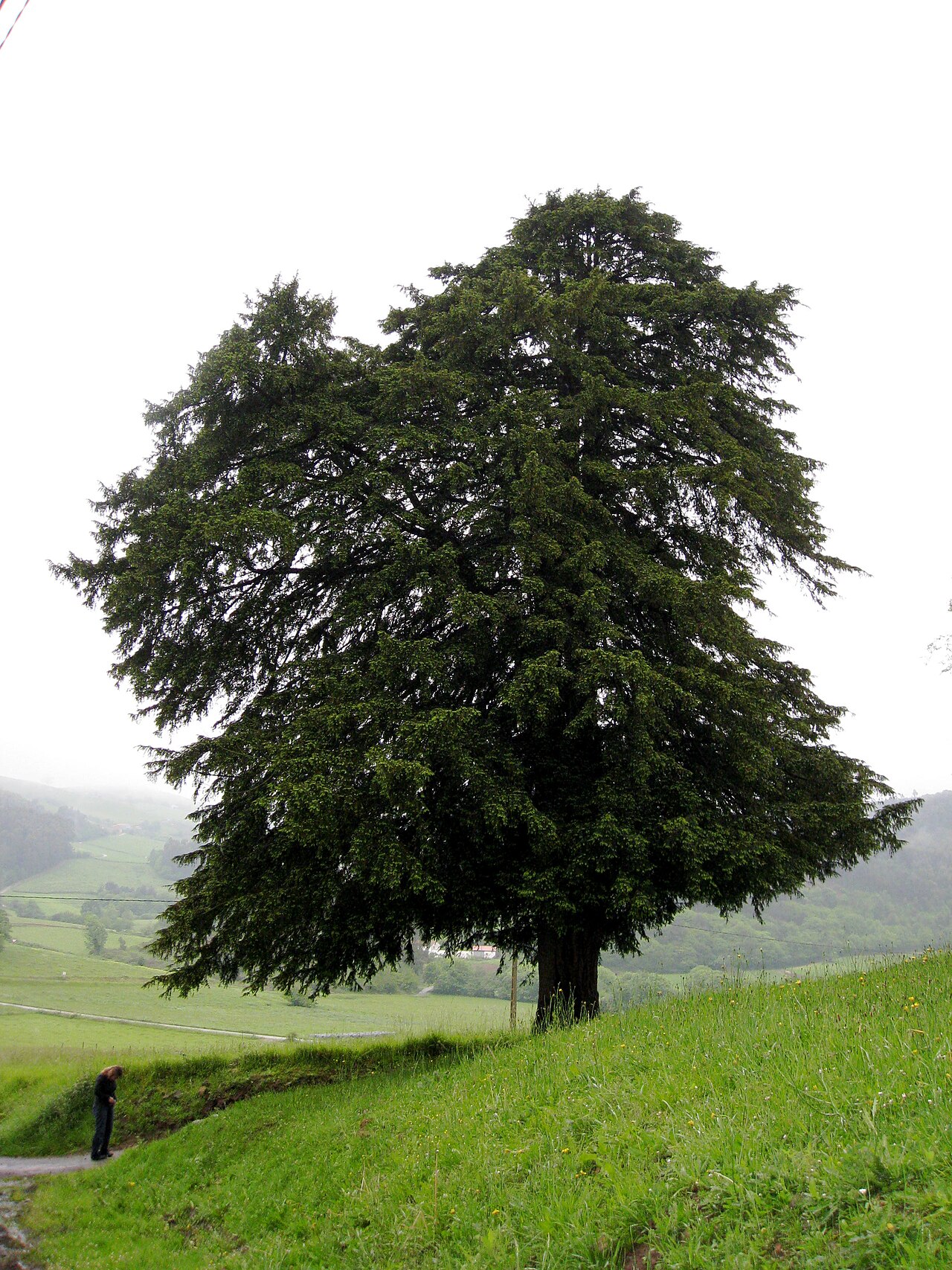 European YewEuropean Yew · 1.7 mi
 Deer Park PlantationForest · 2.2 mi
 The Square RenewalMemorial · 3.0 mi
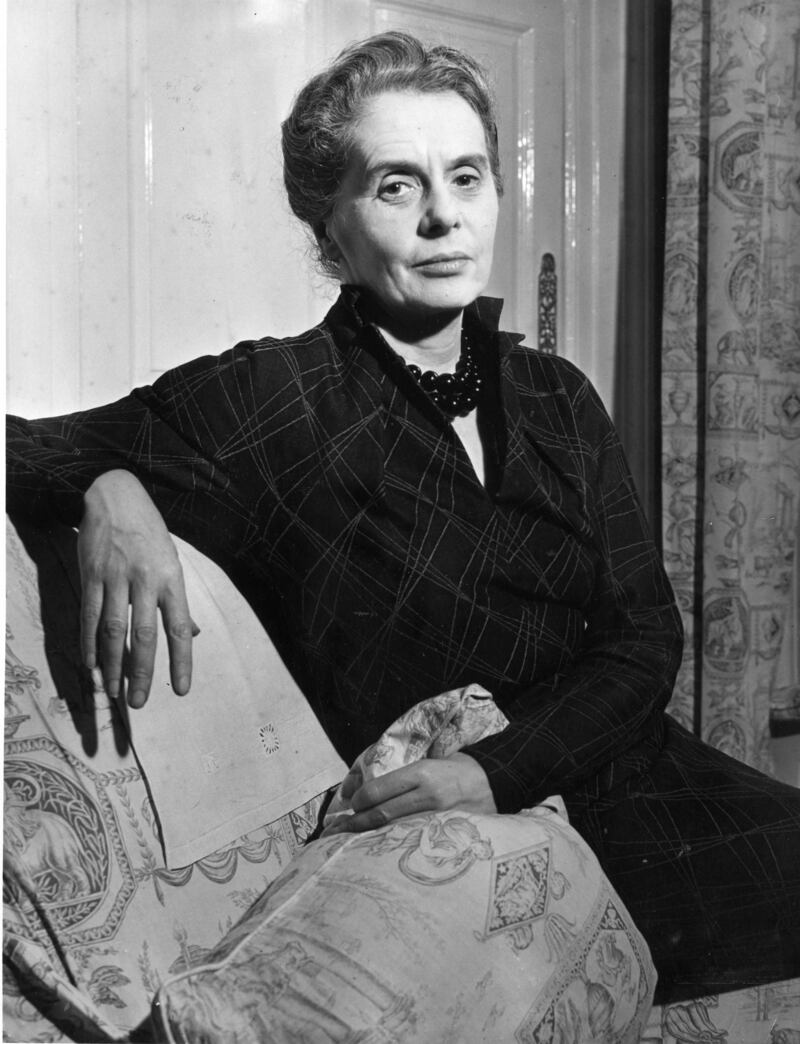 Dame Ninette de ValoisMemorial · 3.0 mi
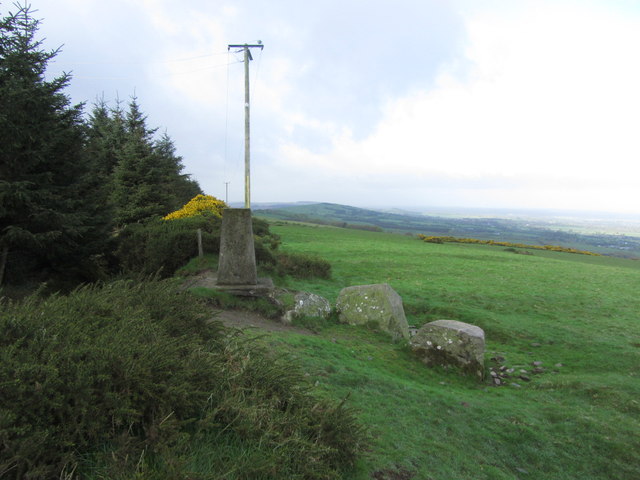 Cupidstown HillMountain / peak · 3.3 mi
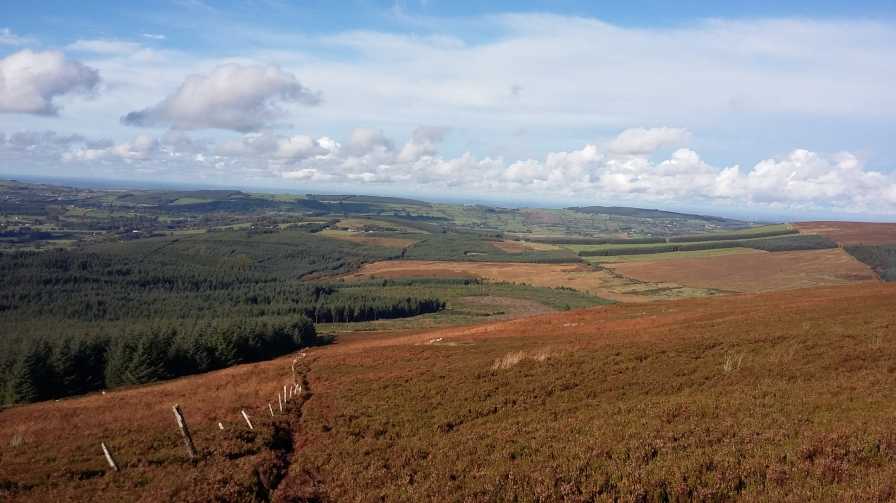 Saggart HillMountain / peak · 4.6 mi
Other information
Photo: National Inventory of Architectural Heritage · Website use allowed for educational or private purposes with source credit