
What is recorded here
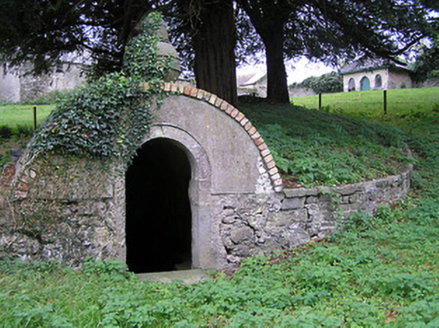
In a natural cleft in rock on a N-facing slope, at the E end of small yew grove enclosed by a stone wall (dims. c. 16m NE-SW; c. 7m NW-SE), in the grounds of Bayswell House. According to Carrigan (1905, vol. 2, 303), 'Up to sixty or seventy years ago this well was visited by crowds of pious pilgrims on the 29th of Sept. and the seven following days. The pilgrims always wound up their devotions with prayers before an effigy of the Crucifixion carved in stone, which had been fixed into the wall surrounding the well. The slab was broken several years ago, and its fragments have been lost, except one piece which Mr. Connell [the owner of Bayswell House] has reverently, but, by a misapprehension of the identity of the carving, mistakenly incorporated with an effigy, in cement, of St. Michael, which he has placed over the well'. The spring well is covered by modern brick structure with an 18th/19th-century pointed doorway of cut limestone. The largely reconstructed plaque (KK008-037001-), mentioned above, is incorporated in the stone walling surrounding the well structure and yew grove, SW of the well and depicts St. Michael flying the lands holding a flag and a book.
In a natural cleft in rock on a N-facing slope, at the E end of small yew grove enclosed by a stone wall (dims. c. 16m NE-SW; c. 7m NW-SE), in the grounds of Bayswell House. According to Carrigan (1905, vol. 2, 303), 'Up to sixty or seventy years ago this well was visited by crowds of pious pilgrims on the 29th of Sept. and the seven following days. The pilgrims always wound up their devotions with prayers before…
From the National Monuments Service (Archaeological Survey of Ireland) record KK008-037
The monument record does not grant public access. Check the route and ask the landowner before entering private land.
- What survives
- Recorded monument
Places near here
Photo credits
- National Inventory of Architectural Heritage
- A.-K. D., Wikimedia Commons · CC BY-SA 4.0
- Mike Searle, Wikimedia Commons · CC BY-SA 2.0
- A.-K. D., Wikimedia Commons · CC0
- Sarah777 at en.wikipedia, Wikimedia Commons · Public domain
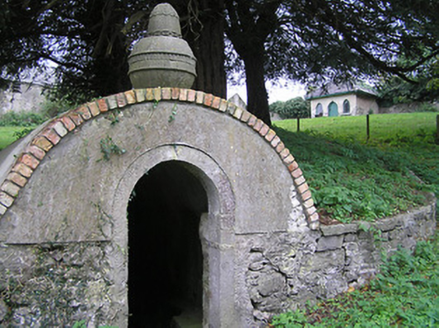 Bayswell HouseHoly well · 13 yd
 Crucifixion plaque in BayswellCrucifixion plaque · 14 yd
 Bayswell HouseSummerhouse · 43 yd
_-_geograph.org.uk_-_4571595.jpg/250px-Castles_of_Leinster,_Castle_Pierce,_Kilkenny_(1)_-_geograph.org.uk_-_4571595.jpg "Photo: Mike Searle, Wikimedia Commons · CC BY-SA 2.0") Castle PierceHouse, fortified house · 1614 yd
Castle PierceHouse, fortified house · 1614 yd Fairy fort / earthen ringfort in BayswellFairy fort / earthen ringfort · 1659 ydCnoc SeanrathaMemorial · 1.8 mi
_-_geograph.org.uk_-_2495691.jpg/250px-Castles_of_Leinster,_Foulkscourt,_Kilkenny_(1)_-_geograph.org.uk_-_2495691.jpg "Photo: Mike Searle, Wikimedia Commons · CC BY-SA 2.0") Foulkscourt castle (in ruins)Castle, tower house · 1.9 mi
Foulkscourt castle (in ruins)Castle, tower house · 1.9 mi John HelyMemorial · 3.4 miTullow HillMountain / peak · 4.1 miStreet fieldArchaeological place · 4.3 miClonmeen WoodWood · 4.5 mi
 Clomantagh HillMountain / peak · 5.3 mi
More archaeology and monuments in County Kilkenny · All of County Kilkenny
What do you know about this place?