Overview
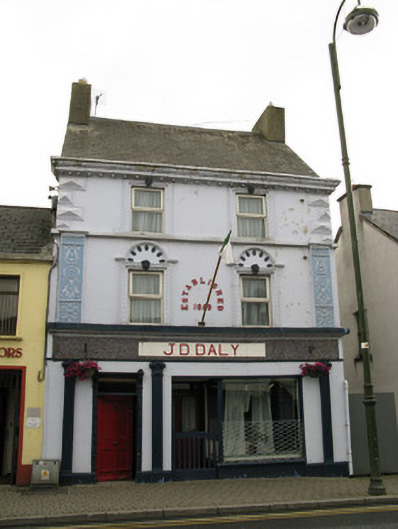
J.D. Daly — An tSráid Mhór is recorded as house, public house in Limerick. End-of-terrace two-bay three-storey former house and pub, dated 1859, having two-bay two-storey additional block and two-bay single-storey extension to rear (south). Now in use as shop with render shopfront to front (north).
Why it was built
The saved account records: End-of-terrace two-bay three-storey former house and pub, dated 1859, having two-bay two-storey additional block and two-bay single-storey extension to rear (south).
People and work
The saved account records: Now in use as shop with render shopfront to front (north).
How it changed
The saved account records: Pitched artificial slate roof with rendered chimneystacks and overhanging corbelled cornice to eaves with concealed rainwater goods.
What survives
The saved account records: Rendered walls to front, rear and side (east, west) elevations, having render sill band and nail-head moulded render quoins to second floor.
Why it mattered
J.D. Daly — An tSráid Mhór matters for the exact reasons given in its official assessment, rather than merely because it is an old structure. The source records: This unusual large scale building makes a significant contribution to the architectural heritage of Abbeyfeale. The building is distinguished from its neighbours by its highly decorative rendered façade, which was applied by the Listowel artisan builder named Pat McAuliffe (1846-1921). The stucco work on Daly's dates to 1890. Here McAuliffe uses an eclectisim of decoration on a single façade: Corinthian capitals, Egyptian cornice mouldings, arabesques, Latin scrolls, Hiberno-Romanesque bearded men and lionheads and Italian diamond pointed quoins. McAuliffe's plasterwork imitates features more commonly found… This explains what the place adds to local life, the street or the surviving built history.
History checked 15 August 2026 against the named sources below.
Places near here
- Provincial House — An tSráid Mhórbuildingunder 0.1 miles
- house — An tSráid Mhórbuildingunder 0.1 miles
- McEnery — An tSráid Mhórbuildingunder 0.1 miles
- shop/retail outlet — An tSráid Mhórbuildingunder 0.1 miles
- O'Connor — An tSráid Mhórbuildingunder 0.1 miles
- shop/retail outlet — Sráid na hEaglaisebuildingunder 0.1 miles
- J.D. Harnett — An tSráid Mhórbuildingunder 0.1 miles
- hotel — An Cheárnogbuildingunder 0.1 miles
- Allied Irish Bank — An Cheárnogbuildingunder 0.1 miles
- D.P. Ahern — Sráid na hEaglaisebuildingunder 0.1 miles
- M.J. Maloney — Sráid na hEaglaisebuildingunder 0.1 miles
- Abbey — Abbeyfeale Westmonument0.1 miles
Add the human story, a picture, a first-hand message or a missing place.
Earn 5 points after the picture is checked and accepted.
Add a pictureAdd its storyTalk or ask a questionAdd a new placeThis official record and map point do not grant access. Most recorded buildings are privately owned; view them only from public ground unless the owner allows entry.
Conversation about this place
Questions and messages sit beneath the source record. They are checked before appearing.
No questions or messages yet.
Ask a question or join the conversation