DDiscover AloneMapAbout

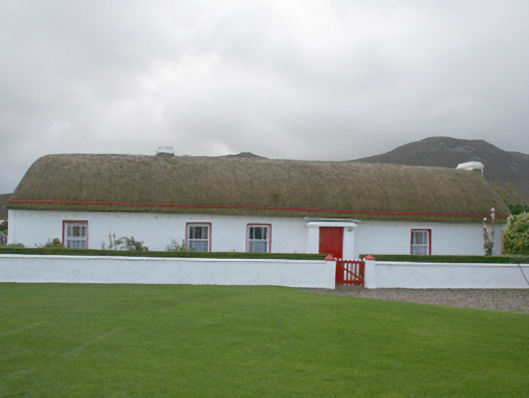
House in Tullagh

House
House in Tullagh
Photo: National Inventory of Architectural Heritage · Report the wrong picture

This does not grant access. Most recorded buildings are privately owned; view them only from public ground unless the owner allows entry.

What do you know about this place?Tap to add a comment or ask a question

What you write will be public.

What is recorded here

Detached five-bay single-storey vernacular house, built c. 1850 and extended c. 1900, having windbreak porch to front (south), adapted bed outshot to rear (north) with added door, and with single-storey addition to the rear (north). Round pitched thatch with rope lattice, stays and steel pegs, limewashed render to…

Read the whole record
Detached five-bay single-storey vernacular house, built c. 1850 and extended c. 1900, having windbreak porch to front (south), adapted bed outshot to rear (north) with added door, and with single-storey addition to the rear (north). Round pitched thatch with rope lattice, stays and steel pegs, limewashed render to chimneystacks, monopitch tar roof to outshot. Limewashed rendered rubble stone walls. Square-headed window openings with painted sills, smooth rendered reveals, and with three-over-three pane horned timber sliding sash windows. Square-headed door opening to windbreak porch having battened timber door. Set in own grounds bound by hedge and limewashed rubble stone wall rendered to front with cast-iron gate and capped piers. Detached three and four-bay single-storey outbuildings having barrel-vaulted tar and felt roofs, limewashed rendered rubble stone walls, and square-headed openings. Located to the north-east of Clonmany.
This appealing and intact example of a vernacular house retains its early form and character, and is an appealing feature in the scenic rural landscape to the north-east of Clonmany, located close to the coast at Pollan Bay. Its integrity is enhanced by the retention of much of its salient fabric including timber sliding sash windows and battened timber door. Of particular interest in the survival of the thatch roof, although recently renewed, which is now sadly becoming increasingly rare in Donegal. The rounded roof is a typical feature of thatched houses located close to the sea in exposed areas in the north-west of Ireland, while the pegs to the eaves were used to tie ropes (and sometimes nets) over the roof to secure it against the prevailing winds, as is the case here at Tullagh. Modest in scale, it exhibits the simple and functional form of vernacular building in Ireland. It retains some characteristic features of the vernacular tradition to the area, including a bed outshot to the rear, windbreak porch, and irregularly-spaced window openings. The low elongated form of this building, and the position of the chimneystacks, indicates that it was extended along its length (to the west) at some stage, which is another feature of extended vernacular tradition. The form of this building, having chimneystacks to the gable ends and a central doorway to the original building, suggests that this building is of the ‘direct entry’ type that is characteristic of the vernacular tradition in north-west Ireland. The three-over-three sash windows are a more sophisticated design than would usually be found in a vernacular house; windows of this type are common in the north end of Inishowen, particularly around Carndonagh, which suggests a regional tradition or local fashion. The interesting collection of single-storey outbuildings with barrel-vaulted tarred felt roofs add significantly to the setting, and are interesting survivals in there own rights. This house represents a fine surviving example of a once ubiquitous building type in the rural Irish countryside, and is a valuable addition to the vernacular heritage of County Donegal.

From the Buildings of Ireland (National Inventory of Architectural Heritage) record 40900307

Places near here

Photo credits
  • Kenneth Allen, Geograph · CC BY-SA 2.0
  • Kenneth Allen, Geograph · Creative Commons Attribution-ShareAlike 2.0
  • Carroll Pierce, Wikimedia Commons
  • Maker not stated on source page, au.pinterest.com
  • N Chadwick, Geograph · CC BY-SA 2.0
  • Maker not stated on source page, ru.pinterest.com
  • N Chadwick, Wikimedia Commons · CC BY-SA 2.0
  • David Ayrton, Geograph · CC BY-SA 2.0
  • Mark McGaughey, Wikimedia Commons
  • Maker not stated on source page, www.tuatha.ie
  • Andreas F. Borchert, Wikimedia Commons · CC BY-SA 4.0
  • Andrejs Plavins / Inishowen News, www.inishowennews.com
Rusty NailPub · 594 yd

Explorer Tom Rusty Nail pub in County Donegal is held together by hope and one very stubborn, rusty nail that has its own…

Crossconnell National SchoolSchool · 612 yd

Explorer Tom Crossconnell National School's 1928 porch gave boys and girls separate doors for a two-room school. The survey later…

Tullagh BaySurfing beach · 879 yd

Explorer Tom Tullagh Bay curves below Binion Hill like someone drew a horseshoe in the sand and forgot to stop. Surfers know its…

Holy well in Binnion (straid Ed)Holy well · 1583 yd

Explorer Tom This holy well in Binnion sits below the high tide mark, where the water stays fresh even when the sea rushes over it.…

Glenevin Waterfall WalkOfficial walking route · 1.0 mi

Explorer Tom Glenevin Waterfall Walk in County Donegal is basically a stream that has been told it’s a waterfall so many times it’s…

Killoran Old Burial GroundGraveyard · 1.1 mi

Explorer Tom Killoran Old Burial Ground is a low earthen circle hiding cross-inscribed stones and church foundations on Binnion…

Glenevin WaterfallWaterfall · 1.3 mi

Explorer Tom Glenevin Waterfall waits up a green valley near Clonmany, where a stream crosses the path again and again before…

Glenevin Waterfall, ClonmanyWaterfall · 1.3 mi

Explorer Tom Glenevin Waterfall near Clonmany has the courtesy to let you hear its stream and walk beside it before showing you the…

Straid ChurchRuins · 1.3 mi

Explorer Tom Straid Church is a set of ruins in County Donegal, and I am delighted that the name sounds like it is constantly…

CastleCastle, unclassified · 1.4 mi

Explorer Tom A castle stood beside the church at Straid in 1600, perhaps a stone house occupied by a priest named Amerson. Its exact…
Clonmany Early Church GraveyardGraveyard · 1.4 mi

Explorer Tom Clonmany Early Church Graveyard hides a stone with two cupmarks called St. Colmcille's knee-prints. I reckon a kneeling…
Páirc Uí Chnáimhsí, UrrisGAA ground · 1.5 mi

More historic places in County Donegal · All of County Donegal

Add to this placeAdd a picture Add a detailed tip Add a story

Explore the map1,095,414 places to discover

Next place · or swipeRusty Nail