DDiscover AloneMapAbout

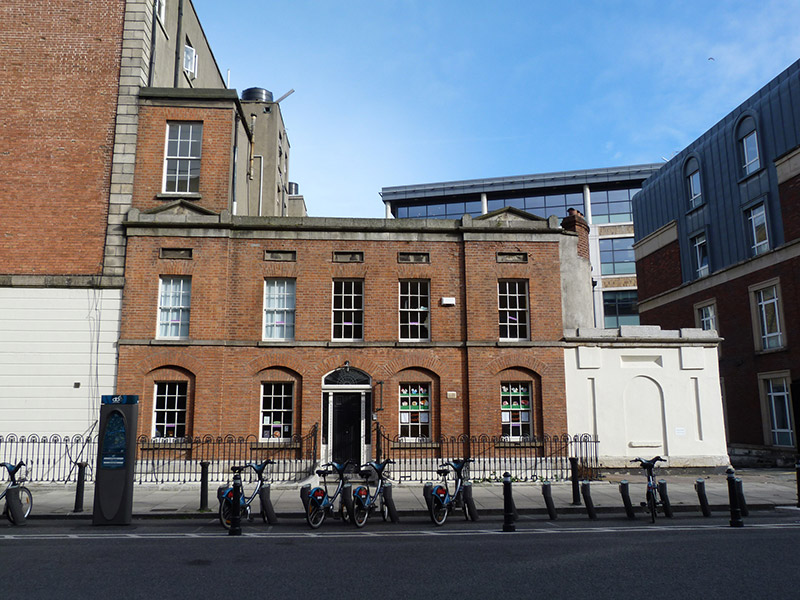
House on Clonmel Street

House
House on Clonmel Street
Photo: National Inventory of Architectural Heritage · Report the wrong picture

This does not grant access. Most recorded buildings are privately owned; view them only from public ground unless the owner allows entry.

Recorded change of use
Originally house; recorded by the architectural inventory as crèche/pre-school
What do you know about this place?Tap to add a comment or ask a question

What you write will be public.

What is recorded here

Attached six-bay two-storey over basement former mews, built c. 1830, with three-storey bay to west end, single-storey return abutting to bowed east elevation and shallow breakfronts to end bays at east and west ends of principal (south) elevation. Now in use as crèche. Flat roof concealed behind ashlar granite…

Read the whole record
Attached six-bay two-storey over basement former mews, built c. 1830, with three-storey bay to west end, single-storey return abutting to bowed east elevation and shallow breakfronts to end bays at east and west ends of principal (south) elevation. Now in use as crèche. Flat roof concealed behind ashlar granite parapet with moulded cornice and granite coping, end-bays topped with pediments, that to west surmounted by single-storey single-bay flat-roofed block. Parapet gutters and replacement uPVC downpipes, curved red brick chimneystack to southeast with cornice and clay pots. Red brick walls laid in Flemish bond with recessed plaques over first floor, granite plinth course over rendered walls to basement of front (south) and rear (north) elevations. Rendered walls to east and rear (north) elevations, with bays to rear punctuated by projecting piers extending to parapet with granite coping. Granite stringcourse over ground floor of north and south elevations, forming parapet coping of single-storey abutment to east elevation and first floor sill course of principal (south) elevation. Square-headed window openings with granite sills; brick voussoirs to south elevation having ground floor openings set within segmental-headed recesses. Six-over-six timber sliding sash windows with horns, one curved to northeast, those to rear are blind openings. One four-pane timber casement to north elevation of east abutment. Segmental-headed central door opening to south elevation with brick voussoirs, panelled pilasters with decorative carved inset rising to console brackets and timber frieze, flanked by leaded sidelights, surmounted by cobwebbed fanlight over four-panel timber door with beaded-muntin. Granite entrance platform with cast-iron boot-scrape and bullnosed step, flanked by decorative cast-iron railings with anthemion motifs on carved granite plinth, enclosing basement areas on principal elevation (south). Round-headed blind opening to centre of south elevation of eastern abutment, flanked by narrow square-headed blind openings, having raised and recessed panels over and stepped coping to parapet; topped with cast-iron railings to east and north. Street-fronted on north side of Clonmel Street, abutted by No. 83 to west (50920238).
Formerly a mews associated with No. 83 Harcourt Street (50920238), the formalized principal elevation successfully addresses this prominent junction between Clonmel Street and Harcourt Street. The combination of granite dressings and red brick provides textural and tonal variation, that is further enlivened by the retention of an early timber-panelled door, decorative railings and neo-Classical embellishments. Harcourt Street was opened 1777 by John Hatch, barrister and Seneschal of the Manor of St. Sepulchre. Development was sporadic until the late 1790s when Messrs Hatch, Wade and Whitten obtained approval from the Wide Street Commissioners for the further development of the street.

From the Buildings of Ireland (National Inventory of Architectural Heritage) record 50920239

Places near here

Photo credits
  • Paul Hermans, Wikimedia Commons · CC BY-SA 4.0
  • Angilbas at English Wikipedia, Wikimedia Commons · Public domain
  • NateBergin, Wikimedia Commons · CC BY 4.0
  • Maker not stated on source page, ru.pinterest.com
  • Superchilum, Wikimedia Commons · CC BY-SA 4.0
  • Oisín Ó Doinn, Wikimedia Commons · CC BY-SA 4.0
  • Maker not stated on source page, www.tripadvisor.ca
  • Agence Rol, Wikimedia Commons · Public domain
  • Taken by Fanghong, Wikimedia Commons · CC BY-SA 3.0
  • Maker not stated on source page, commons.wikimedia.org
  • Maker not stated on source page, www.tripadvisor.com
  • Maker not stated on source page, en.wikipedia.org
Church in Unknown TownlandChurch · 683 yd

Explorer Tom St Anne's on Dawson Street is post-1700, so it's got that classic Dublin church look. Not much else in the record, but…
Bigleaf Maple1072 yd

Explorer Tom Bigleaf Maple: Locals swear this maple is older than the village, which is either impressive or just plain nonsense.…

Cathedral1077 yd

Explorer Tom Cathedral. Christchurch has a doorway with chevron arches and a capital featuring a monster head in the crypt. It is…

Graveyard in Unknown TownlandGraveyard · 1102 yd

Explorer Tom Graveyard in Dublin belonged to St John's medieval Parish Church and is marked 'Dis.' on old maps. Rocque's 1756 map…
Oriental plane1152 yd

Explorer Tom Oriental plane in Dublin once smuggled a whole crate of cabbages up through its hollow trunk during the famine, or so…

Religious houseReligious house, Cistercian monks · 1471 yd

Explorer Tom St Mary’s Abbey in Dublin would handle a nosey neighbour by simply closing its windows and pretending it doesn't hear…

St. Marys ChurchChurch · 1518 yd

Explorer Tom St. Marys Church in County Dublin is one of the earliest galleried churches in Ireland, dating to the late 17th…

Burning of the Custom HouseArmed conflict · 1658 yd

Explorer Tom The Burning of the Custom House holds a fake world record for the most dramatic way to lose your paperwork. It still…
London Plane1.2 mi

Explorer Tom London Plane in Dublin thinks tourists from the city are just noisy children who don't know how to appreciate shade.…

CairnCairn, unclassified · 1.3 mi

Explorer Tom Cairn. Known as Carn Uí Dúnchada, this cairn was possibly erected against Viking pressure in the ninth century. Using a…

Church in Donnybrook East,donnybrook WestChurch · 1.3 mi

Explorer Tom Church in Donnybrook East is mentioned in a deed from 1748, which is quite specific for a ghost church. It was the…

Church in DonnycarneyChurch · 1.3 mi

Explorer Tom Church in Donnycarney exists by tradition, which means nobody is really sure where it is. Wren says there was one…

More historic places in County Dublin · All of County Dublin

Add to this placeAdd a picture Add a detailed tip Add a story

Explore the map1,095,414 places to discover

Next place · or swipeChurch in Unknown Townland