
What is recorded here
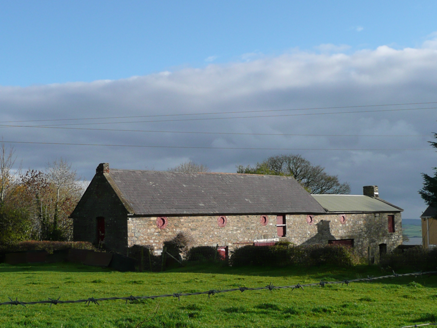
Detached four-bay single-storey vernacular house, built c. 1820. Pitched corrugated-metal roof with three rendered chimneystacks. Rendered walls. Square-headed window openings with one-over-one pane timber sliding sash windows; enlarged window opening to the north end of the front elevation (east) having timber…
Read the whole record
From the Buildings of Ireland (National Inventory of Architectural Heritage) record 40904654
Places near here
Photo credits
- National Inventory of Architectural Heritage
- Eeno11, Wikimedia Commons · CC BY-SA 3.0
- Sitomon, Wikimedia Commons · CC BY-SA 2.0
- Maker not stated on source page, www.irelandtraveldeals.com
- Maker not stated on source page, za.pinterest.com
- Maker not stated on source page, yandex.ru
- Maker not stated on source page, www.britainexpress.com
- Maker not stated on source page, commons.wikimedia.org
- Maker not stated on source page, au.pinterest.com
 Castle ShanaghanOutbuilding · 869 yd
Explorer Tom Castle Shanaghan includes an outbuilding from around 1800 that once belonged to a mill complex. Most openings are…
 Ardrumman HouseCountry house · 1450 yd
Explorer Tom Ardrumman House hosted a dance that went so far the chimney pots are still trying to catch their breath, especially…
 CastlegroveWorker's house, office · 1694 yd
Explorer Tom Castlegrove was built around 1875 for an estate worker or land agent beside the larger house. Its windows are spaced…
 Rowan1715 yd
Explorer Tom Rowan is in the middle of a fierce feud with the oak next door over who has the better view of the sunset. They’ve been…
 European Yew1.0 mi
Explorer Tom European Yew in County Donegal is a yew, which means it’s tough, old, and probably poisonous if you look at it wrong.…
 Castle Grove House HotelHotel · 1.0 mi
Explorer Tom Castle Grove House Hotel sounds fancy but might just be a very confused barn. It's in Donegal, where the wind is strong…
 Castle WrayWalled garden · 1.2 mi
Explorer Tom Castle Wray is a walled garden that absolutely refuses to fall down, which is frankly insulting to the rest of us who…
 Standing stone in Drumnaskea (castlewray Ed)Standing stone · 1.3 mi
Explorer Tom Standing stone in Drumnaskea is marked 'on its side' on an old map, which sounds like it fell asleep standing up. I bet…
 Silver Tassie HotelHotel · 1.4 mi
Explorer Tom Silver Tassie Hotel charges four stars, which means they are billing you for the air you breathe. The bed squeaks with…
 Standing stone in CarrowcashelStanding stone · 1.5 mi
Explorer Tom Standing stone in Carrowcashel sat on level arable land close to the shore of Lough Swilly, but now there is no trace…
 Killydonnell Friary GraveyardGraveyard · 1.6 mi
Explorer Tom Killydonnell Friary Graveyard shares the map with ruins of a friary founded in 1471 for the Franciscan Third Order. The…
 Balleeghan Friary GraveyardGraveyard · 2.1 mi
Explorer Tom Balleeghan Friary Graveyard comes with a quiet but vivid detail: ivy-covered ruins by Lough Swilly, built from granite…
More historic places in County Donegal · All of County Donegal

What do you know about this place?Tap to add a comment or ask a question