What is recorded here
Known as 'Priest Boyle's' or the 'Blessed Virgin's Holy Well'. It is formed by water, seeping down a cliff dammed at its base. It is close to the foreshore on the N side of Inishkeel Island. Described by Ó Muirgheasa in 1936 as 'St. Conall's Well (DG064-001----) and the Blessed Virgin's Well are two Holy Wells on Inniskeel Island, both embraced in the turus. St, Conall's day is 22nd May, from which date until the 12th September the stations may be made. The " Bearnan Conall" or Gapped Bell of St. Conall was always brought to the island for the stations, and the kissing of this venerable relic of the founder was an essential part of the station. The bell came down in the Gearan family (now, alas, anglicised Sharpe), who were no doubt the erenachs or stewards of the monastery. Eventually it came into the possession of a family of the Breslins, who not having the traditional attachment to the relic, sold it about sixty or seventy years ago to the Nesbitts of Woodhill. It is now in the British Museum. It is said that all the cattle and sheep Breslin bought with the price of the bell died. St. Conall, it is believed, still visits the island every year, on the 1st June. Both St. Conall and Dallan Forgall are buried in the same grave on the island' (Ó Muirgheasa 1936, 151). (Ó Muirgheasa no. 40)
The above description was derived from the 'Archaeological Survey of County Donegal. A description of the field antiquities of the County from the Mesolithic Period to the 17th century.' Compiled by: Brian Lacey with Eamon Cody, Claire Cotter, Judy Cuppage, Noel Dunne, Vincent Hurley, Celie O'Rahilly, Paul Walsh and Seán Ó Nualláin (Lifford: Donegal County Council, 1983). In certain instances the entries have been revised and updated.
Attached images:
DG064-002----_01.JPG
DG064-002----_01.JPG
Compiled by Caimin O'Brien
Date of upload/revision: 03 November 2011
Linked to the Blessed Virgin Mary, the well is associated with traditional Catholic devotions and healing practices. Local folklore suggests that the site was a place of pilgrimage, particularly for those seeking cures for eye ailments and general well-being.
The monument record does not grant public access. Check the route and ask the landowner before entering private land.
- What survives
- Recorded monument
Places near here
 Penitential station in IonascailPenitential station · 60 yd
 Inishkeel High Cross FragmentCross, High cross · 215 yd
 St Connell's Church / St Conall's AbbeyChurch · 226 yd
 InishkeelIslet · 337 yd
 Narin–Portnoo StrandOfficial bathing water · 1056 yd
 Site of Old ChurchChurch · 1304 yd
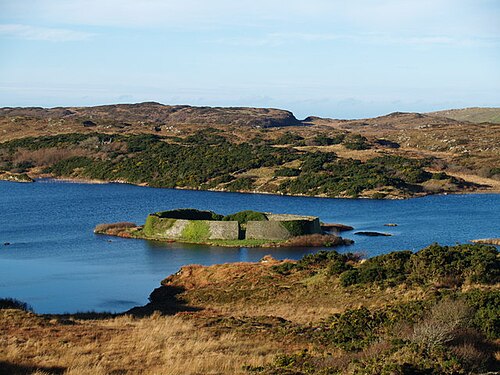 Doon FortFairy fort / stone ringfort · 1.5 mi
 Bonny Glen WoodForest recreation place · 2.2 mi
 Bonny Glen Wood - Bonny Glen walkOfficial walking route · 2.3 mi
 Bawn in KiltoorisBawn · 2.8 mi
 CastleRuins · 2.8 mi
 DooeyOfficial bathing water · 2.9 mi