What is recorded here
Cross stands as a tapering sandstone shaft on the lower slope of Kilmacoliver Hill, overlooking the River Suir valley. It belongs to the early medieval monastery of Kilkieran and still holds fragments of spirals, pelta shapes and angular ribs. The missing head and arms rest elsewhere, while the shaft was once re-used as a lintel, suggesting the cross has survived by adapting rather than remaining untouched. Local story blames Cromwell’s soldiers for breaking it, but the damage may have come gradually through reuse, neglect and time. What remains is enough to show that the place was never ordinary: a hillside graveyard where stone was shaped, moved and remembered across centuries.
On the lower S-facing slope of Kilmacoliver Hill, overlooking the valley of the River Suir. Associated with the early medieval monastery of Kilkieran, and within the graveyard (KK034-032002-) of Kilkiernan church (KK034-032001-) stands the tapering shaft (H 1.43m; Wth at base 0.34m; Wth at top 25m; T at base 0.19m; T at top 0.18m) of a sandstone high cross. The shaft appears to have been re-used as a lintel in the mausoleum of the Osborne family of Kilmacoliver (Anon. 1850-51, vol. 1, 487). The cross (H c. 2.35m; arms Wth 1.17m; max. T 0.19m based on a reconstruction (ibid. 119, Fig. 398)) is described in some detail by Harbison (1992, 119-20, Figs 394-8). The other three fragments of the cross, including the cross head and arms, are currently in storage at Jerpoint Abbey, Co. Kilkenny. According to Harbison, ‘the cross-arms scarcely project at all beyond the ring, which has been almost entirely hacked away’ (ibid. 119). His description is as follows, ‘ The centre of the cross has a circular area outlined by two raised circular ribs of varying size, which enclose a number of conjoined spirals surrounding a central – but no longer clearly recognisable – feature. Extending outwards from the central circle there is a series of pelta shapes, conjoined both vertically and horizontally, and these cover the arms and shaft of the cross. These pelta-shapes decline in size towards the centre of the cross.
The shaft was subdivided into a number of roughly square panels. Their decoration was largely destroyed when the shaft was re-used as a lintel over the doorway of the adjoining structure. But it is still possible to make out the former presence of angular ribs of decoration, some of which may have formed meander patterns or L-shaped fields in the corners of the panels. Near the top of the shaft there is a tall rectangular panel enclosing three parallel upright bars, interrupted almost half-way up by a sunken cross shape. The bars are flanked on each side by what may be a serpent (of which only that on the right remains intact), their heads on top curving inwards as if to devour a small globular object standing on a concave base. At the centre of the head there is an equal-armed cross with rounded centre and terminals, enclosed within a raised rib. From the centre, a raised rib emanates to the limbs, where it joins square panels consisting of whorls, and swastikas. At the top of the shaft there is a square panel, with L-shaped fields in the corners (imitating enamelled metalwork) surrounding a small central square. The roll mouldings on the sides have all been hacked away’ (ibid.). According to local tradition referred to in the 1839 OS Letters, the cross was supposedly broken by the soldiers of Oliver Cromwell (O’Flanagan 1930, vol. 2, 64). Roe (ibid., 9) suggests an 8th-century date for the Kilkieran high crosses.
(National Monument no. 79)
Compiled by: Jean Farrelly
Date of upload: 19 June 2018
The monument record does not grant public access. Check the route and ask the landowner before entering private land.
- What survives
- Recorded monument
Places near here
 Kilkieran CrossesHeritage attraction · 14 yd
 IndicatedCross, High cross · 19 yd
 Holy well in Castletown (iverk By)Holy well · 70 yd
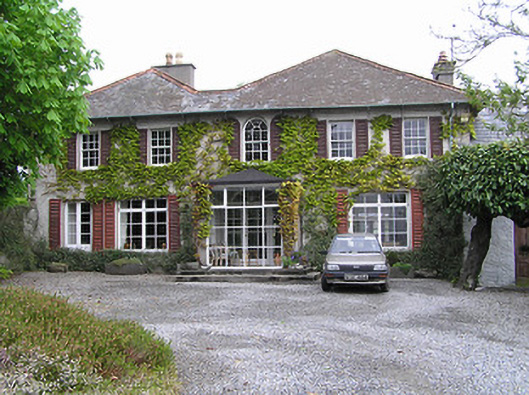 Newtownhouse · 1187 yd
 Kilmacoliver HillMountain / peak · 1233 yd
 Church (in ruins)Church · 1518 yd
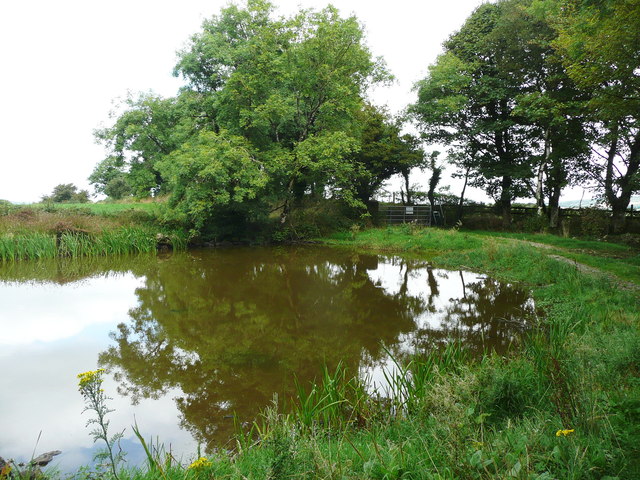 Dwyer Homestead and Pond, BregaunVisitor information · 1.0 mi
 Woodland LoopWalking route · 1.2 mi
 Burns WoodForest · 1.4 mi
 Carrigadoon HillMountain / peak · 1.4 mi
 Irish Republic 1916-2016Memorial · 1.5 mi
 CastleCastle, unclassified · 1.6 mi