
What is recorded here
Just outside the SW corner of Kinneigh graveyard (CO094-104003-), on the site of a monastery founded by St Mo-Cholmog. This round tower is comprised of a unique hexagonal base standing to a height of 18 feet (5.48m; Caulfield 1879, 16), with the remainder cylindrical portion of the tower surviving to a height of 67 feet 3inches (20.50m; Crawford 1927, 67). It is built of roughly-dressed slaty stones, and is entered by a lintelled door (H 1.45m; Wth 0,71m tapering to 0.61m) on the NE face of the hexagonal base, at 1st-floor level. It is lit by four small square-headed windows placed at various height (H 0.38m to 0.5m; Wth 0.3m). The tower now survives to six storeys but was originally taller, possibly with an additional floor, and the characteristic conical cap that some round towers display (Ibid.), though that is not a universal feature. An internal ladder leads to the top, which was altered in the 19th century to make a belfry for the adjacent Church of Ireland church. (Coleman 1894, 177-182 and 202-206; Buckley 1905, 135-8). This is a National Monument in State Ownership (no. 618). Photographs attached
CO094-104002-_01: View of the tower from SE. CO094-104002-_02: View of the tower within the graveyard, from NE
CO094-104002-_03: View of the tower from N. CO094-104002-_04: View of the tower and St Bartholomew's Church of Ireland, from SE. CO094-104002-_05: View of the tower from N. CO094-104002-_06: View of the tower from from E.
Just outside the SW corner of Kinneigh graveyard (CO094-104003-), on the site of a monastery founded by St Mo-Cholmog. This round tower is comprised of a unique hexagonal base standing to a height of 18 feet (5.48m; Caulfield 1879, 16), with the remainder cylindrical portion of the tower surviving to a height of 67 feet 3inches (20.50m; Crawford 1927, 67). It is built of roughly-dressed slaty stones, and is…
From the National Monuments Service (Archaeological Survey of Ireland) record CO094-104002
The monument record does not grant public access. Check the route and ask the landowner before entering private land.
- What survives
- Recorded monument
Places near here
 St Bartholomew's Church of Ireland ChurchChurch/chapel · 36 yd
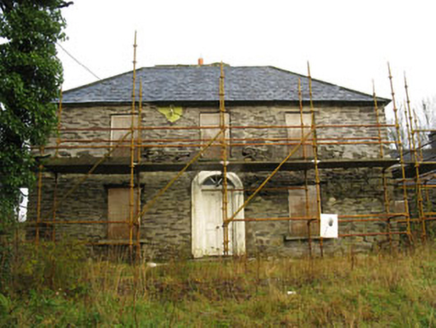 Tower ViewHouse · 173 ydCastle RockNamed rock · 1581 yd
 Fort RobertArchaeological place · 1.9 miIrish National Forestry FoundationNature reserve · 2.6 miOCrowleys Castle (in Ruins)Castle, tower house · 3.3 miThe GlenWood · 3.6 miGreen HillMountain / peak · 3.8 mi
 Sheela-na-gig in Ballynacarriga (carbery East (eastern Div.) By.)Sheela-na-gig · 4.7 mi
 Ballynacarriga CastleCastle, tower house · 4.7 mi
 Kilmichael AmbushAmbush · 4.8 mi
 Kilmichael Ambush SiteMonument · 4.8 mi
Pictures: Jonathan Thacker, Geograph · Creative Commons Attribution-ShareAlike 2.0; National Inventory of Architectural Heritage; Mike Searle, Geograph · CC BY-SA 2.0; SlaineMacRoth, Wikimedia Commons · CC BY-SA 4.0; dougf, Geograph · CC BY-SA 2.0; El Gringo ( talk ) ( Uploads ), Wikimedia Commons · CC BY-SA 3.0; Gordon Hatton, Wikimedia Commons · CC BY-SA 2.0
More archaeology and monuments in County Cork · All of County Cork
What do you know about this place?