
What is recorded here
This church was a chapel of ease to Inishkeel. In 1622, in view of the inaccessibility of the parish church on the island, it was considered fitting that parish services be held in this chapel (Royal Commission, 219). In 1724, services were transferred to the new church of St. James at Narin (McGill 1976, 29). The ruins of this rubble built church, c. 8.1m by 4m internally, comprise the N and S walls 2.5m high, and the entire W gable. The E gable has completely fallen; some foundation courses remain. The N wall is featureless. There is a rectangular lintelled doorway without internal splay in the centre of the W gable. The interior wooden door swung on a post which moved in a perforated stone, projecting from the wall S of the opening. There was, undoubtedly, a pivot hole at the foot; now covered up. The window with splayed ingoings at the E end of the S wall has a simple, unglazed, rectangular ope composed of four roughly-dressed blocks. It formerly had a wooden shutter or frame, the pivot-holes for which remain on the interior of the head and sill; there is a small rectangular groove for a sliding bolt on the interior W jamb. In contrast with the historical sources there is no structural evidence for any secondary alteration or re-use and the architectural features indicate a medieval date for the church. The church is surrounded by a graveyard (DG073-002001-) containing modern grave markers. The site is located close to the W shore of Kiltooris Lough in an area of rough pasture.
The above description was derived from the 'Archaeological Survey of County Donegal. A description of the field antiquities of the County from the Mesolithic Period to the 17th century.' Compiled by: Brian Lacey with Eamon Cody, Claire Cotter, Judy Cuppage, Noel Dunne, Vincent Hurley, Celie O'Rahilly, Paul Walsh and Seán Ó Nualláin (Lifford: Donegal County Council, 1983). In certain instances the entries have been revised and updated.
Date of upload: 22 September 2008
The church at Kiltooris was built as a chapel of ease to Inishkeel parish in the early 17th century, likely by local Catholic communities to serve those unable to reach the main parish church on the island. It reflects the ecclesiastical adaptations made during a period of religious upheaval in Ireland and highlights the importance of accessible worship in remote areas.
The monument record does not grant public access. Check the route and ask the landowner before entering private land.
- What survives
- Recorded monument
Places near here
 CastleRuins · 385 yd
 Bawn in KiltoorisBawn · 386 yd
 Church in KiltoorisChurch · 392 yd
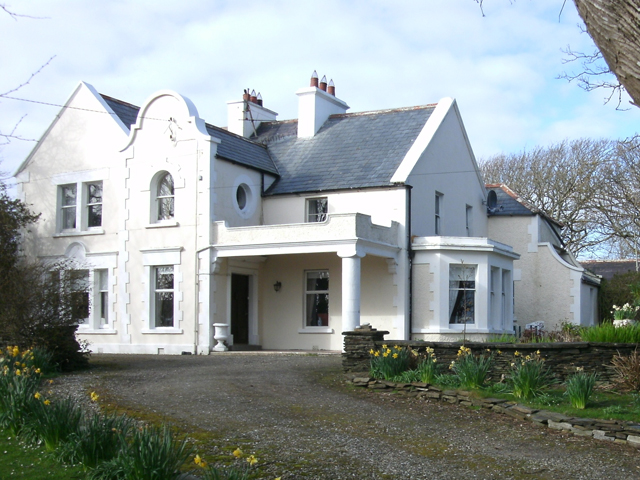 Kiltoorish Hallhouse · 594 yd
 Tramore StrandBeach / strand · 1270 yd
 Carrickalahagh HeadlandPublicly named cliff or headland · 1.2 mi
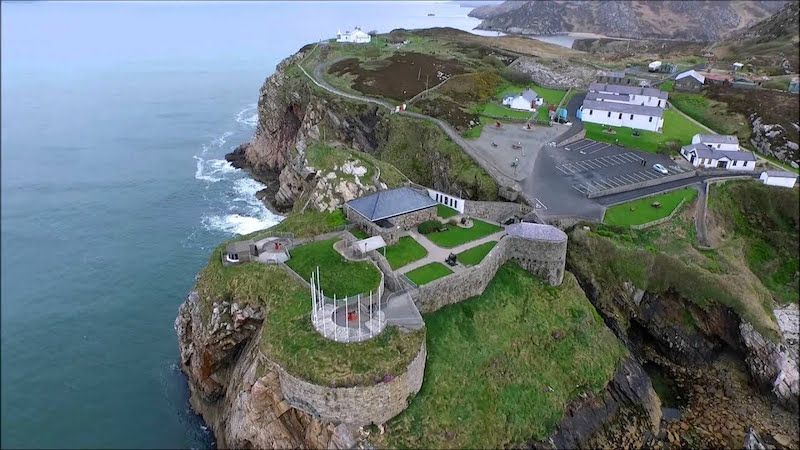 Drumboghill Island Stone FortFairy fort / stone ringfort · 1.5 mi
 Drumboghill Island CashelFairy fort / stone ringfort · 1.6 mi
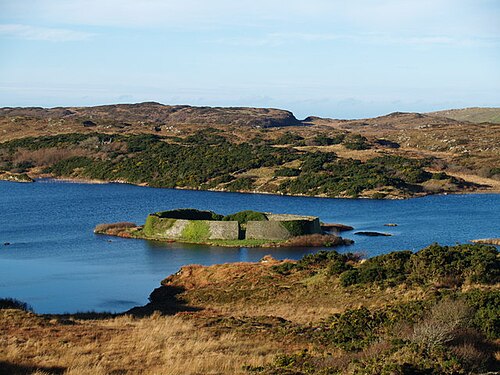 Doon FortFairy fort / stone ringfort · 1.7 mi
 Narin–Portnoo StrandOfficial bathing water · 2.6 mi
 InishkeelIslet · 2.8 mi
 Maghera CavesSea caves · 3.6 mi
Other information
Photo: Credit not shown in the picture search · Rights wording not checked; contact us if this picture should be removed