
What is recorded here
Roughly centrally located within a possible ecclesiastical enclosure (LF021-033----), within the N sector of a graveyard (LF021-033003-). In 1552 Richard Nugent, Baron of Delvin, was granted a 21 year lease of the vicarage of 'Caishell' (Nicholls 1994, vol. 1, 199). Depicted on an early 17th-century map of Rathcline barony as the church of 'Cashell & Clame' (BL, Cotton MS Augustus I.i.48). Remains consist of a medieval rectangular church (ext. dims. 18.9m E-W; 8.1m N-S) that was built in two phases. A section of the S end of the E gable, and the N and S side-walls of the original church survive. The W gable is a later addition, possibly of 15th century date, and it appears to have been keyed into the earlier fabric of the church. It has a pronounced base-batter and a string course is also visible. The church is constructed of limestone rubble and punch-dressed quoins with drafted margins. Larger blocks distinguish the initial construction phase. The S wall has been repointed. Access is gained through a pointed arch doorway, with cut limestone chamfered jambs, at the W end of this wall. Two architectural fragments inserted into the wall above the doorway are decorated with intertwined floral motifs and they appear to be capitals. Other architectural features in this wall include traces of the lower half of a first-floor window at the W end, an ogee-headed single-light window, set into a segmental arched embrasure, at the E end and a flat-headed aumbry or niche on the internal wall-face close to the SE angle. The first-floor window suggests the former presence loft or chamber at this end of the church. Memorials dating to the 19th century have been inserted into the internal faces of the S wall and W gable.
Compiled by: Caimin O'Brien
Date of upload: 4 June 2013
The church at Cashel was likely built in the 16th century, possibly by the Nugent family, who held the vicarage in 1552. Its significance lies in its association with the Nugent barons and its location within an ecclesiastical enclosure, suggesting a regional religious or administrative role.
The monument record does not grant public access. Check the route and ask the landowner before entering private land.
- What survives
- Recorded monument
Places near here
 Grave YardGraveyard · 32 yd
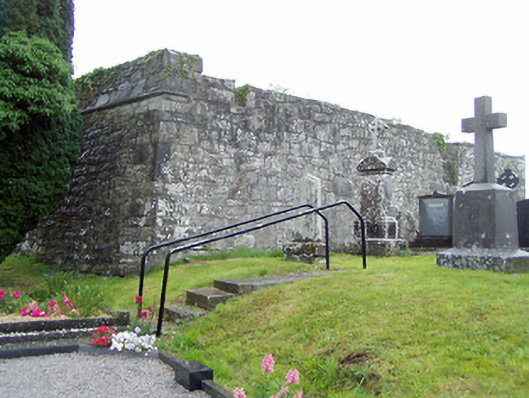 gates/railings/walls, graveyard/cemeterygates/railings/walls, graveyard/cemetery · 37 yd
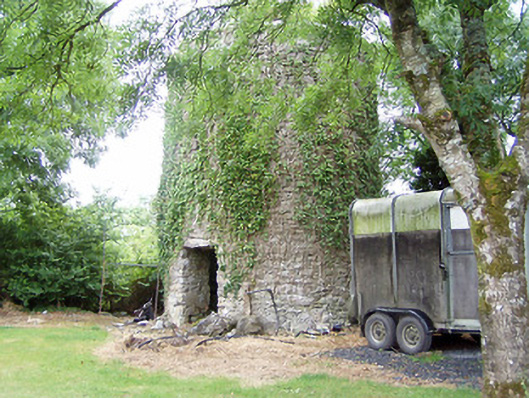 mill (wind)mill (wind) · 531 yd
 Man-made underground passage in Aghavadden,glebe (rathcline By., Cashel West Ed)Man-made underground passage · 1229 yd
 Priest's IslandIslet · 1260 yd
 Elfeet CastleCastle, Anglo-Norman masonry castle · 1526 yd
 Elfeet BayBay · 1.2 mi
 Leveran IslandIslet · 1.2 mi
 Culnagore WoodForest · 1.3 mi
 Caltragh CastleCastle, unclassified · 1.6 mi
 Black RockNamed rock · 2.5 mi
 St. John's WoodWood · 2.6 mi
Other information
Photo: Credit not shown in the picture search · Rights wording not checked; contact us if this picture should be removed