DDiscover AloneMapAbout

Castle in Rosegarland

Castle, tower house

What is recorded here

The manor of Rosegarland lay between the N-S Owenduff river on the W and the N-S Corock River on the E above their confluence before they enter the N end of Bannow Bay. It consisted of the parishes of Inch, Clongeen and Ballylannan and was held by Maurice de London (or de Loundres) in 1247 of de Valence for 3 and a…

Read the whole record
The manor of Rosegarland lay between the N-S Owenduff river on the W and the N-S Corock River on the E above their confluence before they enter the N end of Bannow Bay. It consisted of the parishes of Inch, Clongeen and Ballylannan and was held by Maurice de London (or de Loundres) in 1247 of de Valence for 3 and a quarter knight’s fees together with Duncormick (WX046-035001-) in Bargy. The family had been in Ireland since the 1170s but by 1324 Rosegarland and Duncormick had passed by the second marriage of Matilda to George le Poer, who was attainted in 1346. In 1385 Isabella, a granddaughter of Matilda by her first marriage and the wife of Simon Neville inherited Rosegarland, and the Nevilles are recorded as holding Rosegarland by two knights’ fees in 1425 (Brooks 1950, 103-7). The centre of the de London manor may have been the motte and bailey at Newcastle (WX040-009----), but the Nevilles probably built a tower house at Rosegarland in the 15th century. David Neville was attainted in 1538 when the castle and lands were granted to William Sayntloo and later to others (Hore 1900-11, vol. 3, 173-83), but in 1582 it came into the possession of Richard Synnott of Ballybrennan (WX048-001001-), confirmed in 1626 to his son James and grandson Walter (ibid. 187). According to the Civil Survey (1654-6) Marcus Synnott owned the castle and bawn, which were in good repair in 1640 and 300 acres at Rosegarland, as well as 620 acres in Ballyduffe (Ballyowen?), Ballylannan and Rospile townlands in Ballylannan parish (Simington 1953, 90). Marcus Synnott and 17 dependents were listed for transportation to Connaught in 1653 (Hore 1900-11, vol. 5, 503), but members of the family settled in Clongeen (Murphy c. 1994, 46-7). Rosegarland was then granted to Robert Leigh and this was confirmed by King Charles II in 1666 (Hore 1900-11, vol. 3, 188-93). The castle is situated towards the bottom of an E-facing slope with the meandering N-S Corock River c. 80m to the E. It is a rectangular structure (ext. dims. 12.7m N-S; 8.5m E-W) with battered walls surviving only to the second floor. It has been greatly altered with the insertion of large pointed windows and doorways, probably in the 19th century. There is a projecting garderobe tower at the N end of the W wall. The quoinstones and all dressed stone is granite. A pointed doorway (Wth 1.25m) towards the N end of the E wall leads directly at present to the ground floor which has a single embrasure with a large light (H 1m) on all walls except the W, where the embrasure may be destroyed by an inserted and pointed carriage gateway towards the N end. There is no murder hole or evidence of a first floor under the wicker centred N-S vault, although the ground floor was divided in two at one time by an E-W wall. Inside the entrance a lintelled doorway gives access to a stairs that rises in the N wall, and is lit by four lights, to what is probably the first floor over the vault which had three embrasures in the E and the W walls. The only original features are a cupboard in the S wall and a garderobe in the projecting tower at the NW angle. The walls are surmounted with modern crenellations, and rectangular turrets have been raised over three of the corners, while a tower of four upper stages was added to the garderobe tower. There is no evidence of a bawn unless it is on the site of a small walled enclosure (dims. c. 30m N-S; c. 30m E-W) defined by masonry walls with brick crenellation that has the tower house at its NW angle.

From the National Monuments Service (Archaeological Survey of Ireland) record WX040-042

The monument record does not grant public access. Check the route and ask the landowner before entering private land.

What do you know about this place?Tap to add a comment or ask a question

What you write will be public.

Places near here

Photo credits
  • National Inventory of Architectural Heritage
  • Mike Searle, Geograph · CC BY-SA 2.0
  • GJM Contracts Ltd; individual photographer not named, www.gjm.ie
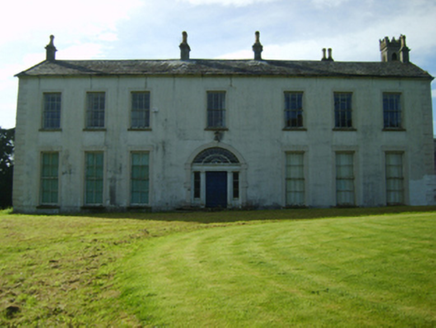
Rosegarland HouseCountry house · 44 yd

Explorer Tom Rosegarland House has a long-standing grudge with the weather because the rain keeps trying to wash its reputation…

Ballingly HouseFarm house · 601 yd

Explorer Tom Ballyingly House in Ballingly was built by a Dr. Harpur who seems to have vanished into history like a ghost at a…
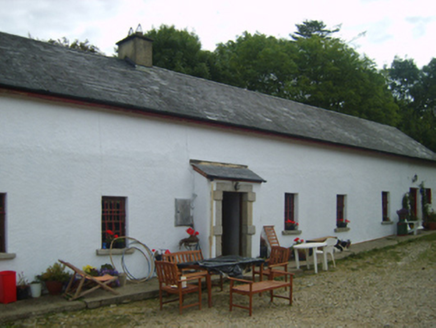
farm house942 yd

Explorer Tom Ballygarra House has an oat-thatched roof that was replenished with grants in 2005 and 2008, meaning someone paid real…
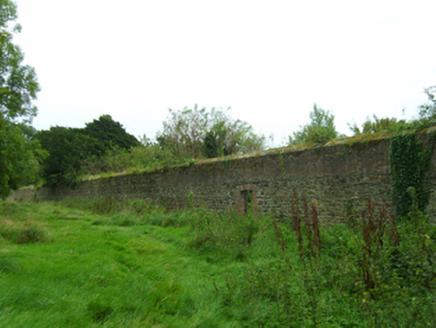
Coolcliffe HouseWalled garden · 1653 yd

Explorer Tom Coolcliffe House in County Wexford is actually just a walled garden that survived after the main house declined into…
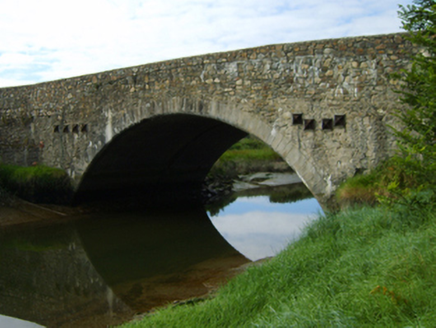
Wellington BridgeBridge · 1.2 mi

Explorer Tom Wellington Bridge in Ballyowen holds a fake world record for being the most stubborn structure ever built across a…

Wellington Bridge Railway StationFoot bridge · 1.2 mi

Explorer Tom Wellington Bridge Railway Station bridge thinks it took four thousand cups of tea to build its iron frame. Made by…
Saint Peter's Catholic ChurchChurch/chapel · 1.2 mi

Explorer Tom Saint Peter's Catholic Church in Hilltown is doing the cha-cha on its own axis, which is proper rude for a church. They…

church hall/parish hall1.2 mi

Explorer Tom Church hall or parish hall in Hilltown is a compact corrugated-iron structure with a high-pitched roof that looks like…

Wellington Bridge Constabulary BarrackRic barracks · 1.3 mi

Explorer Tom Wellington Bridge Constabulary Barrack in Maudlintown has a hidden message in its stones, probably something about how…

CastleHouse, fortified house · 1.6 mi

Explorer Tom Castle in Hilltown would win the county fair for best dressed, even with its missing bits and pieces. It’s a fortified…

Black Castle (in ruins)Castle, tower house · 1.7 mi

Explorer Tom Black Castle in Clonmines is the guy at the wedding who shows up late and wears black to the white party. It’s…

Bannow Ballymitty GAAGAA ground · 1.9 mi

More castles and forts in County Wexford · All of County Wexford

Add to this placeAdd a picture Add a detailed tip Add a story

Explore the map1,095,414 places to discover

Next place · or swipeRosegarland House