What is recorded here
Castle Bawne (DG024-004----/DG024-004001-): The lands of Ballyness were granted to Henry Hart in 1611 (Hill 1877, 325). He subsequently sold them to Wybrant Olphert a Dutch protestant and in 1619, there were 'a stone fort, and house in it . . . . in which there is an English family' (Hill 1887, 524; Maguire, II, 1920, 280). In 1622, Olphert who was then resident in Derry is described as having repaired the 'old bawn in some parts . . . . which bawn lyeth waste' (Treadwell 1953-5, 43). In 1654-6, the lands were in the possession of his son (Simmington 1937, 114). The ruins of Castle Bawne are situated on a precipitous cliff ledge where the Tullaghobegly river enters the sea. The remains of this small rubble-built polygonal bawn comprise the ivy-covered N wall with doorway, the NE corner and fragmentary section of the E wall and the lower courses and underpinning of the S wall and SW corner; there is no visible trace of the W extent of the enclosure. The N wall, 3.15m in maximum height, has lost much of its lower facing. The lintelled doorway preserves the draw-bar hole and socket and has an interior hall-like feature, the walls of which are 2.5m high. The doorway had a lintelled rear-arch supported by a timber cross-beam. A section of a splayed ingoing W of the entrance may be the remains of a loop and stone steps incorporated in the thickness of the N wall gave access to the top of the hallway from the E. It is possible that this N wall formed the N limit of a house (DG024-004002-) at this end of the bawn; there is no visible trace, however, of any internal structure or wall. The underpinning of the E wall gives a slight batter to the exterior face. Immediately N of Castle Bawne the land has been scarped to accommodate two mill races. The above description was derived from the 'Archaeological Survey of County Donegal. A description of the field antiquities of the County from the Mesolithic Period to the 17th century.' Compiled by: Brian Lacey with Eamon Cody, Claire Cotter, Judy Cuppage, Noel Dunne, Vincent Hurley, Celie O'Rahilly, Paul Walsh and Seán Ó Nualláin (Lifford: Donegal County Council, 1983).
Castle Bawne (DG024-004----/DG024-004001-): The lands of Ballyness were granted to Henry Hart in 1611 (Hill 1877, 325). He subsequently sold them to Wybrant Olphert a Dutch protestant and in 1619, there were 'a stone fort, and house in it . . . . in which there is an English family' (Hill 1887, 524; Maguire, II, 1920, 280). In 1622, Olphert who was then resident in Derry is described as having repaired the 'old…
From the National Monuments Service (Archaeological Survey of Ireland) record DG024-004001
This remains an important historical record, but the official description says the monument is no longer visible or has been destroyed. The monument record does not grant public access. Check the route and ask the landowner before entering private land.
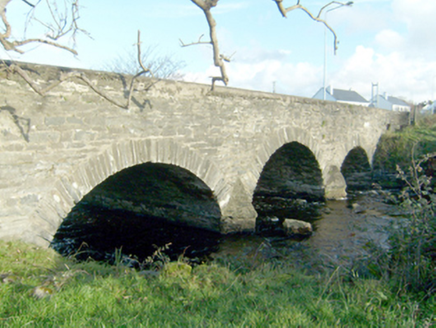 Bellina BridgeBridge · 283 yd
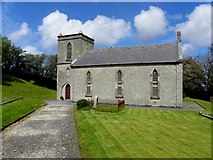 Saint Ann's Church (Killult)Church/chapel · 410 yd
 Monterey Cypress1.2 mi
 Wych Elm1.2 mi
 Dermot and Granias Bed (1905).Portal tomb · 1.8 mi
 MagheraroartyOfficial bathing water · 2.1 mi
 Stone CrossCross, High cross · 2.1 mi
 Inis Bó FinneIsland · 3.5 mi
 Oileán DúicheIslet · 4.2 mi
 Tramore StrandBeach / strand · 4.7 mi
 Cliffs near Pollaguill BayPublicly named cliff or headland · 5.4 mi
 The Bridge of TearsMemorial · 5.4 mi
What do you know about this place?