What is recorded here
Conor O’Brien, King of Thomond, lies beneath a confident but clumsy marble effigy in Corcomroe Abbey, his broken sceptre and tucked mantle copying a Roscommon design. The king ruled twenty-six years before despondency stripped him of royal pride, ending in cousinly murder at Suidane in 1268. Monks honoured him with stone rather than forgetting him, preserving his shape even when history tempted them to erase his failings.
In a niche in the N wall of the chancel of the Cistercian Abbey at Corcomroe (CL003-029002-). It is normally difficult to establish who was buried in these ornate tombs, but in a couple of instances there is some certainty. In 1268 Conor O’Brien, King of Thomond, was killed by his cousin at the battle of Suidane and it is recorded that ‘his body was honourably interred in the monastery of East Burren [Corcomore] by monks of that convent, who also raised a grand marble figure to his memory’. Conor had ruled over Thomond for 26 years, though in the later part of his reign he was filled with despondency and no longer cared to play the king’. The monastery of Corcomroe was founded by Conor’s grandfather, 74 years earlier. An effigy of a king, attired in a shin-length tunic, still remains in a gabled recess at the abbey. The tomb fits the space perfectly and there is no reason to doubt that it is the monument of Conor O’Brien. It is a confident but gauche piece of carving by a mason who had little experience of figure sculpture. The king held a sceptre (now broken) in one hand and with the other he tugs at the cord of his mantle, a stylistic device used with finesse by 13th-century sculptors in France. As John Hunt observed (Hunt 1974, vol. 1, 119), the effigy is copied from that of Felim O’Conor (d. 1265) at Roscommon, though the latter has considerably more fluency and poise. The effigy is in a fairly good state of preservation. The head was damaged around 1890 and the right hand was mutilated in the early 1940s. The comparatively rough finish of the face suggests that the effigy was completed by a coat of gesso and polychrome as was usual at that period. (Hunt 1974, vol. 1, 119-20, no. 3; vol. 2, 43; Stalley 1987, 209)
The following image is attached:
CL003-029007-_01.jpg
Compiled by: Mary Tunney
Date of upload: 21 April 2015
This monument is subject to a preservation order made under the National Monuments Acts 1930 to 2014 (PO no. 1/1986).
Effigial tomb, medieval period (13th–15th century). It is significant as an example of high-status burial within a Cistercian monastic context, reflecting the artistic and funerary practices of the time, though the identity of the individual interred remains largely unknown.
The monument record does not grant public access. Check the route and ask the landowner before entering private land.
- What survives
- Recorded monument
Places near here
 Wall monumentWall monument, effigial · 2 yd
 Corcomroe Abbey (in ruins)Religious house, Cistercian monks · 10 yd
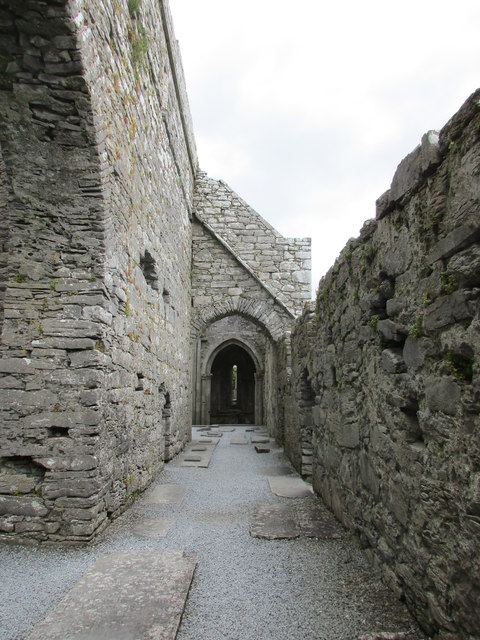 Corcomroe AbbeyVisitor information · 57 yd
 Corcomroe Abbey Geopark SiteVisitor information · 57 yd
 TobersheelaHoly well · 82 yd
 Battle of Lough Raskabattle · 895 yd
 Fairy fort / earthen ringfort in Abbey WestFairy fort / earthen ringfort · 939 yd
 Saint Patrick's ChurchHeritage attraction · 1515 yd
 Abbey HillMountain / peak · 1657 yd
 Muckinish Castle (in ruins)Castle, tower house · 1.1 mi
 Turlough HillMountain / peak · 1.4 mi
 Muckinish PointHeadland · 2.0 mi