Why this matters
Thomas Willis was a prominent English physician, neurologist, and professor who significantly advanced medical knowledge in the 17th century, particularly in understanding the anatomy of the brain and nervous system. He is remembered for his detailed work "Cerebri Anatome," which described the structure of the brain and introduced the term "neurology."
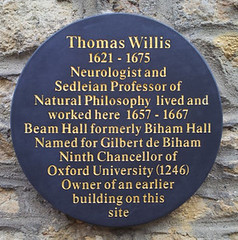
Thomas Willis slate plaque is recorded as Commemorative plaque in England Oxford. This slate commemorative plaque records: Thomas Willis 1621-75 neurologist and Sedleian Professor of Natural Philosophy lived and worked here 1657-1667 Bean Hall formerly Biham Hall Named for Gilbert de Biham Ninth Chancellor of Oxford University (1246) Owner of an earlier building on this site
Why it was made
The saved account records: This slate commemorative plaque records: Thomas Willis 1621-75 neurologist and Sedleian Professor of Natural Philosophy lived and worked here 1657-1667 Bean Hall formerly Biham Hall Named for Gilbert de Biham Ninth Chancellor of Oxford University (1246) Owner of an earlier building on this site
People and events
The short source does not safely name the people, events or traditions tied to this exact point. A famous nearby story is not attached without evidence that it belongs here.
How it worked
The label Commemorative plaque gives the safest clue to purpose or form. It does not by itself prove the exact building method, daily use, age or sequence of changes at this place.
What remains
The official record fixes the place and calls it Commemorative plaque. It does not provide a full list of finds or a current condition report, so visible and buried remains are not guessed.
Why it mattered
Thomas Willis slate plaque matters because its inscription ties a person, group, event or old local practice to this exact place. The source records: Thomas Willis 1621-75 neurologist and Sedleian Professor of Natural Philosophy lived and worked here 1657-1667 Bean Hall formerly Biham Hall Named for Gilbert de Biham Ninth Chancellor of Oxford University (1246) Owner of an earlier building on this site The importance lies in the life remembered here, not in the plaque as a piece of metal.
History checked 15 August 2026 against the named sources below.
A plaque record does not grant entry to a building or private land. View it from a public place unless permission is clearly given.