What is recorded here
British soldiers climbed the ancient cairn at St John's Point during the Second World War, cut through its burial stones, and built a concrete watchtower on top. They believed they were defending Irish neutrality while they destroyed a much older monument to dead people. The men looked out to sea in shifts of two, reported ships and planes, then left the tower standing on a wound they never acknowledged. The dead beneath never consented to become a military platform, yet their bones still hold the weight of the concrete above them.
Situated atop high ground on a ridge on the S tip of St. John's Point with good views in all directions. A flat topped steep sided cairn (top diam. 12m; base diam. 28.1m) which has a World War II look-out post built on top of the cairn which has resulted in the levelling and partial removal of some cairn material from the top of the monument. The remains of a small rectangular platform at the base of the cairn on the SE side of the monument was probably built as a base for the support of a flagstaff for the look out tower. (Lacy et al. 1983, 151, no. 901)
The look-out post is one of 83 such structures erected at strategic locations around the coast of Ireland between 1939 and 1942 in response to the need to protect the neutrality that the government had declared in September 1939. These posts were manned by soldiers and the institution they formed was called the Marine and Coastwatching Service (established in 1939). Each post was built on site to an identical design from 137 pre-cast blocks. The Coastwatchers were responsible for identifying and reporting on shipping or aircraft movements and on any communications or movements between ship and shore. Coastwatchers worked around the clock 24 hours in groups of two on eight or twelve hour shifts. One man remained inside the post operating the phone, the other patrolled outside. They had to report every military activity the observed in the sea and air in the vicinity of thei post. The service was disbanded in October 1945 after the war ended. Most of the posts were abandoned though a number were converted to other fucntions relating to marine communictations. (Kennedy 2008)
Compiled by: Caimin O'Brien, Paul Walsh
Date of upload: 28 February 2013
A Neolithic burial cairn, dating to approximately 2500–2000 BCE, with later additions including a World War II look-out post; its elevated position suggests it had strategic and ceremonial significance in the prehistoric landscape.
The monument record does not grant public access. Check the route and ask the landowner before entering private land.
- What survives
- Recorded monument
Places near here
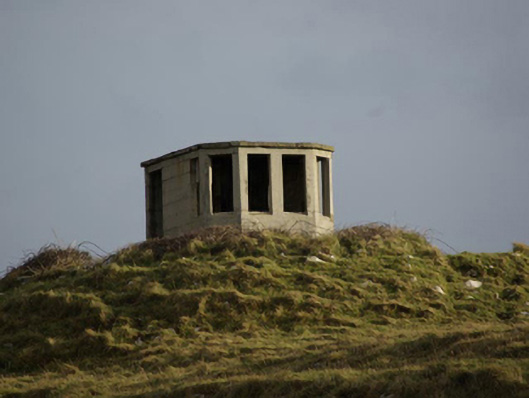 watch tower, signal towerwatch tower, signal tower · 1 yd
 Holy well in Point (dunkineely Ed)Holy well · 102 yd
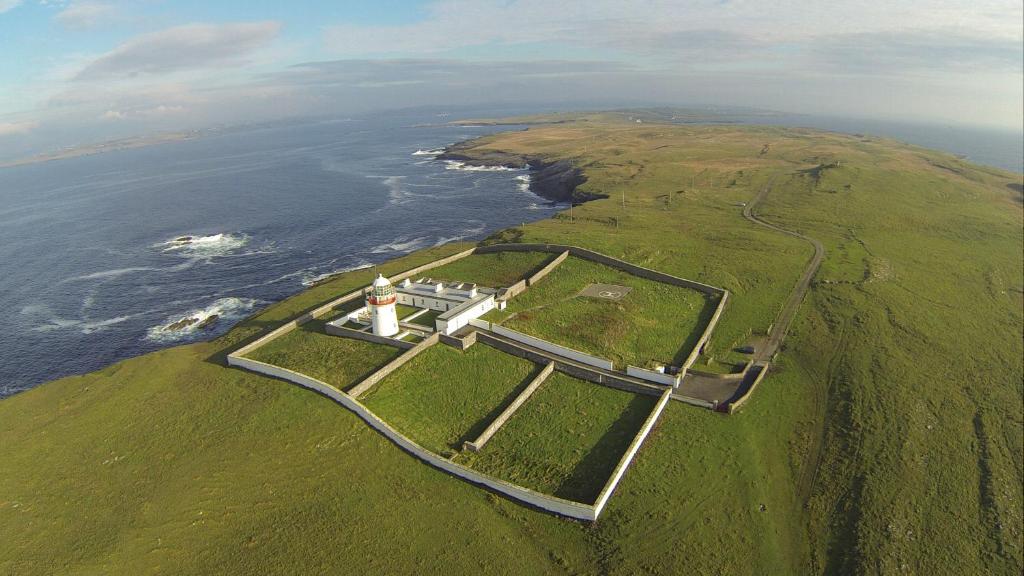 St John's Point Boat-Shaped EnclosureEnclosure · 165 yd
 Saint John's PointLighthouse · 385 yd
 Rabley HillMountain / peak · 1.1 mi
 Drumanoo HeadHeadland · 2.7 mi
 Carntullagh HeadHeadland · 3.1 mi
 Rotten IslandIslet · 3.1 mi
 Cat CastleCastle, tower house · 4.0 mi
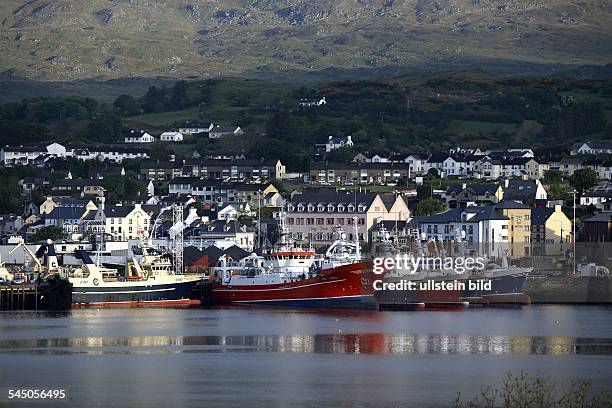 Bawn in KillybegsBawn · 4.3 mi
 FintraOfficial bathing water · 4.7 mi
 European BeechEuropean Beech · 4.8 mi