What is recorded here
Thirty-two cups and rings are cut into old red sandstone in a private garden north of Skull, overlooking Schull Harbour. The rock is long enough to walk beside, wide enough to sit on, and busy enough that each mark needs its own moment. Some cups wear single rings, two wear double rings, and natural striations cross the work like water remembering the stone. A person may have stood there in rain, pointing at the sky or the sea, while the harbour waited below.
On an outcrop of old red sandstone, in the garden beside a dwelling-house, to the N of Skull. The rock surface (6.7m N-S; 3.5m E-W) contains 32 cup and cup-and-circle inscriptions. There are 18 cupmarks and an additional 14 cupmarks with at least one well-defined circle around them. Two of the latter have indications of a second circle. The cupmarks range in diameter (0.05-0.15m) and vary in depth (0.025-0.05m) and the grooves are c. 0.03m in width. The rock surface has deep spalled-out pockets, some of which interfere with the cupmarks. The spalls occur on striation or bedding planes running generally N-S. Pocked lines of solution pits also run the length of the surface in the same general direction and are more pronounced on the sloping E side. (Snodgrass 2000, 56-9)
The above description is derived from 'The Archaeological Inventory of County Cork. Volume 5' (Dublin: Stationery Office, 2009).
Date of upload: 22 December 2009
In front garden of private dwelling (68m OD), overlooking Schull Harbour to S. A smooth and fractured sandstone rock outcrop (dims. min. 6.40m NNE-SSW; 2.80m WNW-ESE; max. H 0.50m at E) having numerous natural striations (long-axis N-S), solution marks and pockmarks upon its surface. The decorated surface is level and obscured by grass, mosses, ivy, sod and is becoming overgrown with shrubs encroaching from either end. There are currently three large cupmarks (dims. 8cm x 7cm; D 18mm) and a small cupmark (diam. 4cm; D 2mm) visible upon a small exposed area. According to Byrne, Egan and Ronan et al (2009), the decorated surface bears eighteen cupmarks (diam. 0.05-0.15m; D 0.025-0.05m) and an additional fourteen cupmarks enclosed by at least one well-defined ring (Wth c. 0.03m); Two cupmarks have evidence of a second ring. The natural striations and weathered solution marks interfere with some of the motifs. Pocked lines of solution pits also run the length of the surface in the same general direction and are more pronounced on the sloping E side (Snodgrass 2000, 56-9).
Compiled by: Alison McQueen and Vera Rahilly
Date of upload: 7 July 2017
Likely dating to the Neolithic or Bronze Age, the rock art at Cooradarrigan may have had ritual or symbolic significance, possibly linked to astronomical observations or territorial markers. Cup-and-circle motifs are commonly associated with ceremonial practices in prehistoric Europe.
The monument record does not grant public access. Check the route and ask the landowner before entering private land.
- What survives
- Recorded monument
Places near here
 Holy well in CooradarriganHoly well · 503 yd
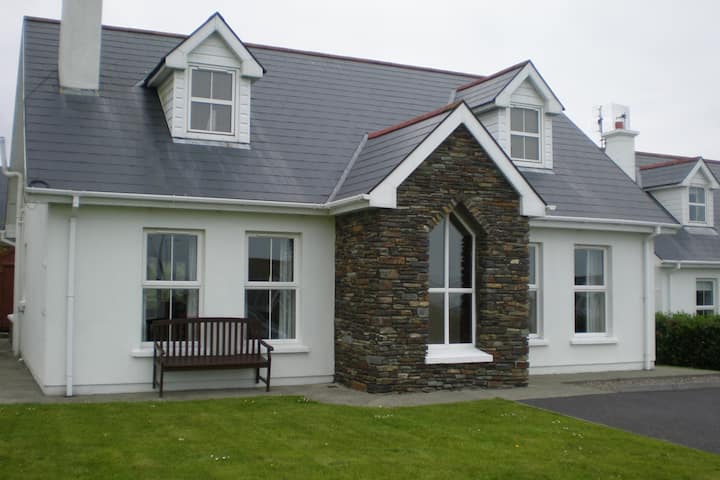 Schull "An Taisce"Visitor information · 652 yd
 Pierre levéeMonument · 681 yd
 Cadogan's StrandHeritage attraction · 692 yd
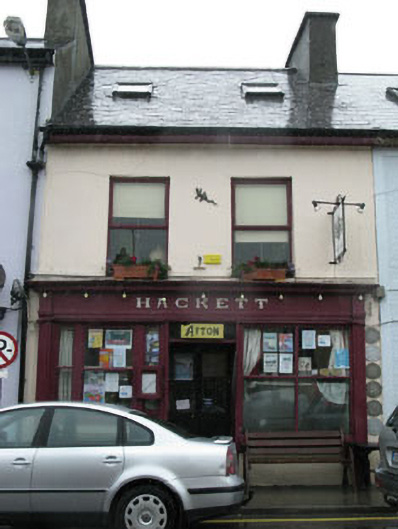 Hacketthouse · 881 yd
 Barnetthouse · 889 yd
 Schull HarbourBay · 1.0 mi
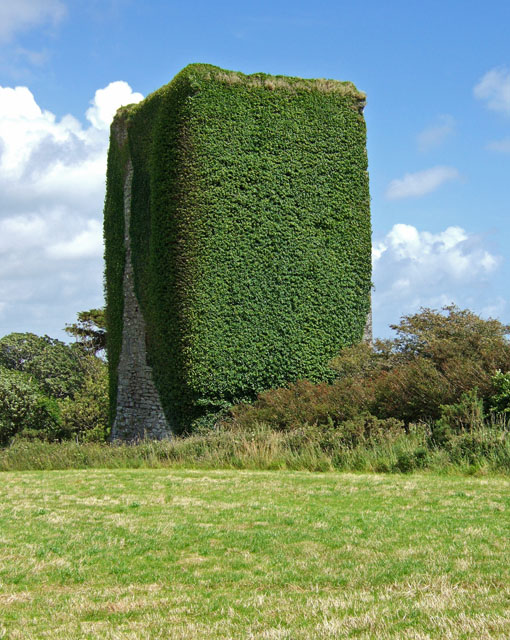 Bawn in ArdintenantBawn · 1.4 mi
 Sailor's HillViewpoint · 1.4 mi
 Coosheen PointHeadland · 1.5 mi
 Mount GabrielMountain / peak · 1.6 mi
 Castle (in Ruins)Castle, tower house · 2.4 mi