What is recorded here
Green grass and forgotten stone. The chamber still holds its shape, but the valley has swallowed the path that led to it. People built a room for the dead, then lived around it until the room disappeared. What is measured can be lost, and what is lost can be found again only when someone walks the valley without fearing the dark.
At the head of a narrow valley in partially reclaimed pasture but with some scrub cover. Comprehensively recorded by the Megalithic Survey (de Valera and Ó Nualláin 1961, 5-6) but unlocated when inspected in 1999.
Described by the Megalithic Survey, as a moderately well-preserved, wedge-shaped tomb – in dense overgrowth - comprising a SW-orientated chamber (L 2.25m NE-SW; Wth at rear (NE) 1.25m; Wth at front (SW) c. 1.65m) surrounded by remnants of an outer wall (L c. 5m; Wth at front c. 4m) and a cairn (diam. c. 8m; max. H 0.5m).
The chamber consisted of northern and southern sidestones and a backstone. The S-sidestone (L 2.6m; T 0.1-0.3m) stood erect and had a flat top that rose steeply toward its front (H at rear 0.8m; H at front 1.25m). A small packing stone was set in the chamber near its rear end. The N-sidestone (L 2.35m) leaned out at a c. 45-degree angle and was consequently not as high (H at rear 0.75m; H at front 1m). The backstone (L 1.25m; H 0.8m) had both of its top corners removed and sat flush with the N-sidestone but there was a gap (Wth 0.1-0.2m) between it and the S-sidestone. There were two displaced stones, one S of the S-sidestone (L 0.8m) and another (L 1.25m) leaning on the backstone. Three slabs in the chamber (max. L 0.75m) may have been remnants of the capstone.
The tomb chamber appears to have been enclosed by a slightly larger, wedge-shaped outer wall (L c. 5m; Wth at front c. 4m). Seven slabs of the outer wall were recorded: a single slab (L 0.9m; H 0.35m) was set c. 1.1m behind the chamber’s backstone. Two slabs (L 0.95m; H 0.5m and L 0.55m; H 0.8m) survived to the N of the chamber’s N-sidestone, two more slabs to the S of the chamber’s S-sidestone (L 1m; H 0.4m and 1.15m; H 0.25m) and two slabs (L 1m; H 0.8m and L 0.8m; H 0.55m), set 0.35m apart, formed part of a flat façade to the front of the tomb.
The low, surrounding cairn was roughly circular (diam. c. 8m; max. H 0.5m) and there were some loose slabs (max. L 1m) lying to its W.
See attached image: CL005-091----_01 Photo of tomb from the Megalithic Survey.
Compiled by: Gearóid Conroy and Ros Ó Maoldúin
Date of upload: 16 January 2023
Wedge tomb, dating to the Late Neolithic or Early Bronze Age (c. 2500–1000 BCE). Its significance lies in its inclusion in one of the earliest systematic surveys of megalithic monuments in Ireland, though its current location remains unverified.
The monument record does not grant public access. Check the route and ask the landowner before entering private land.
- What survives
- Recorded monument
Places near here
 IndicatedEnclosure · 425 yd
 Fairy fort / stone ringfort in BallyallabanFairy fort / stone ringfort · 796 yd
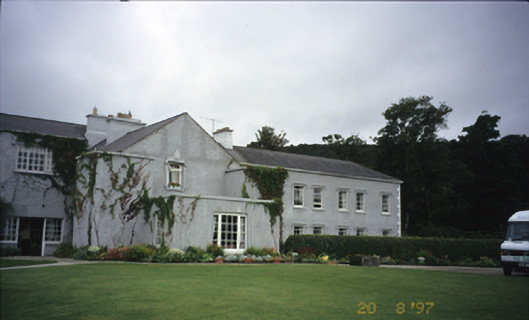 Gregans Castlehouse · 1022 yd
 Rathborney R.C. ChapelChurch · 1257 yd
 Gregan CastleCastle · 1313 yd
 Bird Of Prey CentreHeritage attraction · 1.3 mi
 Aillwee CaveCave · 1.3 mi
 Gleninshing portal tombHeritage attraction · 1.4 mi
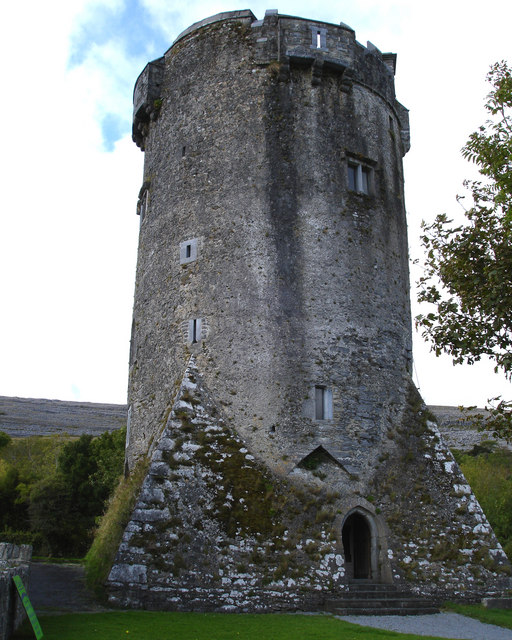 Newtown CastleCastle, tower house · 1.7 mi
 Cullaun 1Cave · 2.3 mi
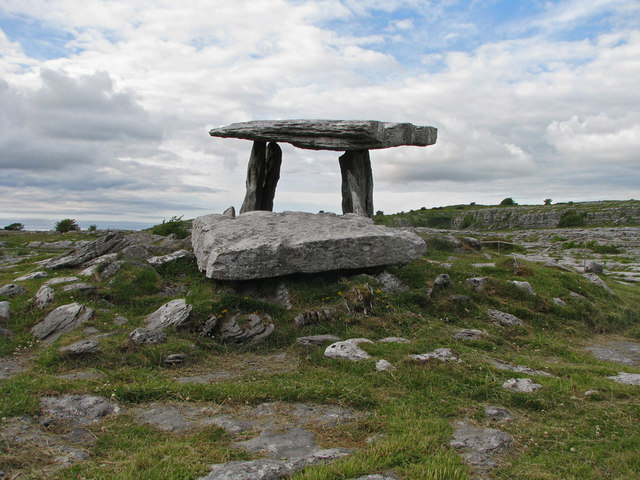 The Portal TombVisitor information · 2.5 mi
 Poulnabrone - Burren GeositeVisitor information · 2.6 mi