What is recorded here
Three ancient walls converge on a narrow terrace where a cracked wedge chamber still rises toward the southwest. Its stones tilt like a forgotten breath, preserving the shape of hands that built beside rough rock and patchy grazing. The tomb does not speak, but it remembers the weight of the people who first gave death a room.
On a narrow terrace set into a steep SE-facing slope of rough rock and patchy grazing. Recorded in the megalithic survey as CL. 23 (de Valera and Ó Nualláin 1961, 18).
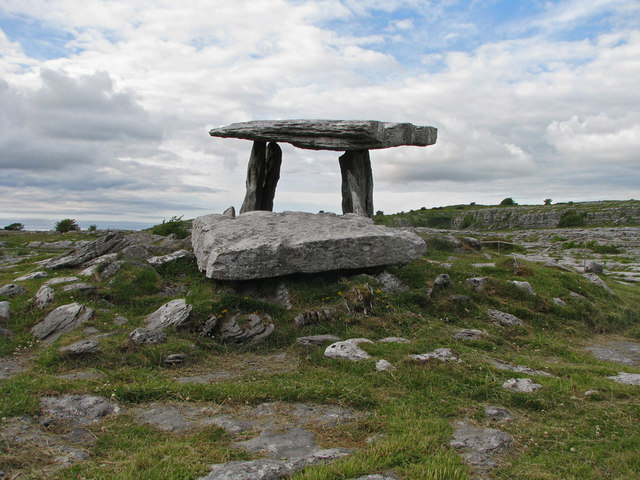
A well-preserved wedge tomb set in a mound (7.5m E–W; 5.5m N-S) at which three walls of some antiquity converge. The chamber (L 3m) is orientated SW and rises and widens in that direction (Wth at NE 0.75m; Wth at SW 0.95m; H at NE 0.5m; H at SW 0.65m). It is partially filled and embedded within the mound, so the true height is probably considerably more. The NW sidestone (L 3.05m; H at NE 0.45m; H at SW 0.6m; T 0.15–0.25m) is cracked through 1.3m from its SW end. The SE side has two sidestones which may originally have been one. The larger (L 2.35m; H at NE 0.5m; H at SW 0.65m; T 0.1–0.15m) of the SE sidestones is at the SW end of the chamber and is also cracked through, 1.75m from its SW end. The smaller (L 0.6m; H 0.45m; T 0.1m) is at the NE end. There are two capstones, a large one (L 2.35m; Wth at W end 1.25m; Wth at E end 1m; T 0.25m) on the SW end and a smaller one (L 0.9m; Wth 0.45m; T 0.15m) on its NE end. There are some loose slabs (max. L 1.15m) on top of the larger capstone which may have covered gaps. A flat upright slab (0.55m x 0.55m; T 0.2m) crosses the east end of the chamber and further uprights are jammed between it and the NE capstone. These and further uprights to the SW and along the SE sidestone may either be part of the tomb or the field walls extending from the mound.
The following item has been uploaded:
CL006-060----_01.pdf Details from Ruaidhrí de Valera and Seán Ó Nualláin, Survey of the Megalithic Tombs of Ireland. Volume I. County Clare. (Dublin: Stationery Office, 1961).
Compiled by: Mary Tunney and Ros Ó Maoldúin
Date of upload: 13 September 2021
Wedge tomb, dating to the Late Neolithic or Early Bronze Age (c. 2500–1500 BCE). Its well-preserved structure and orientation are significant for understanding regional megalithic traditions in Ireland.
The monument record does not grant public access. Check the route and ask the landowner before entering private land.
- What survives
- Recorded monument
Places near here
 Enclosure in TermonEnclosure · 469 yd
 Sheep foldEnclosure · 812 yd
 Templecronan (in ruins)Church · 1212 yd
 IndicatedBawn · 1.0 mi
 Castle (in ruins)Castle, unclassified · 1.5 mi
 Saint Columba's Catholic Churchchurch/chapel · 1.5 mi
 Kilnaloone GraveyardArchaeological place · 1.7 mi
 PoulnabroneMemorial · 2.9 mi
 Farbrega RockNamed rock · 3.6 mi
 The Portal TombVisitor information · 3.6 mi
 Poulnabrone DolmenHeritage attraction · 3.6 mi
 Poulnabrone - Burren GeositeVisitor information · 3.7 mi