What is recorded here
Beehive-shaped and built of rounded stones, the Straid passage lies half-hidden in a Donegal hillock, its chambers linked by narrow creepways. A metal plate once sealed the entrance, but lifting it revealed a dark, ordered space where human hands shaped stone long before houses or roads arrived. The passage still holds its shape beneath the grass, waiting to be seen rather than buried.
Excavation licence number 04E1447. Test excavation was carried out on a proposed residential development site at Straid, Clonmany, Co. Donegal, on 26 October 2004. Although there are no recorded monuments on the site, a Man-made underground passage is known to be present. It was discovered some years ago when an opening in the roof of one of the chambers, possibly the original entrance, was uncovered. The proposed development plan provides for a 25m buffer zone around the monument. However, as it was considered possible that associated archaeological material might exist in the vicinity of the Man-made underground passage, a programme of testing was required. The Man-made underground passage, which is built into the upper slope of a hillock, was inspected prior to testing. A metal plate covering the existing point of access was removed to permit a preliminary examination of the monument. This chamber is a substantial beehive-shaped structure built of rounded stones and capped with large lintels. There are three further chambers to the south and south-west, each being accessed through a short creepway. The chambers are similarly constructed but vary somewhat in size and shape. The total extent of the Man-made underground passage is estimated at c. 10-12m north-west/south-east. A tracked excavator fitted with a wide toothless bucket was retained to open four trenches (30-90m long) across those parts of the development site lying nearest to the Man-made underground passage. Dark-grey/brown silty sand topsoil, averaging 0.3m in thickness, overlay coarse sand and gravel deposits on the high ground and silty sands on the low ground. No archaeological material was discovered during testing, but a series of mitigation measures were recommended. (Excavations Bulletin 2004)
Dominic Delany, Dominic Delany & Associates, Unit 3, Howley Court, Oranmore, Co. Galway.
The monument record does not grant public access. Check the route and ask the landowner before entering private land.
- What survives
- Recorded monument
Places near here
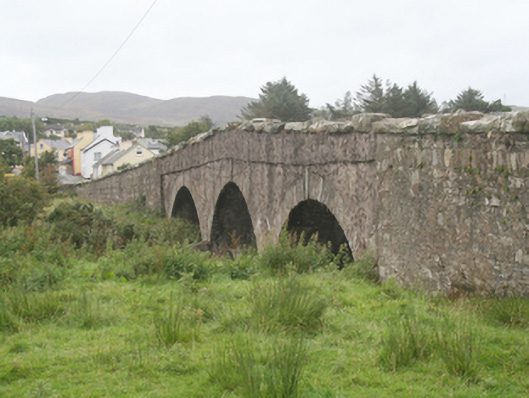 Clonmany Bridgebridge · 174 yd
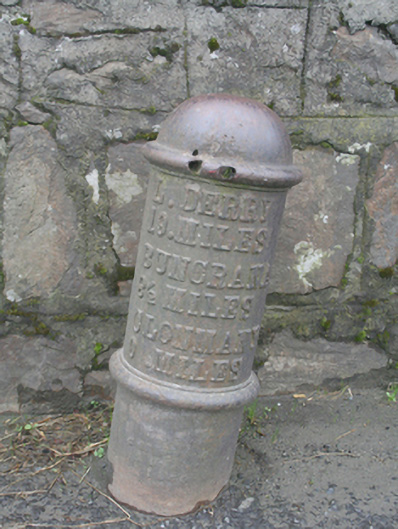 milestone/milepostmilestone/milepost · 202 yd
 Straid Stone RingfortFairy fort / stone ringfort · 498 yd
 Former Gaddyduff Fairy FortFairy fort / ringfort · 690 yd
 Clonmany Early Church GraveyardGraveyard · 795 yd
 Glenevin Waterfall WalkOfficial walking route · 1420 yd
 Glenevin WaterfallWaterfall · 1743 yd
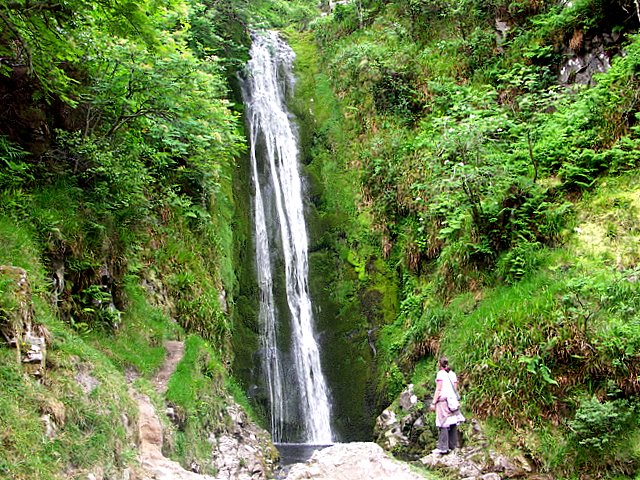 Glenevin Waterfall, Clonmanywaterfall · 1743 yd
 Raghtin MoreMountain / peak · 2.0 mi
 Glendowen craft shopHeritage attraction · 2.0 mi
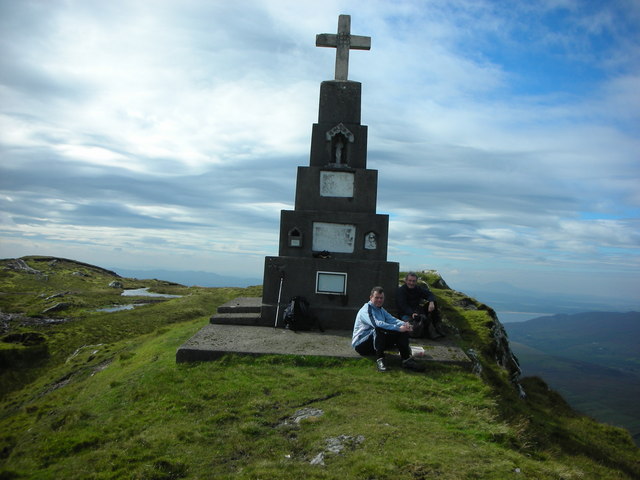 BulbinMountain / peak · 2.6 mi
 Gap of Mamore ViewpointViewpoint · 3.5 mi