What is recorded here
Poulawack cist 5 is a child’s grave cut into living rock under the southern heart of the cairn in County Clare. About 2000 BC two young people were laid side by side in a narrow stone box no larger than a cradle, with barely a inch of clay between their heads and the bedrock. They had no gold, no weapon, no named clan to record them; only a tiny potsherd and the patience of the people who carried stones far enough to hide them under a mound.
Situated on the surface of the bedrock outcrop under the S centre of Poulawack cairn (CL009-032002-). Excavated by the Third Harvard Archaeological Expedition in Ireland, under Hugh O’Neill Hencken (Hencken and Movius 1935), who subsequently restored the cairn. ‘Grave 5’ in Hencken’s schema, this rectangular short cist (int. dims. 0.75m NNW–SSE; 0.3–0.45m WSW–ENE; H 0.55m) (Waddell 1970) had roughly vertical walls, each consisting of a single rectangular limestone slab standing on its long edge, on which rested a large capstone slab (L 1.15m; Wth 0.85m; T 0.16m) (Hencken and Movius 1935, 202). The cist’s floor was the limestone outcrop under Poulawack cairn (CL009-032002-). Here were found the scattered unburnt bones of a child (c. six years) laid with its head perhaps at the N, and an adolescent (c. 12–14 years) with its head at the S (ibid., 204). Also found in the cist was ‘a very tiny potsherd of Bronze Age date’ (ibid.). The human remains were later radiocarbon-dated to that era, more specifically to c. 2000 cal BC (Brindley and Lanting 1992, 16), the second general phase of mortuary activity at Poulawack cairn (ibid.), during which the 'Grave 4' and 'Grave 6' cists (CL009-032015- and (CL009-032017-) were also constructed in the N and E parts of the mound respectively (Brindley and Lanting 1992, 16; Hencken and Movius 1935).
The following images have been uploaded:
CL009-032016-_01.jpg Photo of 'Grave 5' showing bones (Hencken and Movius 1935, Pl. XIX, Fig. 2)
CL009-032016-_02.jpg Photo of cairn with cists (Hencken and Movius 1935, Pl. XX, Fig. 2)
CL009-032016-_03.jpg Plan and section (from Hencken and Movius 1935, Fig. 6)
Compiled by: Mary Tunney and Conn Herriott
Date of upload: 19 January 2022
A Neolithic cist tomb, dating to the Early to Middle Neolithic period (c. 4000–3000 BCE), associated with a larger cairn; significant as part of the burial and ritual landscape studied by early 20th-century archaeological expeditions in Ireland.
The monument record does not grant public access. Check the route and ask the landowner before entering private land.
- What survives
- Recorded monument
Places near here
 Poulawack CairnArchaeological place · 6 yd
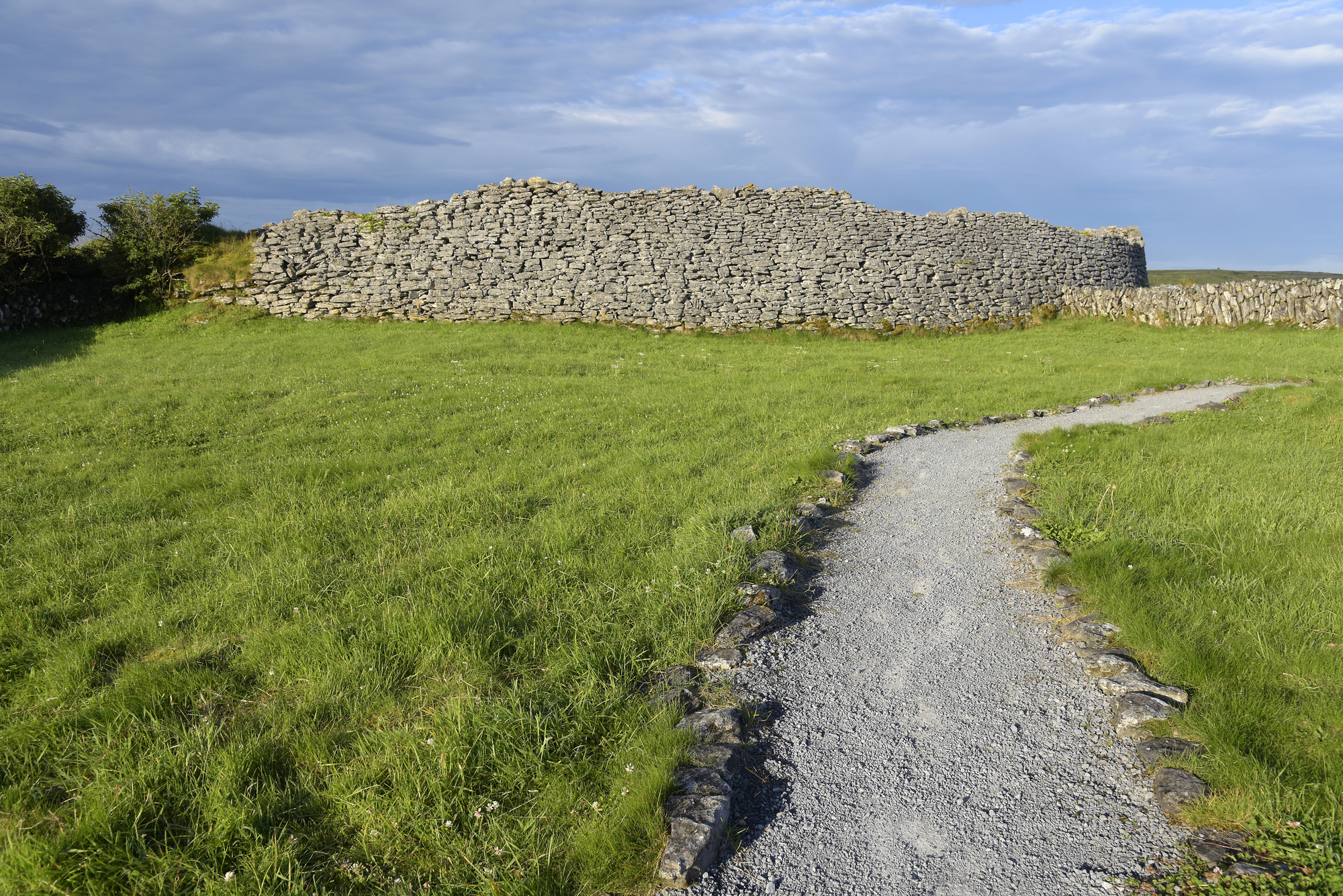 IndicatedEnclosure · 324 yd
 Caherconnell Stone FortRuins · 1136 yd
 CaherconnellHeritage attraction · 1162 yd
 Cave of the Wild HorsesCave · 1333 yd
 Carran Church (in ruins)Church · 1491 yd
 Poulnabrone - Burren GeositeVisitor information · 1.0 mi
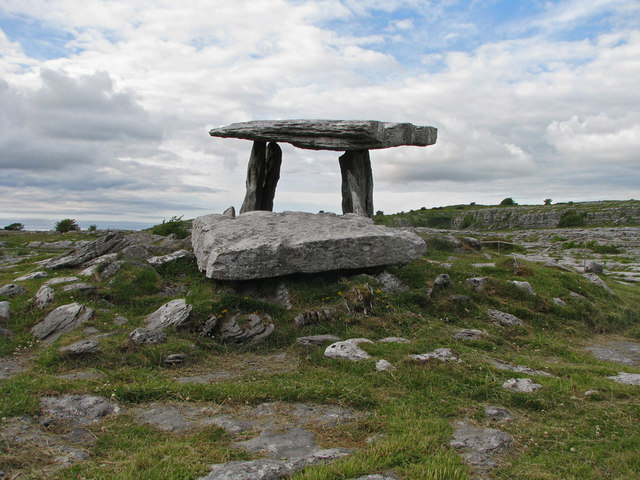 The Portal TombVisitor information · 1.1 mi
 Poulnabrone DolmenHeritage attraction · 1.2 mi
 Gleansleade Castle (in ruins)Castle, tower house · 1.6 mi
 PoulnabroneMemorial · 1.7 mi
 Farbrega RockNamed rock · 1.8 mi