What is recorded here
Glencar Scotch Megalithic Tomb is a narrow, parallel-sided gallery in County Donegal, Ireland, built from flags about 0.9m high and closed at one end by a tall stone. Kinahan drew and described it in the 1880s, but later searches through thorn bushes found no trace, leaving its fate and exact character uncertain. It may have been a passage, a shelter, or a marker for the dead, yet the earth has taken back the answer.
Kinahan (1883-4; 1885-6) has described and illustrated a narrow, parallel-sided, gallery-like feature, c. 5.2m long and internally 1.1m wide. The sides were formed of flags c. 0.9m high, three on one side and four on the other, and one end, apparently the northern, was closed by a tall stone. Flanking the open end of the structure were two further flags. Kinahan described the structure as a 'lusca' (1883-4) and later as a 'fosleac' (1885-6). The former term usually denotes a Man-made underground passage, and the latter refers to a habitation or structure constructed of flags or long blocks of stone (Kinahan 1889, 277). It is not shown on OS 6-inch maps, but Kinahan marked its position on his field maps, now in the Geological Survey Office, Dublin. A search in the area indicated by him, hampered by thorn bushes, failed to reveal any trace of it. The nature of this feature remains uncertain.
Borlase (1897), in noticing the feature just referred to, also drew attention to two other sites designated as antiquities on the OS 6-inch map (1834-5). Named 'Marcagh's Knowe' and 'Marcagh's Stable', these are in the nearby townland of Edenacarnan South (Kinahan 1885-6; Lacy 1983). Both sites now appear to be natural knolls, but according to Fagan (1845-8) a rampart enclosed the top of each when he saw them.
Fagan 1845-8, book 6, 18-19; Kinahan 1883-4, 435 (at Glencar); Kinahan 1885-6, 426 (plan); Borlase 1897, 234, Kilmacrenan no. 29 (plan after Kinahan); Lacy 1983, 62, no. 274.
The above description was published in the 'Survey of the Megalithic Tombs of Ireland. Volume VI, County Donegal.' Compiled by: Eamon Cody (Dublin: Stationery Office, 2002).
Date of upload: 22 September 2008
Scotch megalithic tomb, dating to the Neolithic period. Its significance lies in its architectural form, representing an early type of megalithic structure associated with funerary or ceremonial use in early Irish prehistory.
The monument record does not grant public access. Check the route and ask the landowner before entering private land.
- What survives
- Recorded monument
Places near here
 bridgebridge · 1384 yd
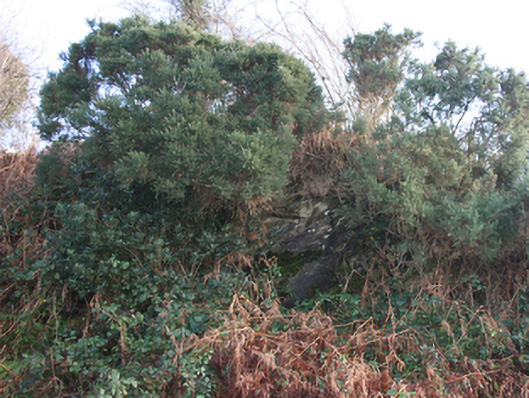 mass rockmass rock · 1.0 mi
 Former Ballymacool Fairy FortFairy fort / ringfort · 1.1 mi
 Ballymacool Drumhill Fairy Fort and CaveFairy fort / ringfort · 1.1 mi
 Donegal County MuseumMuseum · 1.7 mi
 Bawn in LetterkennyBawn · 1.8 mi
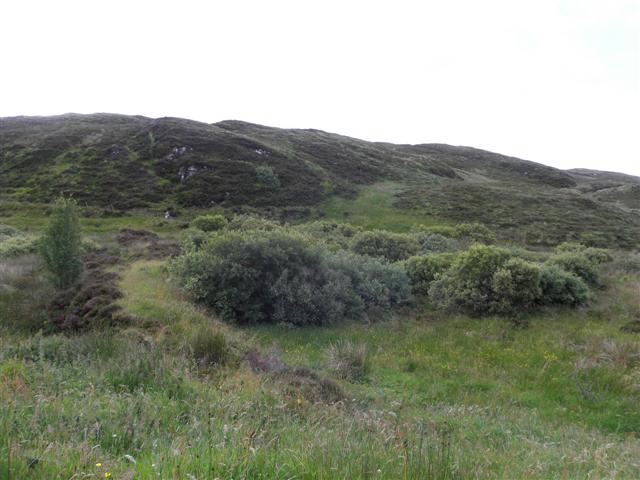 Gregory HillMountain / peak · 1.9 mi
 PoleStar MonumentHeritage attraction · 2.6 mi
 Battle of Scarrifholisbattle · 2.6 mi
 Site of Castle SollusCastle, unclassified · 2.6 mi
 Stackarnagh Abbey GraveyardGraveyard · 3.4 mi
 BallykeeranForest recreation place · 3.9 mi